Kitchen project - T&J
This guide explains what those rules mean for your new kitchen and what to plan before the walls are closed.
Which Electrical Code Applies to a Wisconsin Kitchen
Wisconsin's electrical code, chapter SPS 316, adopts the 2023 edition of the National Electrical Code (NEC) and then lists the places where Wisconsin's rules differ. The state's changes to the kitchen-related sections were most recently rewritten effective September 1, 2026. That is why a national article about kitchen wiring can be close but not exactly right for a Wisconsin home, especially on islands and appliance protection.
Kitchen Circuits: What the Code Calls For
| Requirement | What it means in your kitchen |
|---|---|
| At least two 20-amp small-appliance circuits | The countertop outlets are split across two or more circuits, so a toaster and a coffee maker do not overload one |
| Small-appliance circuits serve only receptacles in the kitchen, pantry, breakfast room and dining room | No lighting or outlets from other rooms on those circuits |
| Major appliances on their own circuits | Ranges, cooktops, wall ovens, dishwashers, disposals and microwaves are wired as their installation instructions specify |
A remodel often adds load: a bigger range, a second oven, an induction cooktop, under-cabinet lighting. If the electrical panel has no room for new circuits, our guide to electrical panel upgrade cost explains when an upgrade is needed.
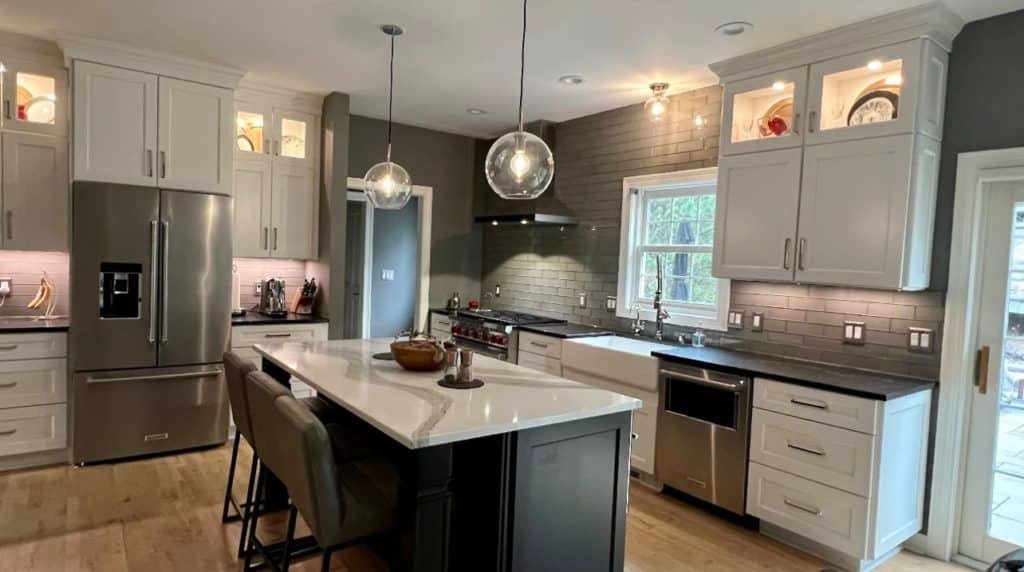 Kitchen - T&J
Along a counter wall, no point may be more than 24 inches from an outlet, so outlets on a long run end up no more than about 4 feet apart.
Countertop Outlets: Spacing and Height
- Every counter space 12 inches or wider along a wall needs an outlet.
- No point along the wall line more than 24 inches from an outlet.
- No higher than 20 inches above the countertop.
Islands and peninsulas: Wisconsin's own rule
This is where Wisconsin differs most. The 2023 national code made an island or peninsula outlet optional, as long as provisions are made for a future one. Wisconsin replaced that rule: at least one outlet is required at each island and peninsula countertop space that is 24 inches or longer and 12 inches or deeper, with a peninsula measured from the wall it connects to.
Wisconsin also limits when an island outlet may go below the countertop. It is allowed in construction for people with physical impairments, or on a flat island or peninsula with no backsplash, divider or overhead cabinet to mount an outlet within 20 inches above it. Even then, the outlet must sit no more than 12 inches below the countertop and not where the top overhangs more than 6 inches beyond its base.
Want this priced for your kitchen?
John walks your space, measures it, and leaves a written itemized estimate. No cost, no obligation, no sales script.
If you are adding an island, plan the outlet with the rest of it; our guides to kitchen island cost in Waukesha County and moving a kitchen sink or adding an island sink cover the cabinets and plumbing.
GFCI Protection in a Wisconsin Kitchen
A ground-fault circuit interrupter (GFCI) cuts power in a fraction of a second when current leaks to ground, such as through a person touching a wet appliance.
- Kitchen outlets: Wisconsin keeps GFCI protection for kitchen receptacles but words the rule for 125-volt, single-phase, 15- and 20-amp receptacles.
- Appliances: The 2023 national code added GFCI protection for the circuits feeding a list of appliances, including dishwashers, electric ranges, wall-mounted ovens, counter-mounted cooking units and microwave ovens. Wisconsin removed electric ranges, wall-mounted ovens, counter-mounted cooking units and clothes dryers from that list. Dishwashers and microwave ovens keep the requirement.
Because Wisconsin's rules differ from the national code on islands and appliance GFCI protection, check that your electrician is working to Wisconsin's version. National checklists and articles may not reflect these changes.
Who Can Do the Electrical Work
Wisconsin requires electrical wiring to be installed by an electrician licensed or registered by the Department of Safety and Professional Services (DSPS), working under a master electrician, with exemptions. The one that matters for homeowners: a residential property owner may install, repair or maintain wiring on premises they own and occupy as a residence, unless a local ordinance requires a license or registration.
Doing it yourself does not change the code. Wisconsin's electrical code makes electrical wiring installations subject to inspection, and your city, village or town decides how permits and inspections work locally. Ask before the work starts, especially for new circuits. Our guide to what a homeowner can do without a permit in Wisconsin covers the wider picture.
 Kitchen - T&J
Plan the Wiring Before the Walls Close
Map every outlet against the counters.
Use the 12-inch and 24-inch rules, and add outlets where you will actually use appliances.
Decide on the island outlet early.
Wisconsin requires it on most islands and peninsulas, and its location affects cabinet design.
List the appliances and their circuits.
The range, dishwasher, disposal, microwave and any second oven each come with installation requirements.
Plan the lighting.
Recessed, pendant and under-cabinet lights are easiest to run during rough-in; see our kitchen lighting cost guide.
Plan the range hood circuit and duct together.
Our guide to kitchen range hood venting in Wisconsin covers the venting side.
Check the panel.
New circuits need space and capacity.
In an older home, opening the kitchen walls can reveal wiring that has to be updated before new circuits go in. Our guide to knob-and-tube rewiring cost in Wisconsin explains one common case.