 Deck project - T&J
A quick note on the numbers you'll see throughout. The dollar figures in this guide come from 2025-2026 regional contractor pricing data on completed Wisconsin projects, not national estimators. We've been remodeling across Waukesha County and the Greater Milwaukee area for roughly a decade, with 35-plus years of combined carpentry behind the crew, so the ranges below match what we actually see on job sites.
What Wisconsin Homeowners Pay Per Square Foot in 2026
Here's the honest range. Pressure-treated wood decks run $15-$30 per square foot installed, and composite decks run $40-$50 per square foot installed, according to 2026 Wisconsin remodeling market data. A typical Wisconsin deck project totals $14,000 to $30,000 once you add footings, framing, decking, railings, and the permit. Custom builds can climb far higher: regional contractor pricing data shows completed projects spanning $10,000 to $150,000 depending on size, height, and materials. That spread isn't padding. A ground-level 200-square-foot platform in New Berlin and a two-story build off a Brookfield walkout with stairs and built-in seating are different animals.
The reason Wisconsin costs sit above a national average comes down to the ground freezing. Footings have to reach below the frost line, which means real excavation and real concrete on every post. Homeowners from Madison in Dane County up through Milwaukee face the same frost-line rule, so it's not a Waukesha quirk. That fixed cost shows up whether your deck is small or large, and it's the first thing a cheap bid quietly leaves off.
A typical Wisconsin deck project runs $14,000 to $30,000 installed in 2026, per current regional contractor pricing data.
Material Tier Breakdown: Wood vs. Composite vs. Vinyl
Material is the single biggest lever on your per-square-foot number. Pressure-treated wood runs $15-$30 per square foot installed, composite runs $40-$50, and vinyl decking material alone runs $30-$60 per square foot before labor. The right pick isn't the cheapest one. It's the one that matches how long you plan to own the house and how much weekend maintenance you're willing to do in a climate that cycles through a hundred-plus freeze-thaw swings a year.
Wood: $15-$30/sqft Installed
 Deck - T&J
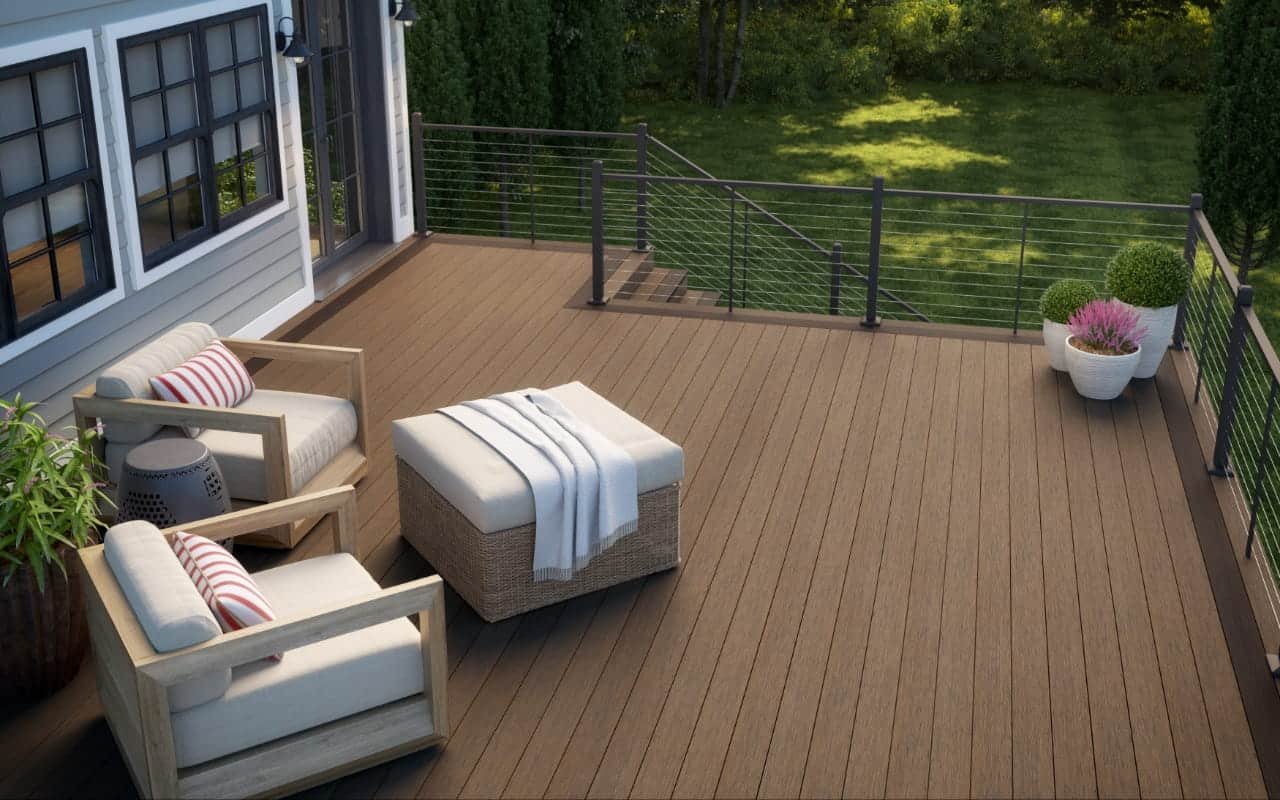
Pressure-treated pine is the workhorse and the most common decking material across southern Wisconsin. It's the lowest upfront cost at $15-$30 per square foot installed, and a well-maintained wood deck lasts 15-25 years. The catch is the word "maintained." Wood needs annual sealing or staining, and our freeze-thaw swings cause checking and warping faster than milder climates do. If you like the look and don't mind a spring weekend with a stain roller, it's the value play.
Want this priced for your deck?
John walks your space, measures it, and leaves a written itemized estimate. No cost, no obligation, no sales script.
Composite: $40-$50/sqft Installed
Composite decking (boards made from wood fiber blended with recycled plastic) costs $40-$50 per square foot installed. That's a real premium over wood. But the maintenance is close to zero: no sealing, no staining, no splinters, and it shrugs off our wet springs and hard winters. Over a 20-year window in Wisconsin, that near-zero upkeep narrows the gap with wood considerably. The U.S. Environmental Protection Agency also flags recycled-content composites as a lower-waste option, which matters to some homeowners.
Vinyl: $30-$60/sqft Material
Vinyl (PVC) decking material runs $30-$60 per square foot, and that's material only, so your installed cost lands higher once labor is added. It's a smaller niche here, chosen mostly for its fully waterproof surface and no-maintenance finish. If you want a surface you never seal and never scrub, it's worth a line-item quote.
Deck Size and What It Actually Costs in Wisconsin
Size sets the total, but not in a straight line. Regional pricing data breaks Wisconsin builds into three brackets: small platforms under 200 square feet run $2,500-$6,000, medium builds of 200-500 square feet run $6,000-$14,000, and large builds over 500 square feet run $14,000-$30,000. Notice the per-square-foot cost effectively drops as the build grows. That's not a discount for being fancy. It's math.
| Size | Square footage | Total installed cost |
|---|---|---|
| Small | Under 200 sqft | $2,500-$6,000 |
| Medium | 200-500 sqft | $6,000-$14,000 |
| Large | Over 500 sqft | $14,000-$30,000 |
The reason bigger builds cost less per square foot is fixed costs. Your permit, your ledger attachment, your mobilization, and a baseline set of footings cost roughly the same whether the build is 150 square feet or 450. Spread those fixed dollars across more boards and the per-foot number falls. So a small platform can feel expensive per square foot even though the total is modest.
If you're deciding between a 180-square-foot platform and a 240-square-foot one, price both. The bigger option often costs surprisingly little more because the footings and permit are already paid for.
What Moves Your Quote Up or Down
Two builds of identical square footage can quote thousands apart, and it's almost never the contractor padding. It's the details. Here are the levers that actually move a Wisconsin quote, and where a cheap bid tends to cut corners.
- Height above grade. A build 30 inches off the ground needs a guardrail (the code-required barrier that keeps people from falling off the edge). The higher it sits, the taller the support posts, the more framing, and the more guardrail. A raised build off a Wauwatosa walkout basement costs meaningfully more than a ground-level platform.
- Distance from the house. Every additional 2 feet of projection can trigger an extra row of support posts and footings. That's more concrete, more excavation, more labor. Deeper builds add up fast.
- Frost-depth footings. The Wisconsin Uniform Dwelling Code (§ SPS 320.10) mandates footings below the frost line to prevent heave damage, typically 48 inches in Waukesha County and across southern Wisconsin. This is non-negotiable, and it's the first thing an inspector verifies. Some low bids get sneaky here, using shallow tube forms that don't meet code and won't pass inspection. You can read the code yourself through the Wisconsin Department of Safety and Professional Services.
- Stairs. Each stair run adds real cost in framing, stringers, and railings. Ask any contractor to line-item stairs separately so you can see them.
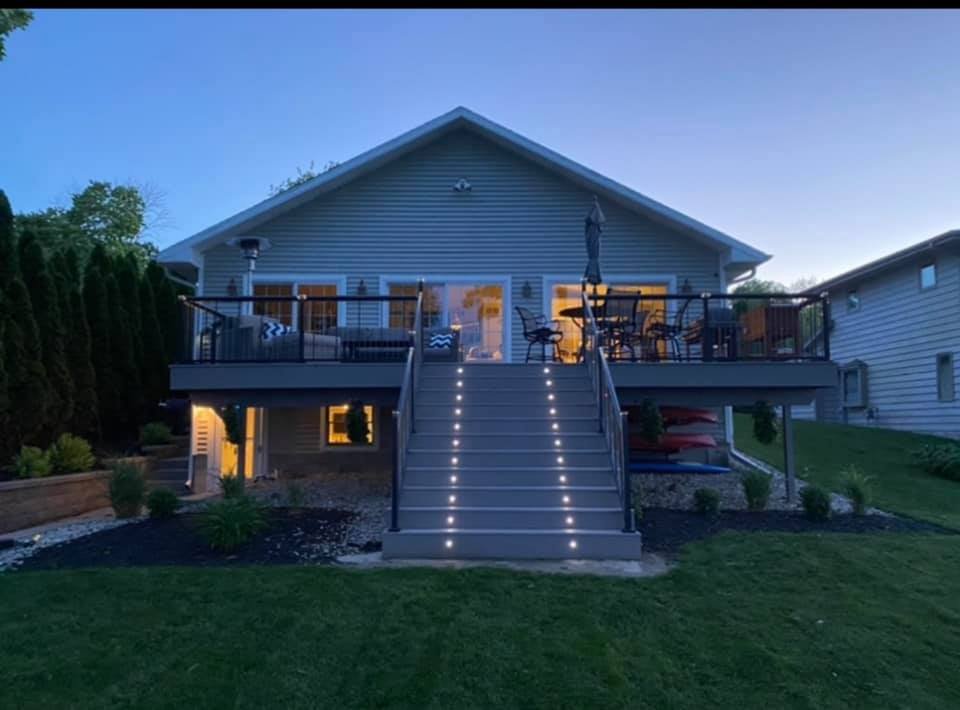
- Railings and balusters. Guardrails are code-required at 30 inches above grade, and material choice swings the number hard. Basic wood balusters versus aluminum or cable railing is a big fork in the budget. For a deeper dive on railing materials and code compliance, see our deck construction services in Brookfield and Waukesha County.
- Ledger vs. freestanding. A ledger board is the beam that bolts the structure to your house. Attaching to a ledger is cheaper, but it has to be flashed correctly to keep water out of your wall. A freestanding build costs more (it needs its own posts on the house side) but sidesteps water-intrusion risk entirely.
Here's a real example of how those levers stack. In fall 2026 we completed a 300-square-foot composite build in Brookfield that landed around $14,500 because the homeowner chose cable railing and a ledger attachment with proper flashing. Through the hard 2024-2025 winter and its full freeze-thaw cycle, the homeowner reported zero movement, zero board issues, and no maintenance beyond a spring rinse. The competing quotes that "forgot" the flashing came in lower on paper and higher once you asked the follow-up question.
If a bid doesn't mention footing depth or ledger flashing, that's not a cheaper build. It's an incomplete scope, and the difference comes back as a change order once the inspector shows up.
Ask every contractor to line-item these six items. When all three bids show them, you're finally comparing the same project. If you're weighing this against a fuller outdoor build, our sunroom addition costs in Wisconsin guide walks through where the money shifts.
Wisconsin Deck Permits: What They Cost and Why You Can't Skip Them
Yes, you need a permit. This work requires a building permit across Wisconsin, and every municipality in Waukesha County enforces it. Permit fees vary by city: Brookfield, New Berlin, and Wauwatosa each run different fee schedules, so confirm with your local building department before you sign a bid. I won't quote you a flat number that turns out wrong on your second call. Instead, make sure your contractor includes permit pulling in the written scope. A complete bid always does. A stripped-down bid often doesn't, which is one common reason two quotes look thousands apart.
The permit isn't red tape for its own sake. It triggers a structural inspection that verifies footing depth, ledger attachment, and guardrail height, the exact three things a cheap build cuts. Skipping the permit creates real liability: unpermitted structures can stall a home sale, create gaps in a homeowner's insurance claim, and in a worst case force a costly retrofit or removal.
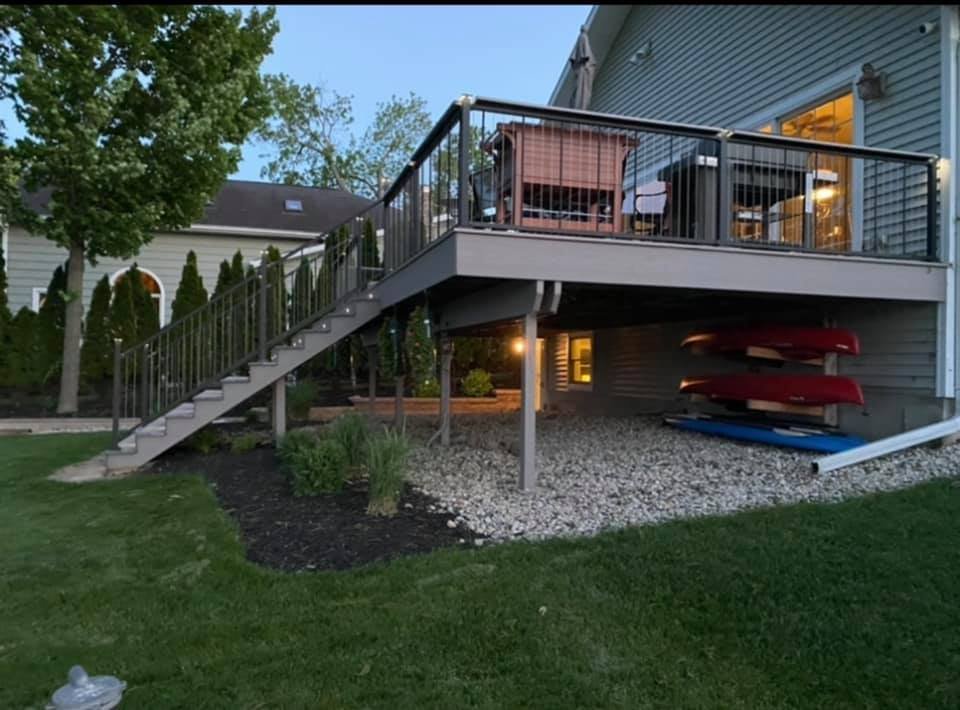 Deck - T&J
Wisconsin's Uniform Dwelling Code governs residential construction statewide, and a build attached to the house is treated as a structural addition. For a plain-English breakdown of what does and doesn't require a permit, see the Wisconsin permit rules for outdoor structures.
How to Read a Deck Quote: What a Complete Scope Looks Like
The lowest bid only wins if it's the same project. Most of the time it isn't. A complete, code-compliant Wisconsin quote should spell out every one of these line items:
- Demo and haul-away of the existing structure, if applicable
- Frost-depth footing excavation and concrete
- Framing lumber and hardware
- Decking material with the species or brand named
- Ledger flashing (the metal that keeps water out of your wall)
- Stairs, with count and width specified
- Guardrails, with material specified
- Permit fee and final inspection
When a bid comes in $10,000 low, it's usually missing three or four of those. The footings, the flashing, or the permit got left off. Those costs don't vanish. They resurface mid-project as change orders, and by then you've already committed to the crew. That's how a "cheaper" build ends up costing more than the honest bid you passed on.
Here are four questions that surface the gaps fast. Ask all your bidders:
Does this quote include permit pulling and the final inspection?
What footing depth are you using, and does it meet frost-depth code?
Is ledger flashing included, or is this a freestanding build?
What happens to the price if the inspector requires a revision?
The contractor who answers those clearly, in writing, is the one you can actually compare. A vague answer on any of them tells you the number will move later. This is the same discipline we apply to our Wisconsin home addition cost per square foot estimates: scope agreed on paper before anyone signs.
Labor Rates and Timeline for Wisconsin Deck Builds
Labor in Wisconsin runs roughly $20-$60 per hour depending on crew size and complexity. Regional data puts general labor at $20-$40 per hour, while specialized carpentry runs $50-$70 per hour. Where you land depends on how skilled the crew is and how complex the build gets, so treat $20-$60 as the market band, not a promise. Most projects take 1-4 weeks from start to final inspection, with simple ground-level platforms on the short end and multi-level builds with stairs on the long end.
The real constraint in Wisconsin is the calendar. Our build season runs roughly May through October, and every homeowner in Waukesha, Pewaukee, and Brookfield wants theirs done by June. That creates a booking crunch. Our own lead times typically run 4-8 weeks depending on the season, which is normal for a reputable crew. If you want a May start, begin the quoting process in March.
Getting a Quote in Waukesha County: What to Expect from T&J
If your biggest fear is getting handed off to a junior project manager after you sign, that's exactly the fear we built around. John handles every project's communication directly, start to finish, and Telli is on-site running the actual carpentry. You talk to the people building your project, not a call center.
We start with a free in-home consultation. No cost, no obligation, no sales pitch, just a walkthrough of your scope so you know what a complete, code-compliant build costs before you commit to anything. We agree on the full scope before you sign, so there are no mid-project surprises and no "oh, that footing wasn't included" conversations. When you're ready to compare real numbers, book a free Waukesha County consultation or learn more about T&J Remodeling.
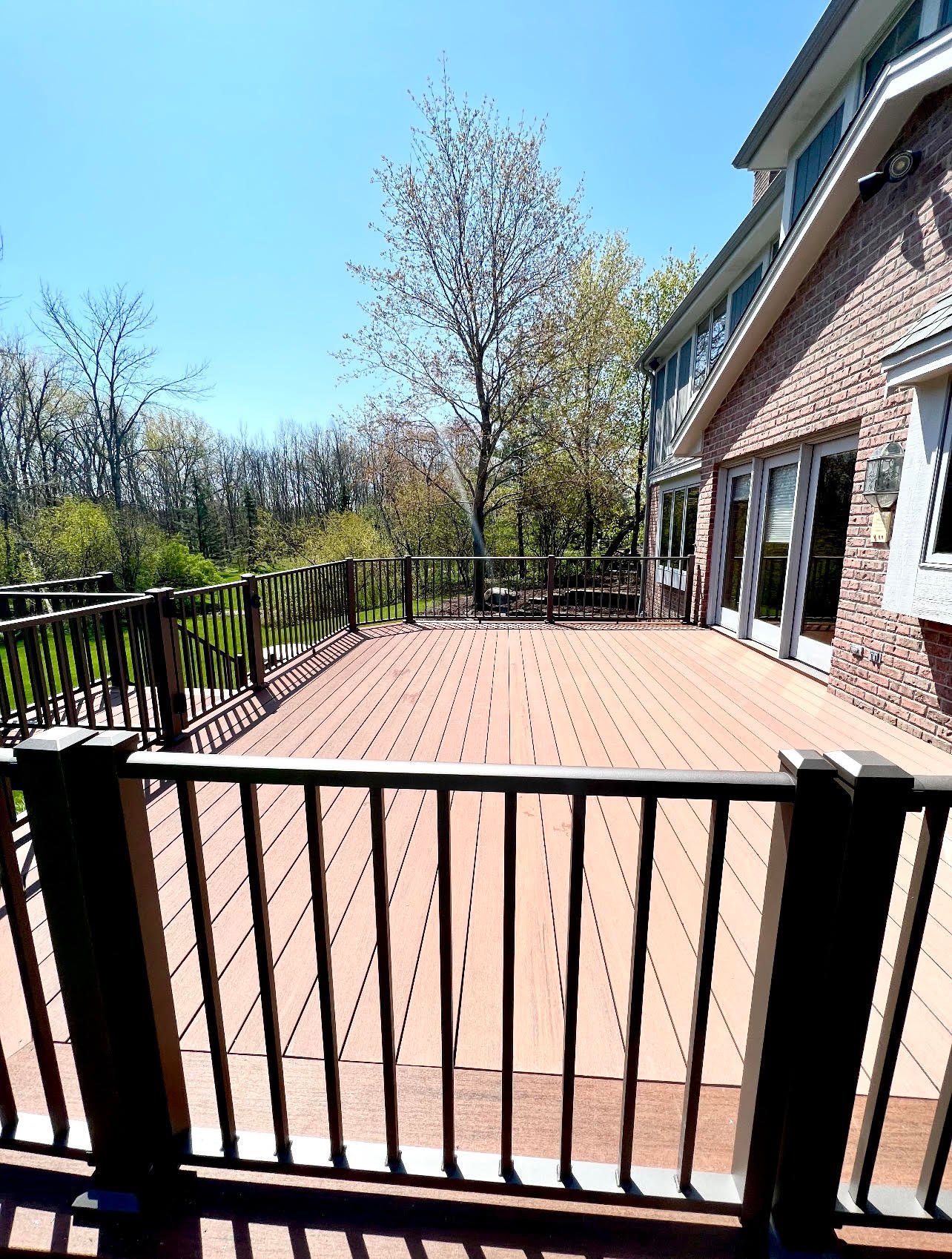 Deck - T&J
Frequently asked questions
Why do Wisconsin decks cost more than national averages?
Because the ground freezes here. Wisconsin code requires footings below the frost line, typically 48 inches in Waukesha County and across southern Wisconsin, which means real excavation and concrete on every post. That's the why. In practice, a crew has to auger or dig each footing deep, pour it, and let it cure before framing starts, which adds labor and material a warmer-climate build skips. What that means for your number: even a modest ground-level build carries fixed footing and permit costs that push the per-square-foot figure above the national estimators you'll find online.
What's the difference between composite and pressure-treated wood?
Composite is wood fiber blended with recycled plastic; pressure-treated wood is pine chemically treated to resist rot. That's the what. The why it matters in Wisconsin: our hundred-plus freeze-thaw cycles a year cause wood to check, warp, and gray faster than milder climates, while composite shrugs those cycles off. How the cost breaks down: wood runs $15-$30 per square foot installed but needs annual sealing, while composite runs $40-$50 with near-zero maintenance. Over a 20-year hold, composite's upkeep savings narrow the upfront gap considerably.
Do I need a permit for a deck in Wisconsin?
Yes. This work requires a building permit across Wisconsin municipalities, including Brookfield, New Berlin, and Wauwatosa. The why: Wisconsin's Uniform Dwelling Code treats a structure attached to the house as a structural addition, so it triggers a mandatory inspection. How that inspection works: an inspector verifies footing depth, ledger attachment, and guardrail height before you can use it. What happens if you skip it: unpermitted work can stall a home sale, void an insurance claim, and force a costly retrofit or removal down the road.
Why is one quote $10,000 cheaper than another for the same size?
The most common reason is missing scope, not a better price. That's the why. How to check: compare whether each bid includes frost-depth footing excavation and concrete, ledger flashing, permit fees, stairs, and guardrails. What that gap usually means: one contractor priced a complete, code-compliant build and the other priced only the boards and framing. Those left-off items don't disappear, they resurface as change orders after you've committed. Ask both bidders for a line-itemized scope so you're comparing the same project.
How much does a 12x16 deck cost in Wisconsin?
A 12x16 build is 192 square feet, just under the 200-square-foot small threshold, so expect $2,500-$6,000 in pressure-treated pine and up to roughly $9,600 in composite at $50 per square foot. The why behind the wide spread: small builds carry the same fixed permit, footing, and ledger costs as larger ones, so cost-per-square-foot runs higher at this size. How to pin your number: height above grade, whether stairs are needed, and whether the permit is included all move it. What to do: get the permit and footings line-itemized so a low bid can't hide them.
How long does it take to build a deck in Wisconsin?
Most projects take 1-4 weeks from start to final inspection. The why for the range: simple ground-level platforms sit on the short end, while multi-level builds with stairs and built-in features run longer. How the timeline actually stretches: permit review adds 1-2 weeks in many Wisconsin municipalities, and that clock doesn't start until drawings are submitted. What that means for planning: booking a May start means initiating the quote process in March, since our own lead times typically run 4-8 weeks in peak season.