 Addition project - T&J
If you're comparing contractors right now, this guide covers what your project should cost, what a complete scope actually includes, and the questions to ask before you sign anything. We do these as home addition contractors in Waukesha County every season. In our experience, when two bids on the same project differ by $50K, it's almost always because the scope is different on paper, not because one contractor is more efficient.
Cost Per Square Foot by Addition Type
The per-sqft number is a useful sanity check, but only once you match the type of addition. Here's how 2026 pricing breaks out for the projects we see most often in Brookfield, Elm Grove, Pewaukee, and the rest of Waukesha County.
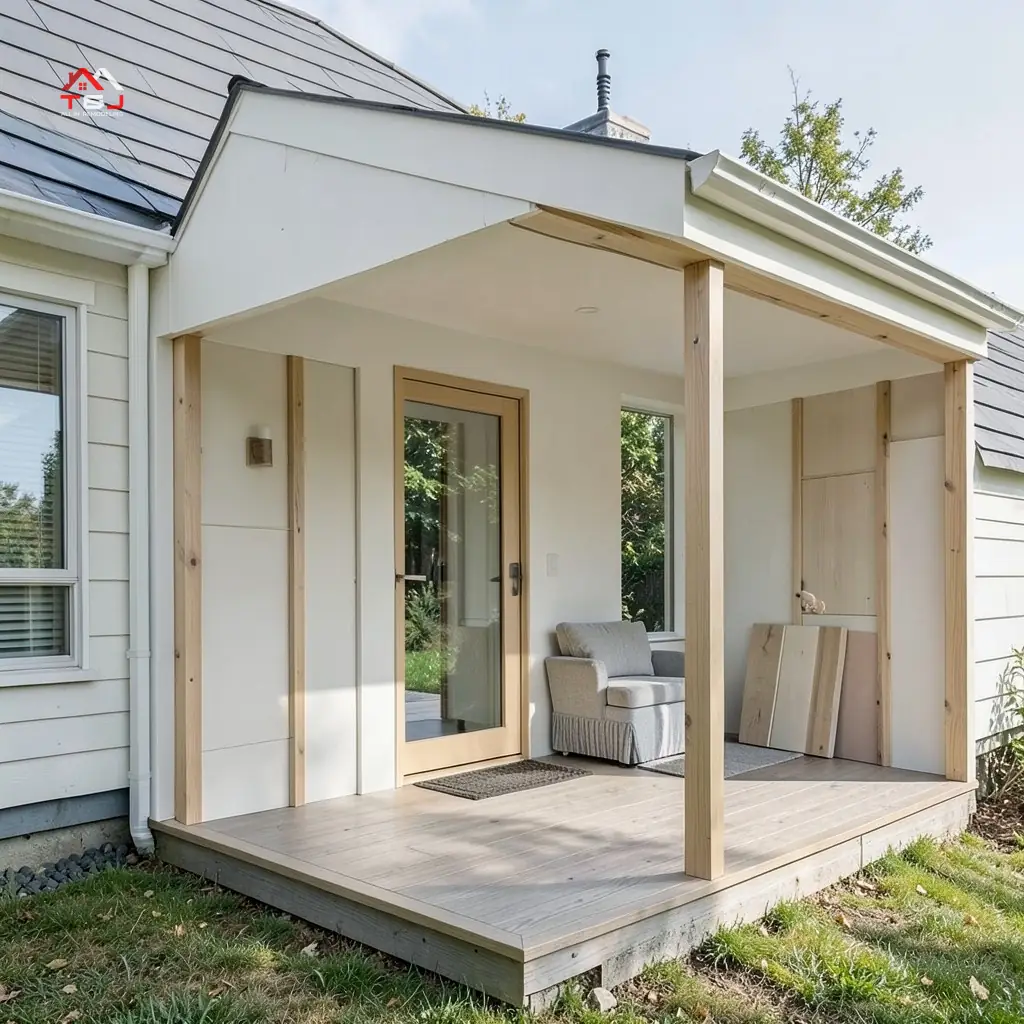
Bump-out (50-150 sqft)-$200-$300/sqft. A kitchen eat-in extension or a bathroom expansion off the back of a 1960s Brookfield ranch. No new roof system in most cases (it ties into the existing eave), small foundation footprint, minimal mechanical work. Typical total: $15K-$40K. What drives it up: cantilevered floor systems, moving a sink or toilet, matching old brick.
First-floor addition (300-600 sqft)-$275-$425/sqft. Family room, dining room, or a new primary bedroom on grade. Full footings, new roof tie-in, HVAC zone extension, possibly a panel upgrade. Typical total: $95K-$240K. National averages run $80-$200/sqft for horizontal build-outs. Wisconsin runs higher because frost-depth footings and R-21+ wall insulation aren't optional here.
Second-story addition (600-1,000 sqft)-$300-$500/sqft. Stacks new bedrooms or a primary suite over the existing first floor. Requires structural reinforcement of existing walls and footings, full roof tear-off, weatherproofing during the open-roof phase, and often temporary housing for the family. National data shows build-ups at $300-$500/sqft versus $80-$200 for build-outs. Typical total: $200K-$450K.
In-law or primary suite with kitchenette/full bath (400-800 sqft)-$400-$650/sqft. The plumbing, cabinetry, and finishes do the heavy lifting on cost. A bath alone runs $150-$200/sqft inside the addition footprint. Typical total: $180K-$420K. If you're adding a full kitchen, our kitchen remodeling cost guide breaks down where the dollars go.
Garage conversion to living space, $150-$250/sqft. Different math because the shell exists. The work is insulation to code, raising the floor, HVAC extension, egress, drywall, and finishes. Typical total: $60K-$110K for a standard two-car.
When a contractor gives you a per-sqft number without asking what type of addition you want, that's the first sign their bid is going to need change orders. The five types above use the same crews but very different math.
We recently wrapped a 450-sqft primary suite addition in Brookfield that came in right at $285/sqft because the homeowner chose a simple gable roofline tying into the existing ridge and stayed with builder-grade finishes. A similar-sized suite two miles away with a hip roof and tile-shower upgrades came in at $415/sqft. Same crew, same season, very different numbers.
What a Complete Scope Actually Includes (and What Cheap Quotes Leave Out)
This is the section we wish every comparison shopper read before signing. A complete Wisconsin addition contract covers all of the following, not as add-ons, but as the baseline.
What's In a Real Scope
 Addition - T&J
| Design & Permits | Structure & Mechanicals | Finishes & Cleanup |
|---|---|---|
| Architectural drawings ($2,400-$14,000 ) | Excavation + frost-depth footings | Insulation to code (R-21 walls, R-49 attic) |
| Structural engineering when required | Foundation (slab, crawl, or basement) | Drywall, trim, paint |
| Building permit | Framing, sheathing, house wrap | Flooring, tile, fixtures |
| Electrical, plumbing, HVAC permits | Roofing tie-in + siding match | Final grading + dumpster |
| UDC SPS 321 compliance | HVAC extension or new zone | Daily cleanup |
| Plan review fees | Electrical load calc + panel work | Workmanship warranty |
| Zoning + setback review | Plumbing rough + finish | Punch-list completion |
Common Low-Ball Omissions
When you stack two bids side by side, look for these gaps in the cheaper one:
Want this priced for your addition?
John walks your space, measures it, and leaves a written itemized estimate. No cost, no obligation, no sales script.
- "Permit by owner" or no permit line at all
- No allowance numbers for cabinets, flooring, tile, or fixtures, or allowances set unrealistically low
- "HVAC by others" or no mention of mechanical tie-in (see our HVAC and mechanical scope notes for what's typically required)
- No siding-match line (you'll get vinyl over your brick)
- No engineering line for a second-story or load-bearing change
- Vague "electrical as needed" without a panel evaluation
- No dumpster, no final cleanup, no warranty term stated
If a bid comes in 20%+ below the others on the same project, it's almost never because that contractor is more efficient. The scope is smaller on paper, and those missing line items will show up as change orders mid-build, when you have no leverage.
The 7 Things That Move Your Price Up or Down
Here's what actually drives the price up or down. Each variable can swing the per-sqft number meaningfully.
Foundation choice.
Slab is cheapest, crawlspace mid, full basement most. Foundation pours run $5-$37/sqft on their own. Adding a full basement under the addition can add $40-$80 per square foot of footprint to your total.
Roofline complexity.
A simple gable that ties into the existing ridge is cheapest. Hips, dormers, and valleys add framing labor and roofing waste. The standard 12% material waste allowance climbs fast on cut-up rooflines.
Finish tier.
Builder-grade versus mid versus high-end can swing your $/sqft by 25-40%. Interior finishes alone range from $30-$300/sqft, a 10x spread depending on cabinets, tile, flooring, and trim.
Kitchen or full bath inside the addition.
Adding a full kitchen adds $25K-$60K+. A full bath adds $150-$200/sqft just for the bathroom footprint. Our bathroom remodeling page walks through where the cost lands.
Site access and lot conditions.
Tight side-yard access, mature trees, grading issues, or a septic field in the way all add days of careful work.
Existing-house surprises.
Knob-and-tube wiring, undersized 100-amp panels, settled footings, asbestos in old plaster, none are the addition contractor's fault, but they're real costs that show up after demo opens the wall.
Match-existing requirements.
Sourcing siding to match a 1970s LP profile, or finding shingles that blend with a 12-year-old roof, can mean custom-order lead times and premium pricing.
Labor accounts for 40-60% of total home addition cost. With Wisconsin skilled-trade rates averaging $44/hr and trades booked 2-4 months out in 2026, that's where regional labor rates really matter. Milwaukee County and Dane County rates run similar to Waukesha; rural northern counties typically run 10-15% lower but have fewer qualified crews to choose from.
Wisconsin Permits, Code, and Hidden Compliance Costs
Any addition that adds conditioned square footage falls under Wisconsin's Uniform Dwelling Code (SPS 321), the state code that governs one- and two-family dwellings. That means a building permit from your municipality, plus separate electrical, plumbing, and HVAC permits in most jurisdictions.
Permit fees in Waukesha County typically run $400-$1,500 depending on the municipality and project value. Brookfield, Elm Grove, Pewaukee, New Berlin, and Menomonee Falls each have their own fee schedules and plan-review timelines. Second-story additions and any project that modifies load-bearing structure require engineered drawings stamped by a Wisconsin-licensed structural engineer, that's a separate $1,500-$4,000 line item depending on complexity.
The code requirements that quietly drive cost:
- Frost-depth footings of 42-48 inches, the ground freezes deeper than most people think in southeastern Wisconsin, and shallow footings will heave
- WI energy code, R-21 walls and R-49 attic insulation minimums per the Wisconsin Department of Safety and Professional Services
- Egress windows in any sleeping room, minimum opening size and sill height defined by code
- Smoke/CO alarm updates that may be triggered house-wide when you pull a permit
- Zoning setbacks, most Waukesha County municipalities enforce 25-foot front, 10-foot side, 30-foot rear minimums, with variances required if you're tight
A contractor who quotes your addition without a permit line item isn't saving you money, they're exposing you to forced removal by your municipality and serious problems with your homeowner's insurance and at resale. Verify the permit is pulled in your name or the contractor's, never "by owner" on a project this size.
Sample Budgets: Three Real Wisconsin Addition Scenarios
Use these to sanity-check your own bids. Splits are approximate and vary by site and finish.
A. 200 sqft kitchen bump-out, $55K-$80K total
 Addition - T&J
- Design + permits: $4K-$7K
- Foundation/structure (cantilever or shallow footing): $8K-$14K
- Shell (framing, roof tie-in, siding match, windows): $14K-$22K
- MEP (electric, minor plumbing, HVAC extension): $6K-$10K
- Finishes (flooring, trim, paint, existing cabinets assumed): $10K-$15K
- GC overhead/profit and cleanup: $13K-$22K
B. 500 sqft first-floor family room + half bath, $140K-$210K total
- Design + engineering + permits: $8K-$14K
- Foundation (crawlspace): $18K-$32K
- Shell with new roof tie-in and siding match: $35K-$55K
- MEP including half bath rough and HVAC zone: $22K-$35K
- Finishes (mid-tier flooring, trim, paint, half-bath fixtures): $25K-$40K
- GC overhead/profit, dumpster, warranty: $32K-$50K
C. 800 sqft second-story primary suite, $260K-$400K total
- Design + structural engineering + permits: $14K-$24K
- First-floor structural reinforcement + new footings if required: $20K-$40K
- Roof tear-off, framing, re-roof, weather protection: $55K-$85K
- Shell (windows, siding match, exterior trim): $40K-$60K
- MEP (full bath rough, electrical including possible panel upgrade, HVAC): $45K-$70K
- Finishes (primary bath, walk-in closet, bedroom): $50K-$80K
- GC overhead/profit, temp housing allowance, cleanup: $40K-$60K
When your bids come in, ask each contractor to break their number into roughly these buckets. If one of them can't, that's information.
How to Compare Three Contractor Bids Without Getting Burned
You're doing the right thing getting three quotes. Here's how to compare them without falling into the lowest-bid trap.
Ask every contractor the same eight questions, in writing:
Is the building permit included? Electrical, plumbing, HVAC permits?
What are the allowances for cabinets, flooring, tile, and fixtures? Are they realistic for the finish level we discussed?
Who's pulling the structural engineering, and is the stamped drawing included?
How do you handle change orders, fixed markup, written approval before work?
What's your workmanship warranty? (Look for 2+ years on workmanship, manufacturer warranties on products.)
Are you licensed as a Wisconsin Dwelling Contractor (DC) and do you have a Dwelling Contractor Qualifier (DCQ) on staff? Both are required by Wisconsin DSPS to pull permits on residential work, verify on the state license lookup.
What are your general liability and workers' comp limits, and can I see the certificates?
Can I talk to two recent addition clients and visit a current job site?
A contractor who answers all eight without hedging is a real contractor. A contractor who says "we'll figure that out later" is the bid you set aside.
On the "can you match X's price" question: we'll match a price by matching a scope. Show us what's actually in the lower bid, every line item, every allowance, and we can almost always find the gap. Sometimes the lower bidder is genuinely leaner on overhead. More often, the permit is missing, the cabinet allowance is half what you'll actually spend, and the siding-match line says "existing to remain" on a project that obviously requires new siding.
If you're still weighing whether the project pencils at all, our take on how to compare adding on versus moving to a larger home lays out the real trade-offs.
The lowest bid is almost never the cheapest finished project. Industry data from the NAHB and the Remodeling Cost vs. Value Report consistently shows change orders on under-scoped projects close most of the gap between low and middle bids, finish downgrades close the rest.