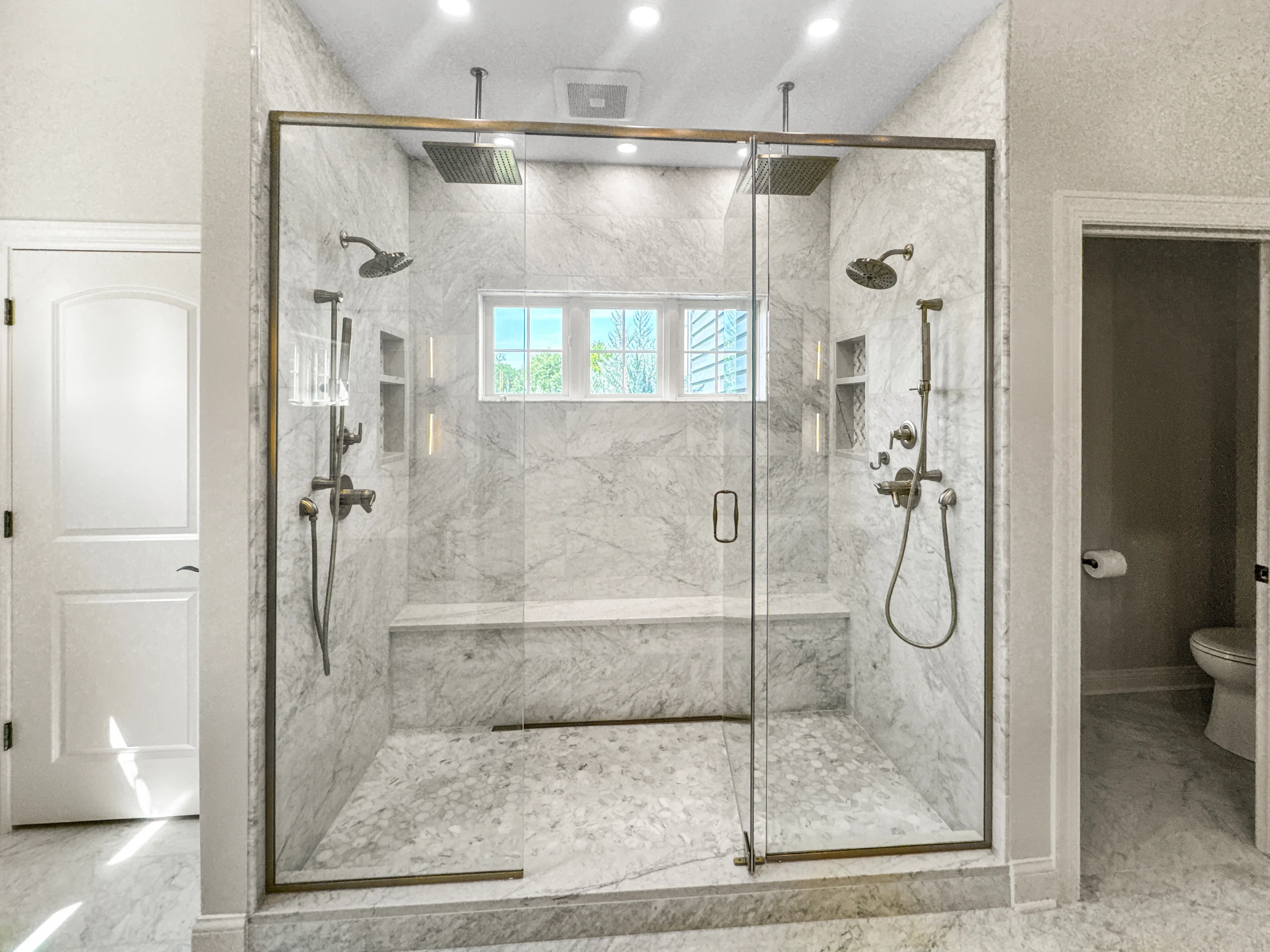
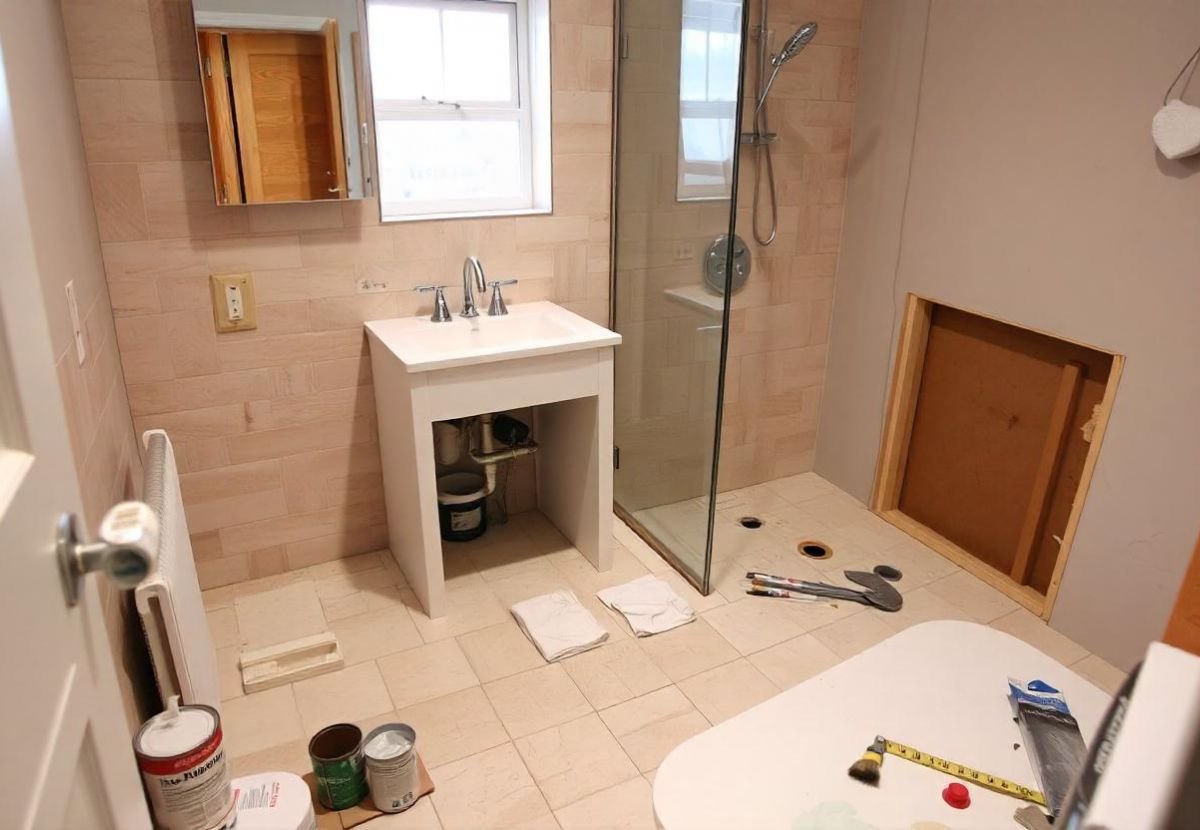
 Bathroom project - T&J
If you're comparing contractors right now, this guide covers what your project should cost, which permits you'll need through the New Berlin Department of Community Development, and how to vet a contractor before you sign anything. We're a father-son team, Wisconsin-credentialed and based in Brookfield, with 35+ years combined remodeling experience across New Berlin, Elm Grove, Waukesha, and the surrounding Waukesha County market. This guide is written the way we'd explain it at your kitchen table.
Bathroom Remodel Cost in New Berlin, WI: The 2026 Numbers
Here's the honest breakdown for 2026. A cosmetic refresh (paint, a vanity swap in place, new fixtures, no layout changes) lands in the low-to-mid teens. A mid-range full remodel with new tile, a walk-in shower, a new vanity, and existing plumbing locations lands in the mid $20Ks to low $40Ks for a hall bath. A luxury master with layout changes, custom tile work, heated floors, and a curbless shower routinely runs $55,000 to $80,000+.
What pushes a New Berlin bathroom to the top of its range isn't finish selection nearly as often as it is plumbing relocation. That's the split-level tax we'll get into in a minute. For a broader benchmark across the state, see our average bathroom remodel cost across Wisconsin writeup.
In New Berlin's 1965-1985 split-levels, moving fixtures off the existing wet wall is the single largest cost variable, often larger than tile or vanity selection combined.
Cost by Bathroom Size and Scope Tier
Most bids fall into one of three tiers. Knowing which tier your project belongs to is the fastest way to sanity-check three different quotes.
| Tier | Scope | Typical New Berlin Range (2026) | Timeline |
|---|---|---|---|
| 1. Cosmetic Refresh | Paint, vanity swap in place, new fixtures, no layout change | $12,000-$18,000 | 1-2 weeks |
| 2. Mid-Range Full Remodel | Full demo, tile, walk-in shower, new vanity, existing plumbing locations | $22,000-$45,000 | 3-5 weeks |
| 3. Luxury / Layout Change | Expanded footprint, moved fixtures, custom tile, heated floors, glass enclosure | $55,000-$80,000+ | 5-8 weeks |
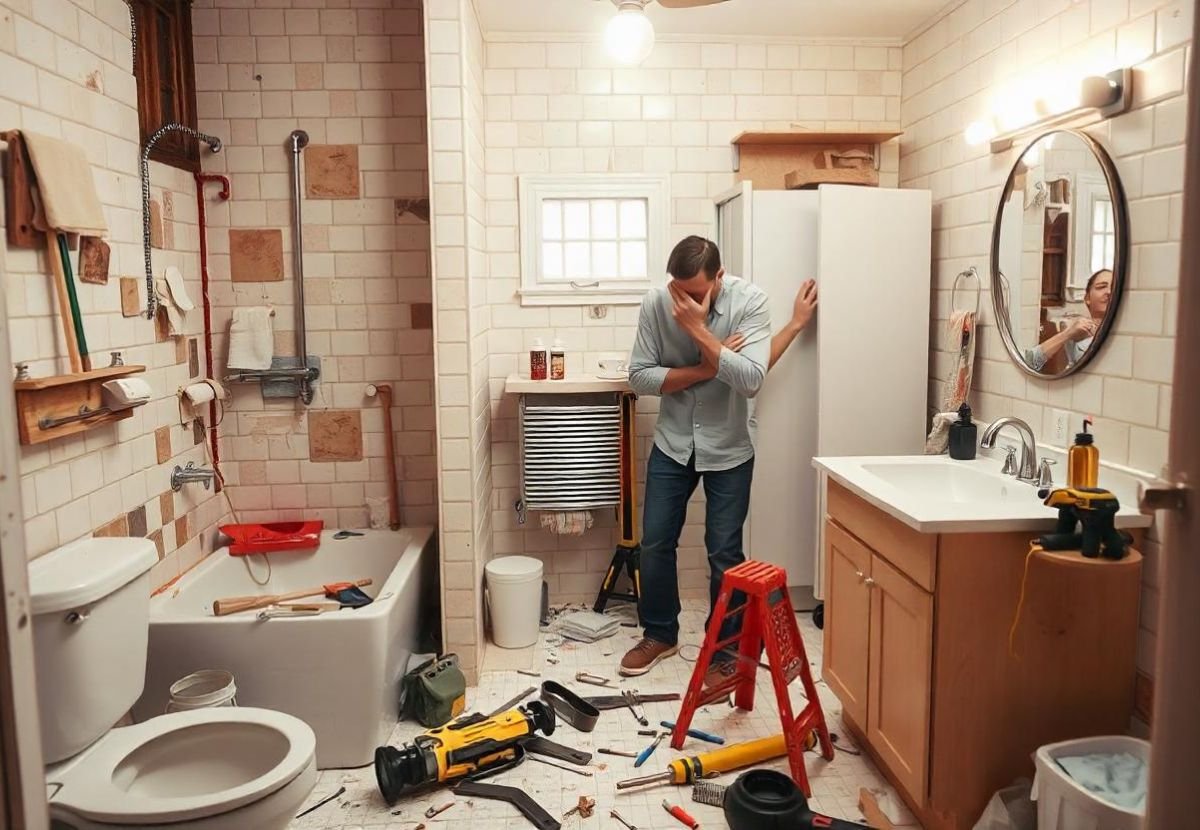 Bathroom - T&J
Tier 1: Cosmetic Refresh
Paint, new vanity in the same footprint, new toilet in the same spot, new mirror and light fixture, new faucet, maybe a re-glaze on the tub. No tile work beyond a possible backsplash. No plumbing moves. In a New Berlin hall bath, this tier lands at roughly $12,000-$18,000. It's honest work when the layout already functions and the tile is in decent shape. It usually doesn't require a plumbing permit if nothing moves.
Want this priced for your bathroom?
John walks your space, measures it, and leaves a written itemized estimate. No cost, no obligation, no sales script.
Tier 2: Mid-Range Full Remodel (where most New Berlin homeowners land)
Full demo to studs, new tile floor, tiled walk-in shower with a proper waterproofing system, new vanity and top, new toilet, new lighting and exhaust fan on a dedicated circuit, new trim and paint. Fixtures stay in their current locations, so the plumbing rough-in is a re-connect rather than a re-route. This is the tier most 3-bathroom New Berlin split-levels choose for a hall or guest bath, and it lands at $22,000-$45,000.
Tier 3: Luxury / Layout-Change Master
Expanded footprint (often stealing a closet), separated shower and freestanding tub, double vanity, heated floor, custom tile, glass shower enclosure, and usually at least one moved fixture. In a New Berlin split-level master, layout changes almost always involve the wet wall, which is where the cost climbs. Realistic range: $55,000-$80,000+, and the top of that band comes fast when you're moving a toilet or shower drain.
If two contractors are quoting the same room but one is $12K lower, the difference is almost never labor rate. It's scope. Ask both for a line-item scope on the same day and lay them side by side.
Why New Berlin Split-Levels Change the Math
This is the part most contractors quote around instead of explaining. New Berlin's housing stock skews heavily toward split-levels and tri-levels built between the mid-1960s and mid-1980s, especially in the neighborhoods off National Avenue between Sunny Slope Road and Calhoun, and the pockets north of Cleveland Avenue. The main-floor bathroom in these homes is almost always sharing a wet wall with the kitchen, or stacked back-to-back with another bathroom. That single design decision is why the same bathroom costs wildly different amounts depending on your plan.
Keep the toilet, sink, and shower drain in their existing locations and that back-to-back plumbing wall is a gift. The rough-in is short, the drain runs are already sized correctly, and the vent is already there. You save real money versus a ranch remodel of the same room.
Move a fixture, though, and the math flips hard. In a split-level, the main-floor bath often sits on a slab or over a very tight joist bay above a finished lower level. Moving a toilet four feet means three separate costs stacking on each other. First, cutting concrete or opening a lower-level ceiling ($800-$1,500 in labor and patch). Second, re-routing the drain to maintain proper slope, which under Wisconsin Plumbing Code (SPS 382 and SPS 384) must be performed by a licensed plumber ($1,200-$2,500). Third, re-vent work to keep the trap sealed under negative pressure, also code-required under SPS 382 ($500-$1,000). Add it up and a "small" toilet move adds $2,500-$5,000 versus the same move in a ranch with an open, unfinished basement below.
We recently finished a 1974 split-level master near the intersection of Sunny Slope and National Avenue where the homeowner wanted the toilet moved to the opposite wall for an aging-in-place layout. That single decision added roughly $4,200 to the bid versus keeping it in place. It was the right call for them because they plan to stay 15+ years. But it's the kind of number you want quoted up front, not discovered as a change order.
A quote that includes "minor plumbing relocation" without specifying which fixtures and how far is a change-order landmine. In a split-level, "minor" is not a real category. Ask for the exact new fixture locations on a drawing before you sign.
This is also where the housing stock's age shows up in unforeseen conditions. Cast-iron drain stacks that look fine at demo can be paper-thin at the base. Galvanized supply lines behind the vanity are often at end of life. A contractor who's actually worked in these homes builds an unforeseen-conditions allowance into the bid. See when a Wisconsin bathroom plumbing permit is required for the code side of any plumbing change.
What a Complete Bid Includes (and What Low Bids Skip)
The biggest reason two bids on the same bathroom look nothing alike is that they're quoting different jobs. Here's what a complete New Berlin bathroom bid should include, line by line.
Included in a complete bid:
- Demo, dumpster, and disposal fees
- Plumbing, electrical, and building permits (pulled by the contractor)
- Plumbing rough-in and final connections by a licensed plumber
- Electrical: GFCI outlets, dedicated exhaust fan circuit, code-compliant lighting
- HVAC adjustment if a register or return needs to move
- Framing changes (blocking for grab bars, shower niche, curb build-out)
- Waterproofing system for the shower (Schluter Kerdi, Wedi, or Laticrete Hydro Ban) named in writing
- Tile and setting materials (thinset, grout, sealer)
- Vanity, countertop, and faucet
- Toilet and supply lines
- Shower door (frameless or semi-frameless glass, not a curtain rod)
- Trim carpentry, caulk, and paint
- Final cleaning
- Project management and daily supervision as a line item
- Written warranty on labor and separately on the shower pan
- A stated unforeseen-conditions allowance (dollar figure, not vague language)
Commonly missing from low bids:
- Permit fees ("you pull it as the homeowner" is the tell)
- The waterproofing membrane behind the tile
- Shower door (quoted separately after you've signed)
- Disposal and dumpster fees
- Electrical upgrades to meet current NEC and Wisconsin code
- Any allowance for rotted subfloor, failed shutoffs, or cast-iron stack replacement
- Project management as a labor line (which usually means no one is actually managing the job)
A $16K bid and a $30K bid on the same room usually aren't $14K apart in reality. They're often $2K-$4K apart once the low bid's change orders come in. But by then you've signed, demo is done, and you're negotiating from a weak position. This is exactly the pattern we describe in bathroom remodel mistakes we see in Waukesha County.
Wisconsin's Uniform Dwelling Code (SPS 320-325) requires bathroom outlets to be GFCI-protected and the exhaust fan to vent to the exterior, not into an attic. Both are routinely skipped in cheap bids and both fail inspection.
Permits and Inspections in New Berlin
New Berlin permits are pulled through the City of New Berlin Department of Community Development at 3805 S. Casper Drive. A plumbing permit is required any time you move or replace fixtures or supply and drain lines, and a separate electrical permit is required for new circuits. A pure cosmetic refresh with no plumbing or electrical changes typically doesn't need a permit.
Typical permit fees for a full bathroom remodel in New Berlin run roughly $150-$400 total across plumbing, electrical, and building permits, depending on scope. Application-to-approval timing is usually 5-10 business days, and inspection scheduling once work is underway is typically 2-5 business days out. Rough-in inspection happens after framing and rough plumbing/electrical, before insulation and drywall. Final inspection happens after fixtures are set.
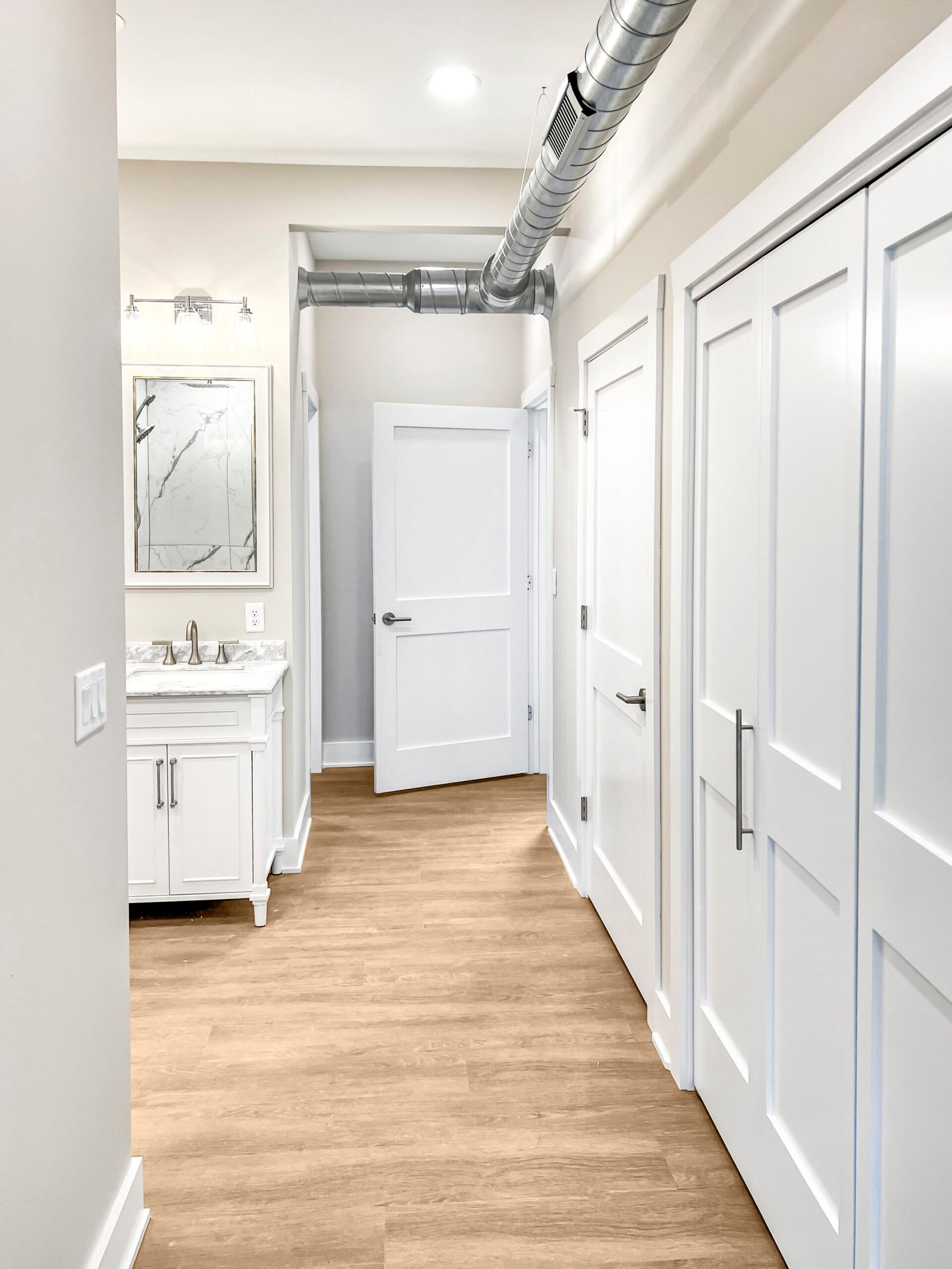 Bathroom - T&J
A licensed contractor pulls the permit in their name, which matters because it puts the code-compliance responsibility on us, not you. If a contractor asks you to pull it as "the homeowner," that's often a signal they may not be credentialed to pull it themselves. Wisconsin real estate disclosure law (Wis. Stat. § 709) also requires you to report material improvements at resale, and a buyer's home inspector will flag obvious remodel work. Unpermitted bathroom work has forced partial rip-outs during inspection contingencies more than once in this market.
Timeline: How Long a New Berlin Bathroom Remodel Actually Takes
There are two clocks running. First is lead time to start, meaning how long from signed contract until we're swinging hammers. For quality contractors in-season (spring through fall), that's typically 4-8 weeks. Anyone promising to start next week in June either has a canceled job or a bench problem.
Second is construction duration on site:
- Cosmetic refresh: 1-2 weeks
- Mid-range full remodel: 3-5 weeks
- Luxury / layout change: 5-8 weeks
Split-level slab work adds 3-5 days for concrete cutting, drain re-routing, and patching. Material lead times are the other variable most homeowners underestimate. Semi-custom vanities and specialty tile can run 4-6 weeks from order to delivery, so we order before demo starts, not after.
If your contractor wants to demo before materials are on-site, push back. Living without your bathroom for six weeks waiting on a backordered vanity is the single most common complaint we hear from homeowners who hired someone else first.