 Deck project - T&J
What the 3-4-5 Rule Actually Means
The 3-4-5 rule is a field trick for checking a right angle without a framing square, laser level, or speed square. Measure 3 feet along one board from the corner. Measure 4 feet along the board that meets it. Then measure the diagonal distance between those two marks. If that diagonal reads exactly 5 feet, the corner is square. If it reads long or short, pivot the corner until the diagonal hits 5 feet on the nose.
It works because 3, 4, and 5 satisfy the Pythagorean theorem, so any right triangle built on that ratio has a guaranteed 90-degree angle where the 3-foot and 4-foot legs meet. The ratio scales too. A bigger deck footprint needs more precision over a longer run, so pros often switch to 6-8-10 or 9-12-15, the same triangle multiplied out. Longer legs make a small error easier to catch before it grows.
A framing square gets you close on a short board, but it won't hold accuracy across a 12-foot or 16-foot rim joist the way a stretched tape diagonal does. A laser level checks level, not square. If you're weighing which parts of a deck build you can handle yourself, this is a good place to start; it's one of several tasks covered in what Wisconsin homeowners can safely DIY without a contractor, and it's free, fast, and more accurate over distance than most of the tools already sitting in a DIYer's garage.
Step-by-Step: Squaring Your Deck Frame With the 3-4-5 Method
Start at the ledger board, the board bolted to the house that every other measurement squares off of. Mark a point 3 feet from one corner along the ledger. From that same corner, mark a second point 4 feet out along the rim or joist that runs perpendicular to it. Measure the diagonal between those two marks. If it's exactly 5 feet, the corner is square. If it's off, pivot the rim board in or out at the far end until the diagonal reads 5 feet, then lock it down.
On a small deck, one person with a tape measure and a helper holding the far end can do this alone. On a larger footprint, stakes and mason's string make it easier to hold a straight reference line while you adjust. For anything wider than a single sheet of plywood, jump to 6-8-10 for better accuracy over the longer distance. This is the same layout method our crews use on deck remodeling in Waukesha County jobs before a single joist gets hung.
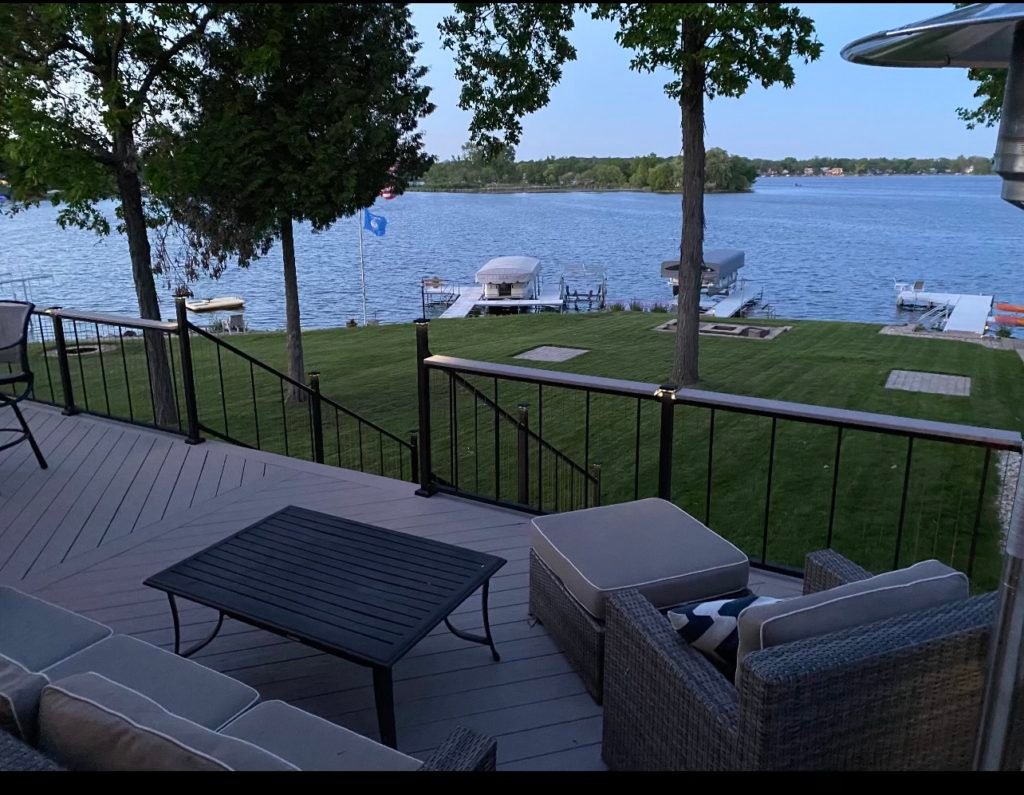
 Deck - T&J
Want this priced for your deck?
John walks your space, measures it, and leaves a written itemized estimate. No cost, no obligation, no sales script.
One corner isn't the whole story. Once all four corners read square individually, measure both diagonals of the full rectangle, corner to corner across the frame. If those two diagonals match, the frame is a true rectangle. This is the double-check every framing pro runs, because a deck can pass the 3-4-5 test at one corner and still be racked out of square overall if the opposite end was never checked the same way.
Snap a chalk line along your ledger before you measure anything. A tape pulled against a bowed or unmarked board gives you a false reference point before you've even started the triangle.
Common Mistakes That Throw Off the Triangle
The 3-4-5 rule is simple math, but field conditions ruin simple math fast. Tape sag on a long pull is the biggest one. Pull a tape measure across 12 to 16 feet without support and gravity bows it slightly. That reads a shorter distance than what's actually there. Measuring from an inconsistent reference point, edge of board on one mark and center of board on the other, does the same thing: small, invisible errors that compound as the run gets longer.
Board thickness at the corner trips people up too. If you measure your 3-foot and 4-foot marks from two different faces of the same corner post, you've introduced an error before the tape ever crosses the diagonal. Rounding to close enough instead of holding the exact fraction feels harmless in the moment and gets expensive two weeks later. We caught this on a real job: a Pewaukee deck rebuild where the original frame looked square by eye, but the diagonals were off by almost 3 inches because the prior builder had measured from the outside edge on one corner and the inside edge on the other.
A corner that's off by even a half inch at the 4-foot mark can be off by several inches by the time you're 16 feet down the rim joist. That shows up as decking boards that won't run parallel to the house and railing posts that won't line up, which usually means pulling boards back up and starting over.
Where the 3-4-5 Rule Stops Mattering: Footings, Frost Depth, and Ledger Attachment
A perfectly square deck built on footings that are too shallow still fails inspection, and it still fails structurally. Squareness doesn't fix a footing that heaves in winter or a ledger board that's only screwed into siding. These are the two things a Waukesha County building inspector actually checks, and the 3-4-5 rule has nothing to say about either one.
Frost footing depth is set locally, and it's worth knowing your specific number before you dig, not a regional average. The City of Waukesha's adopted Uniform Dwelling Code amendment requires deck footings to bear at least 48 inches below finished grade, and Oconomowoc's building department enforces that same 48-inch minimum on residential accessory structures. Menomonee Falls and most other Waukesha County municipalities set a comparable depth, but the number is theirs to set, so a five-minute call to your local building department before you order concrete is worth more than any blog post's estimate.
Get the depth wrong and a footing can heave a fraction of an inch every winter as the ground freezes and thaws. After a few seasons that adds up to a tilted post and a deck that's out of level, no matter how square the corners were on day one. We saw this play out on a deck in Menomonee Falls where the original footings were poured at barely half the required depth; by year three, two of the four posts had lifted enough that the whole structure had a visible lean toward the yard.
Ledger board attachment is the other half of this. The ledger carries a significant share of the deck's total load and transfers it straight into the house's structural framing. That means it has to be lag-bolted or through-bolted through the sheathing into the framing itself, with flashing installed above it to shed water away from the house. A ledger that's just screwed into siding looks solid until it isn't. Ledger failure is consistently one of the most common points of catastrophic deck collapse nationally, according to the American Wood Council's residential deck construction guide. This is also where our deck work spends most of its attention, because it's the part a homeowner can't eyeball from the driveway.
Frost depth and ledger fastening requirements both trace back to the Wisconsin Uniform Dwelling Code administered by the Department of Safety and Professional Services, but your municipality sets the exact enforced depth. Confirm it with your building department before you dig.
Do You Need a Permit for a DIY Deck in Wisconsin?
Most Wisconsin municipalities require a permit for a deck that's attached to the house or built above a certain height off grade, because an attached deck is structurally tied to your home and a fall from height carries real safety implications under code. A permitted deck gets inspected at the footing stage and again at framing, so an inspector checks footing depth and ledger attachment directly, no matter how square your corners came out.
This mirrors permit requirements Wisconsin homeowners often miss on other projects like bathroom plumbing work. The permit isn't paperwork for its own sake. It's the mechanism that forces someone qualified to look at the parts of the project that can't be undone easily once decking is nailed down. Skipping it doesn't make those requirements disappear, it just means nobody checked, and an unpermitted deck in Waukesha or Brookfield can complicate a home sale or an insurance claim later when it surfaces during an appraisal or a claim inspection.
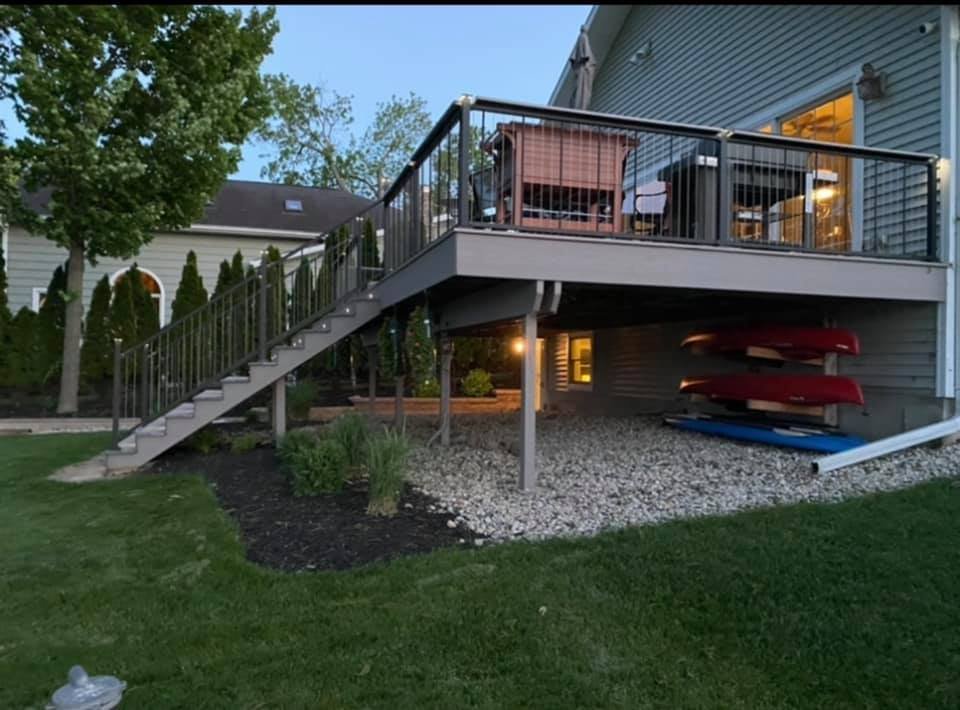
 Deck - T&J
What You Can DIY vs. Where a Pro Earns Their Fee
Squaring the frame with 3-4-5, laying decking boards, and installing balusters are all reasonably within reach for a patient DIYer with the right tools and a free weekend or two. These are the parts where doing it yourself genuinely saves labor cost, and mistakes there are usually cosmetic and fixable.
Structural work is a different math problem. Beam sizing, joist spans for your specific footprint, footing depth and placement, and ledger attachment are code-driven decisions where a mistake isn't cosmetic, it's a safety and inspection issue.
| Task | DIY-friendly? | Why |
|---|---|---|
| Squaring the frame (3-4-5) | Yes | Just a tape measure and patience |
| Laying decking boards | Yes | Cosmetic fixes if a board's off |
| Installing balusters/railings | Yes | Low structural risk, visible mistakes are fixable |
| Beam and joist sizing | Pro-recommended | Wrong span rating means a bouncy or unsafe deck |
| Footing depth and placement | Pro-recommended | Frost heave and code compliance, hard to fix after pour |
| Ledger board attachment | Pro-recommended | Most common point of structural deck failure nationally |
Get a joist span wrong and the deck can feel bouncy or unsafe under load. Get the ledger wrong and you're looking at water damage to the house framing that doesn't show up for years. A failed inspection on any of these means tearing out completed work and rebuilding it, which erases whatever percentage you thought you'd save by doing it yourself. Layout and finish work, go ahead and DIY it. Structural load paths are worth a second set of eyes first.
On our jobs, Telli is still on-site running the structural work himself, and John manages permits and inspections from the first call to the final sign-off. That's less about marketing and more about who's actually accountable if an inspector flags something on framing day.
A half-inch squaring error at 4 feet can grow to several inches of misalignment by the far end of a 16-foot rim joist.