 Remodel project - T&J
The Short Answer: What Moving Out Actually Costs in Wisconsin
Temporary housing in Wisconsin, whether an extended-stay hotel or a short-term rental, typically runs $1,500-$4,000 per month depending on unit size and how close you stay to Waukesha County. That range is the biggest single variable in your displacement budget, but it's not the only one. Storage for kitchen contents and furniture runs $100-$200 per month for a standard unit. Increased food costs for a family of four eating out more often add another $600-$1,200 per month compared to cooking at home. Pet boarding adds to that total if you have animals.
Put those numbers together for a 5-week kitchen remodel and the math gets real fast. At $2,500 per month in housing, $800 in food, and $150 in storage, a full move-out costs roughly $3,450-$4,450 for the project duration. That figure matters when you're comparing bids. A quote that looks $3,000 cheaper on paper but extends your timeline by two extra weeks may not actually save you anything once displacement costs are added back in.
For a full picture of what the remodel itself should cost, the average kitchen remodel cost in Wisconsin is a useful starting point before you factor in displacement.
Move-Out vs. Stay-Put: The Three Scenarios Most Wisconsin Homeowners Use
According to the Houzz 2026 Kitchen Trends Study, a survey of more than 1,300 homeowners, 66% stayed in their home during a kitchen remodel, 26% partially moved out, and just 8% moved out entirely. Those numbers challenge the assumption that moving out is the default, or even the smart, choice. Here's how each scenario plays out for a Waukesha County household.
Scenario 1: Stay put entirely (66% of homeowners)
 Remodel - T&J
Want this priced for your remodel?
John walks your space, measures it, and leaves a written itemized estimate. No cost, no obligation, no sales script.
This works best for single-room remodels where the rest of the house stays functional. A kitchen remodel in a Brookfield ranch with a finished basement often leaves enough livable space to get through 4-6 weeks without leaving. The cost implication is minimal: a temporary cooking setup and slightly higher food costs. The stress trade-off is real, with 84% of homeowners who stayed put reporting at least some stress, but the regret rate is the lowest of the three options at just 16%.
Scenario 2: Partial move-out (26% of homeowners)
This usually means sleeping elsewhere but returning during the day, or keeping one household member at home while others stay with family. It's the most flexible option but also the most logistically complicated. Partial movers reported the highest extreme-stress rate at 8%, and 23% reported regrets about their arrangements. The cost depends entirely on where the partial move lands.
Scenario 3: Full move-out (8% of homeowners)
Of those who moved out completely, 55% stayed with a friend or family member, 37% went on vacation, and only 12% stayed in a hotel. Full move-out doesn't eliminate stress. 88% of homeowners who moved out completely still reported some stress during the remodel. Moving out removes the noise. It doesn't fix a poorly managed project.
Partial move-outs carry the highest regret rate of the three scenarios at 23%. If you're going to disrupt your household, committing fully in one direction tends to produce better outcomes than a halfway arrangement.
How Long Will You Actually Be Displaced? Timeline by Project Type
Timeline is the multiplier that turns a manageable displacement cost into a serious budget line. Here are realistic duration ranges by project type based on Wisconsin contractor market data:
| Project Type | Typical Duration | Displacement Cost at $2,500/mo Housing |
|---|---|---|
| Small kitchen or bathroom update | 3-4 weeks | $1,875-$2,500 |
| Custom kitchen (no structural work) | 4-6 weeks | $2,500-$3,750 |
| Bathroom remodel | 3-4 weeks | $1,875-$2,500 |
| Floor replacement (whole home) | 1-2 weeks | $625-$1,250 |
| Basement remodel | 5-8 weeks | $3,125-$5,000 |
| Major addition | 2-4 months | $5,000-$10,000 |
Those are on-schedule estimates. Timeline overruns are common when permits are pulled late, subcontractors aren't pre-scheduled, or the scope wasn't fully defined at contract signing. Every extra week of displacement adds $600-$1,000 in real money when you account for housing, food, and storage. That's not a convenience issue. It's a financial one.
For a bathroom project specifically, a realistic bathroom remodel budget breakdown can help you size the full cost before displacement is factored in.
A 6-week kitchen remodel at $2,500/month in temporary housing costs $3,750 in housing alone, before storage or food.
Staying Home: How to Make It Work (and When It's Not Worth It)
If you decide to stay, a little planning goes a long way. Here's what actually works for Wisconsin homeowners living through a remodel.
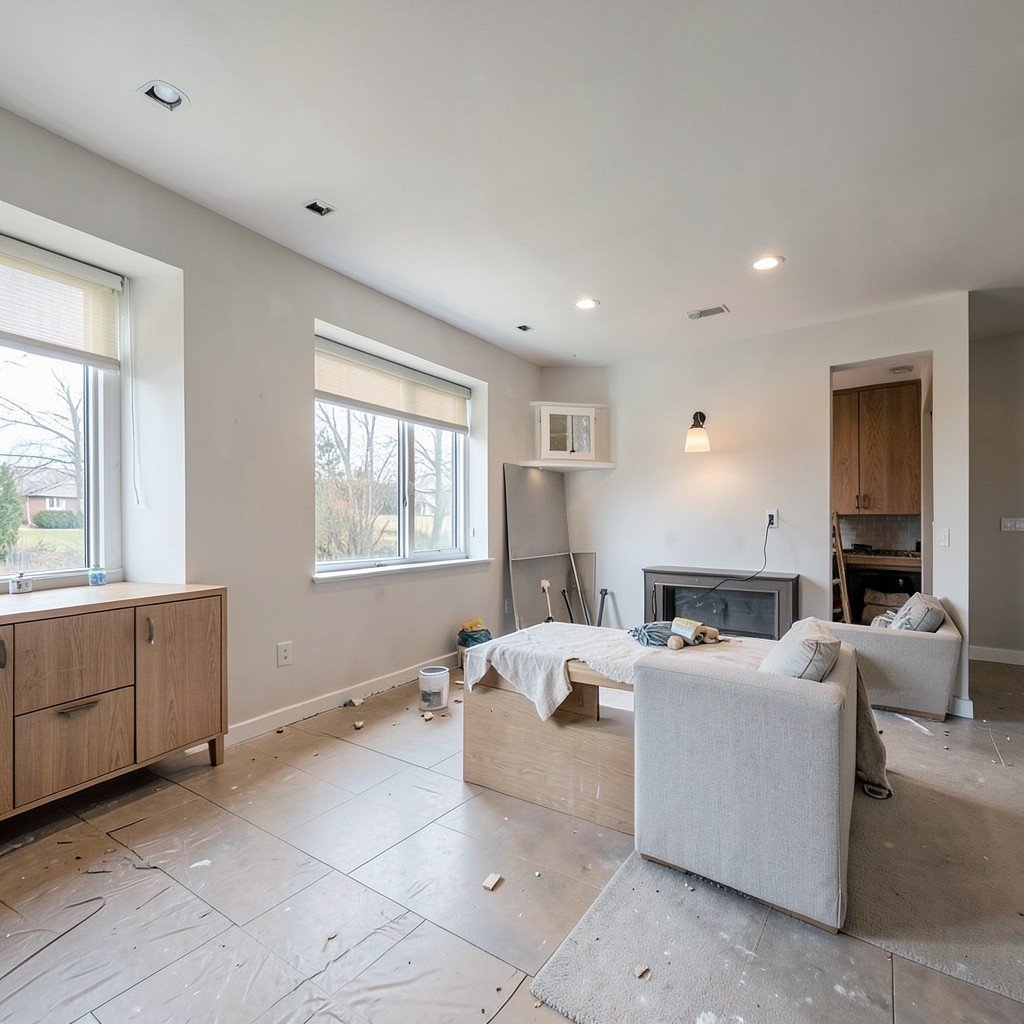
Set up a temporary kitchen. 62% of homeowners who stayed home during a remodel set up an alternative cooking area. A folding table, microwave, mini-fridge, and electric hot plate in the dining room or basement covers most daily meals. It's not comfortable, but it's functional for 4-6 weeks.
Telli, T&J's co-founder and master carpenter, has run occupied-home kitchen projects across Waukesha County for nearly a decade. His standard advice before demo starts: move your coffee maker, a microwave, and a mini-fridge into the dining room and test the setup for a weekend. If it's tolerable for two days, it'll be tolerable for five weeks. If it's not, you've learned that cheaply, before you've committed to a living arrangement.
Ask about dust containment. A zip-wall system (temporary plastic sheeting stretched across a zippered frame to seal off the work zone from the rest of the house) is standard practice on well-run jobs. Ask every contractor you interview whether they use one. If they look at you blankly, that's useful information.
Get the noise schedule in writing. Demo days are the loudest. Finish days, trim, paint, hardware, are quieter. Ask your contractor for daily start and stop times and which days will be the most disruptive. A contractor who can't give you that answer hasn't built a real schedule.
When staying is not viable: A full gut kitchen with no secondary cooking space, asbestos or lead abatement work, or a whole-home HVAC replacement are the situations where staying put genuinely doesn't work. If any of those apply to your project, budget for a move-out from the start.
The regret data supports staying when it's feasible. Only 16% of homeowners who stayed put reported regrets, compared to 23% who partially moved out.
Before demo starts, move your coffee maker, a few plates, and a microwave to a secondary room and test the setup for a weekend. If it's tolerable for two days, it'll be tolerable for five weeks. If it's not, you've learned that cheaply, before you've committed to a living arrangement.
What Your Contractor Quote Should Say About Displacement
This is the section that matters most if you're comparing bids right now. A complete scope addresses your living situation directly. A low-ball quote usually doesn't.
Here's what a thorough quote should include:
 Remodel - T&J
- A phasing plan. Which rooms get worked in what order, and which areas of your home remain livable during each phase. No phasing plan means no real project management.
- Dust containment spec. Whether zip-wall or another method, it should be named in the scope, not assumed.
- Daily work hours. Start time, stop time, and which days are scheduled for demo vs. finish work.
- Permit timeline. Permits should be pulled before demo starts, not after. A contractor who pulls permits after demo begins can stall the project for weeks while you're already displaced.
- A realistic project calendar. Not just a total duration number, but a week-by-week sequence you can hold them to.
What a low-ball quote often omits: project management overhead, phasing detail, permit costs, and subcontractor scheduling buffer. The result is a longer timeline, which directly increases your displacement cost. A quote that saves $3,000 on labor but adds three extra weeks to your timeline can cost $4,500 in housing and food. The math works against the cheap bid more often than homeowners expect.
Three questions to ask every contractor before you sign:
What is your phasing plan, and which areas of my home will be livable during each phase?
A vague answer means no real plan exists.
Do you pull permits before demo starts, or after?
Permits pulled after demo has begun can stall the project and extend your displacement.
Who is my single point of contact throughout the project, and how do you handle schedule changes?
A contractor who delegates communication to a rotating crew member is a timeline risk.
These questions work on any bid. They're not T&J-specific. But for what it's worth, John, T&J's co-founder and project manager, handles every project's communication directly from first walkthrough to final punch list. Not a junior PM. Not a crew lead. That's the standard you should expect from any contractor you hire.
For a broader look at our remodeling services in Waukesha County, including how we structure phasing for occupied homes, that page covers the full scope of what we offer.
Real Cost Scenarios: Stay, Partial Move-Out, or Full Move-Out
Here's what a 5-week kitchen remodel actually costs a typical Waukesha County household under each scenario.
Scenario A: Stay put
- Housing: $0
- Extra food costs: ~$400
- Storage: $0
- Total displacement cost: ~$400
- Trade-off: Requires a livable temporary kitchen setup and tolerance for noise and dust for 5 weeks.
Scenario B: Partial move-out (stay with local family)
- Housing: $0
- Food: ~$200
- Storage for kitchen items: ~$150
- Total displacement cost: ~$350-$500
- Trade-off: Only works if family is local. This scenario carries the highest regret rate of the three options at 23%.
Scenario C: Full move-out (extended-stay hotel or short-term rental)
- Housing: $2,500-$3,500 for 5 weeks - Food: ~$800
- Storage: ~$150
- Total displacement cost: ~$3,450-$4,450
- Trade-off: Most comfortable living situation, but adds meaningful cost to the project total.
The gap between Scenario A and Scenario C is $3,000-$4,000 for the same 5-week remodel. Use our home remodeling cost calculator to run your own numbers before your next contractor meeting.
Wisconsin-Specific Factors That Affect Your Decision
A few things about Wisconsin and Waukesha County specifically that don't show up in national remodeling guides.
Wisconsin winters. If your project involves exterior work, siding, additions, roofing, winter scheduling means indoor disruption during the coldest months. A January addition project in New Berlin or Brookfield is a different experience than the same project in May. Plan your move-out budget accordingly if your project has an exterior component.
Waukesha County permit timelines. Permits can add 1-3 weeks to a project start date depending on the municipality and the time of year. A contractor who pulls permits early keeps that window tight and minimizes your displacement window. Ask every contractor when they plan to pull permits relative to your project start date.
Short-term rental availability. The short-term rental market in Waukesha County is thinner than Milwaukee proper. If you're planning a full move-out, start looking for a rental as soon as you sign a contract, not the week before demo starts.
Wisconsin DSPS (Department of Safety and Professional Services) requires permits for structural, electrical, and plumbing work. Contractors who skip permits to move faster are creating a resale and insurance liability for you. Verify contractor credentials and permit requirements at dsps.wi.gov.
How to Get a Quote That Accounts for Your Living Situation
Tell every contractor upfront whether you plan to stay or move out. It affects phasing, dust containment spec, and daily work hours. A contractor who doesn't ask about your living situation during the quote walkthrough is not building a complete scope.
A thorough quote walkthrough looks like this: the contractor walks the space with you, asks about your household's daily schedule, identifies which rooms need to stay functional, and builds the phasing plan before the quote is written. The living situation isn't an afterthought. It's part of the scope.
 Remodel - T&J
That's the standard we hold ourselves to at T&J Remodeling. With 35+ years of combined remodeling experience and a track record of occupied-home projects across Waukesha County, we walk the space, ask about the household, and build the phasing plan before a number is written down. No surprises mid-project because the scope was built around how you actually live.
If you're ready to have that conversation, book a free Waukesha County consultation with T&J Remodeling. No cost, no obligation, no sales call. Just a clear look at what your project actually involves and what it will cost you to live through it.
Frequently asked questions
Do I have to move out during a kitchen remodel in Wisconsin?
Most homeowners don't. The Houzz 2026 Kitchen Trends Study found that 66% of homeowners stayed in their home during a kitchen remodel, and 62% of those set up a temporary cooking area. Whether you need to move out depends on the scope. A full gut remodel with no secondary cooking space is harder to live through than a cabinet-and-countertop refresh. The key question to ask your contractor is whether they can phase the work so at least one functional area remains livable at all times. A contractor who can't answer that question hasn't built a real project plan.
How much does temporary housing cost during a home remodel in Wisconsin?
Extended-stay hotels and short-term rentals in the Waukesha County area typically run $1,500-$4,000 per month depending on unit size and location. Add storage at $100-$200 per month and increased food costs of $600-$1,200 per month for a family eating out more. For a 5-week remodel, total displacement costs can reach $3,000-$5,000 or more before you account for the remodel invoice itself. A lower bid that extends the timeline by two weeks may not actually save you money once displacement costs are added back in.
Does moving out during a remodel reduce stress?
Not as much as you'd expect. The Houzz 2026 Kitchen Trends Study shows 88% of homeowners who moved out completely still reported some stress during their remodel, compared to 84% who stayed put. The difference is smaller than most people assume. Remodel stress comes primarily from uncertainty: unclear timelines, missed communication, and schedule slippage. Moving out removes the noise and dust from your daily life, but it doesn't fix a poorly managed project. The real stress reducer is a contractor with a clear project calendar and a single point of contact who handles every communication personally.
How long will a home remodel take in Wisconsin?
Timeline varies significantly by scope. Small kitchen or bathroom updates typically run 3-4 weeks; a custom kitchen renovation without structural work takes 4-6 weeks; a basement remodel runs 5-8 weeks; major additions can take 2-4 months. These are on-schedule estimates. Timeline overruns are common when permits are pulled late, subcontractors aren't pre-scheduled, or the scope wasn't fully defined at contract signing. Every extra week of displacement adds real money in housing, food, and storage costs, which is why timeline discipline is a financial issue, not just a convenience issue.
What questions should I ask a contractor about living in my home during a remodel?
Three questions that surface gaps in a contractor's scope: (1) What is your phasing plan, and which areas of my home will be livable during each phase? A vague answer means no real plan exists. (2) Do you pull permits before demo starts, or after? Permits pulled after demo has begun can stall the project and extend your displacement by weeks. (3) Who is my single point of contact throughout the project, and how do you handle schedule changes? A contractor who delegates communication to a rotating crew member is a timeline risk. These questions work on any bid and will quickly separate contractors who have built a real scope from those pricing off a gut feeling.
Is it cheaper to stay home or move out during a remodel?
Staying home is almost always cheaper in direct costs: $0 in housing versus $1,500-$4,000 per month for a rental. The trade-off is noise, dust, and limited access to your kitchen or bathroom. Moving out makes sense when the remodel affects your only bathroom, involves hazardous material abatement (lead, asbestos), or when the project is large enough that the household genuinely cannot function. For most single-room remodels in Waukesha County, staying put with a well-phased contractor is the financially rational choice.