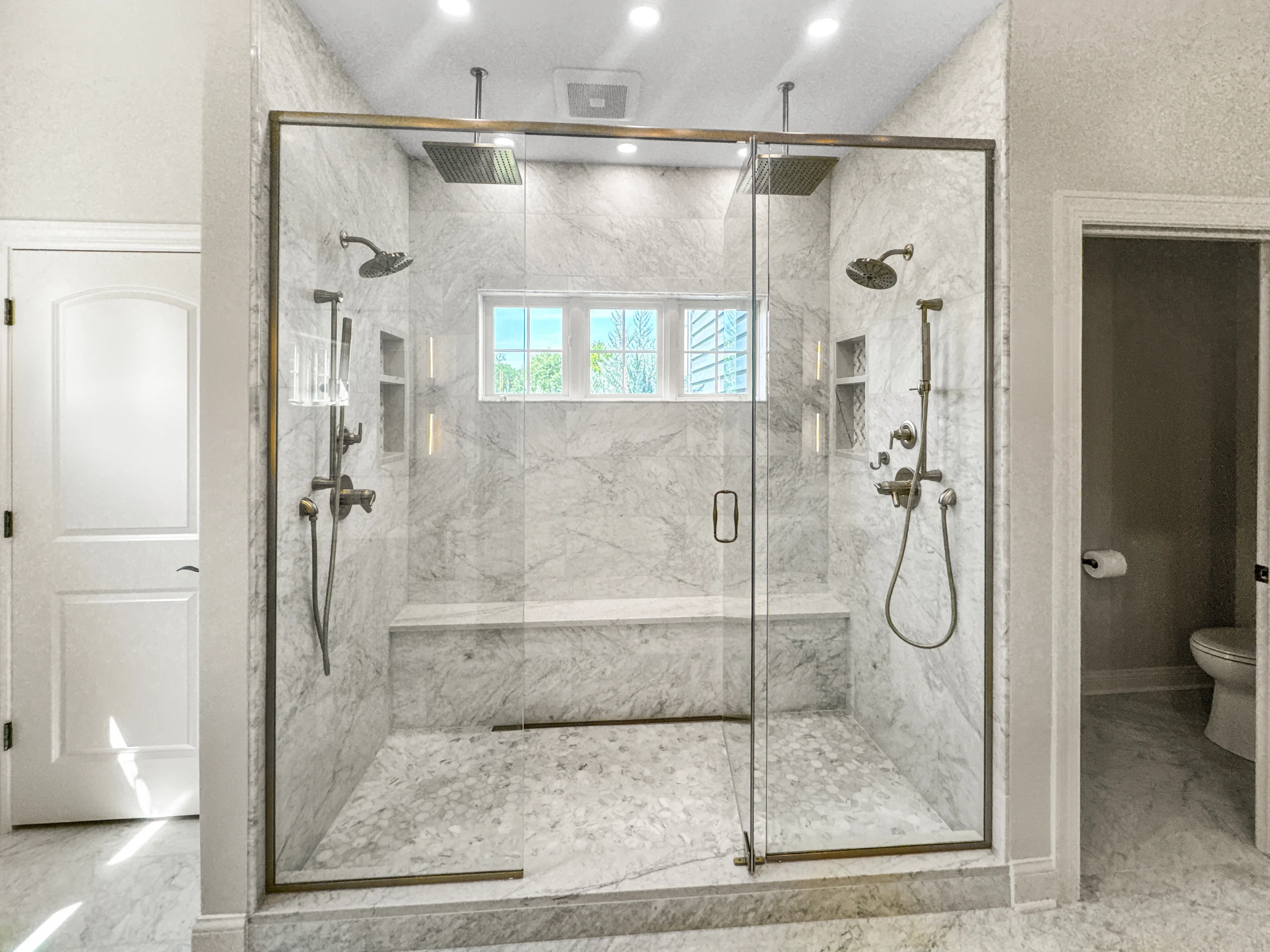
Kitchen project - T&J
What Wisconsin Homeowners Actually Pay in 2026
Wisconsin labor rates run slightly below Chicago-metro but above rural Midwest averages. That means national cost tools tend to understate what you'll pay in Waukesha or Brookfield, while Madison-market figures from higher-cost neighborhoods can overstate it.
The wide range exists because scope varies dramatically. Here's what that looks like in practice:
- A Brookfield homeowner in a 1970s colonial kept the layout intact, chose semi-custom cabinets, and upgraded to quartz countertops. Total: $52,000, mid-range, no surprises, finished in six weeks.
- A Hartland homeowner in a 1985 split-level moved the sink to center it under a new window, added an island, and installed mid-grade appliances. Total: $74,000, still mid-range, but the sink move added $4,200 in plumbing alone.
- A Waukesha homeowner in a 1958 ranch did a full layout reconfiguration with custom cabinetry and a wall removal. During a 2026 demo, we found knob-and-tube wiring running through the same wall cavity as the new plumbing, that added $3,200 in electrical remediation before the plumber could start. Final project: $118,000.
All three homeowners called it a "kitchen remodel." The scope made them three different projects.
If you want a personalized starting number before calling anyone, use our kitchen remodeling cost estimate calculator to build a rough baseline, then get a contractor walkthrough to validate it against your actual kitchen.
Cabinets represent 30-40% of a typical kitchen remodel budget, the single largest line item in almost every project.
What's Actually Included in Each Tier
Minor Refresh: $15,000-$30,000
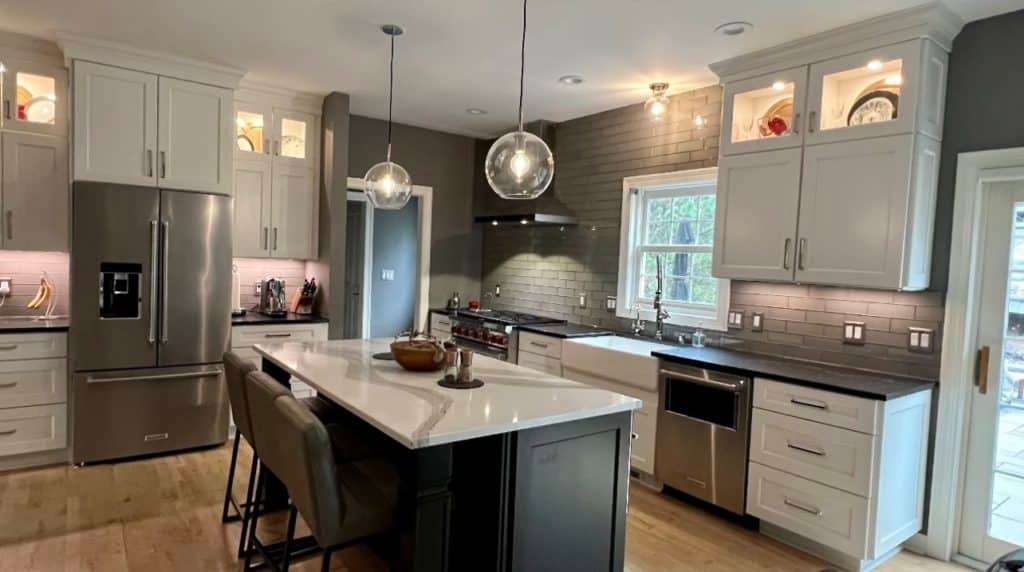
Cosmetic upgrades, no layout changes. Picture a 1970s Hartland ranch where the bones are solid but everything looks dated: new countertops, paint, hardware, a basic appliance swap, and a backsplash. Cabinet boxes stay, you might reface or paint the doors. No plumbing moves, no electrical panel work, no structural demo. The moment you move the sink or touch the panel, you've left this budget.
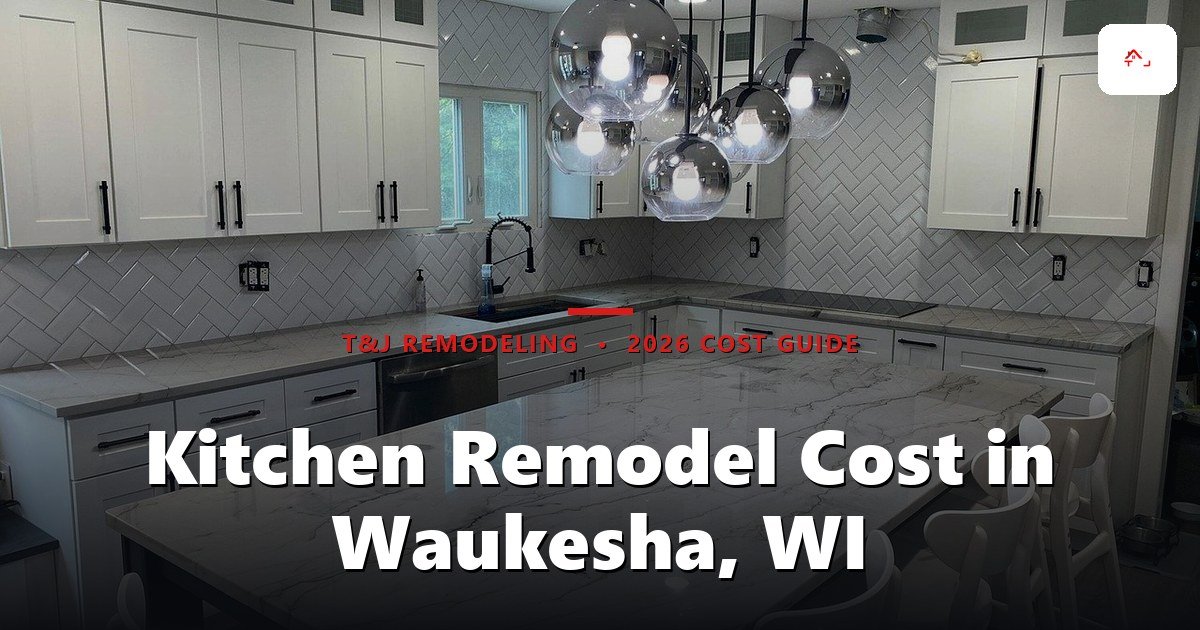
 Kitchen - T&J
Mid-Range Remodel: $35,000-$75,000
This is where most Waukesha County homeowners land when they want a real remodel. Semi-custom cabinets (factory-built with more size and finish options than stock, but without the lead time of full custom), quartz or granite countertops, mid-grade appliances, new LVP or tile flooring, updated lighting, and sometimes an island addition. Layout stays put, sink, range, and refrigerator stay on their existing walls. Electrical and plumbing get updated within current locations.
Want this priced for your kitchen?
John walks your space, measures it, and leaves a written itemized estimate. No cost, no obligation, no sales script.
Major / Luxury Remodel: $80,000-$150,000+
Custom cabinetry (built to exact measurements by a cabinet shop, not pulled from a manufacturer's catalog), premium stone countertops, professional-grade appliances, and a layout reconfiguration. This tier almost always involves moving at least one plumbing line, upgrading the electrical panel, and sometimes removing a load-bearing wall. In pre-1980 Waukesha County homes, discovery items, subfloor rot, knob-and-tube wiring, asbestos-containing floor tile, are most common here because demo goes deeper.
Cost Breakdown by Component: Where the Money Goes
Knowing where dollars go helps you make trade-offs, and catch quotes that are missing whole categories.
| Component | % of Budget | Typical Range (Mid-Range Project) |
|---|---|---|
| Cabinets & hardware | 30-40% | $18,000-$30,000 |
| Labor (demo, carpentry, tile, electrical, plumbing) | 20-35% | $12,000-$26,000 |
| Appliances & ventilation | 15-20% | $9,000-$15,000 |
| Countertops | 10-20% | $6,000-$15,000 |
| Flooring | 10-20% | $6,000-$15,000 |
| Lighting & electrical | 5-8% | $3,000-$6,000 |
| Permits & inspections | Fixed | $500-$1,500 |
| Design / project management | 5-10% | $3,000-$7,500 |
For a deeper look at cabinet costs broken out by type and finish level, see our guide on what cabinet replacement actually costs.
If a quote lists a "$2,000 countertop allowance" and you want quartz, that placeholder will not survive contact with a fabricator's invoice. Allowances are deferred decisions, every one is a potential change order waiting to happen. Ask your contractor to replace every allowance with a real product selection before you sign.
What Moves the Price Up, and What Keeps It Down
The single biggest cost lever in any kitchen remodel is whether you move the sink. Moving a sink means relocating the drain line, supply lines, and potentially the vent stack, that's $2,000-$6,000 in plumbing work before you've touched a cabinet.
Cost drivers that push the budget up:
- Moving plumbing or gas lines
- Upgrading an undersized electrical panel, common in Wisconsin homes built before 1980; per NEC 210.52(B), kitchen countertop receptacles require dedicated 20-amp circuits, which older panels often can't support without an upgrade
- Custom cabinetry over semi-custom
- Removing a load-bearing wall (requires engineering drawings and a structural permit)
- Professional-grade appliances vs. mid-grade
- Premium stone with complex edge profiles or waterfall details
- Discovery of subfloor rot or asbestos-containing floor tile during demo
Cost levers that keep the budget down:
- Keeping the layout exactly as-is, sink, range, and refrigerator stay on their walls
- Semi-custom cabinets instead of custom
- LVP flooring (luxury vinyl plank, a floating floor product that installs faster than tile and holds up well in kitchens) instead of ceramic tile
- Mid-grade appliance package
- Phasing the work: do cabinets and countertops now, upgrade appliances in 18 months when a sale hits
If your current layout is functional but dated, the best ROI move is almost always to keep the footprint and upgrade the finishes. A layout change that saves you 30 steps a day rarely pencils out at $4,000-$8,000 in added plumbing and electrical costs, especially if you're planning to sell within five years.
How to Read a Kitchen Remodel Quote, and Spot the Gaps
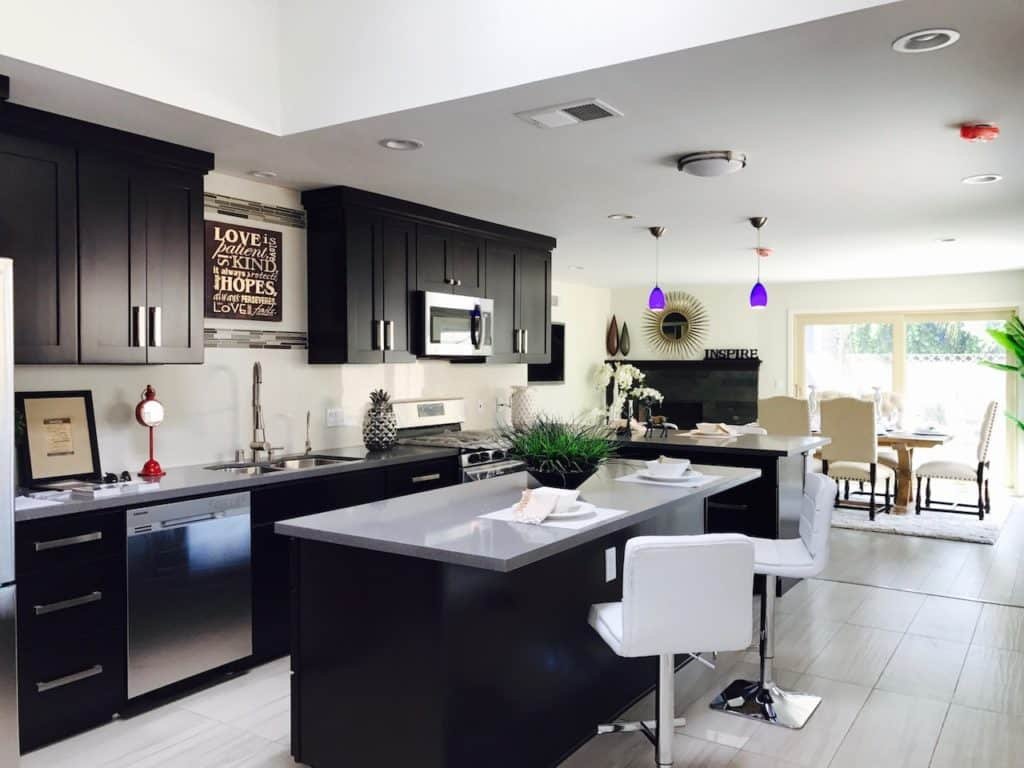
This section matters most if you're comparing bids right now. A complete kitchen remodel quote includes, as separate line items: materials by category (cabinets, countertops, flooring, fixtures), labor by trade (carpentry, plumbing, electrical, tile), permit fees, demo and haul-away, project management, and a written change-order policy. If any of those categories are absent, not zero-priced, but missing, the scope is incomplete.
A low bid that omits permits, haul-away, and project management isn't cheaper, it's incomplete. Those costs don't disappear; they show up as change orders when your kitchen is already torn apart and you have no leverage.
 Kitchen - T&J
On project management: John, T&J's co-founder, handles every client communication personally on every project, no hand-off to a junior coordinator. When you're comparing quotes, ask each contractor who specifically will be your contact from demo day through punch list. The answer tells you a lot about how the project will actually run.
A contractor who delivers a quote without a site visit is guessing. Subfloor condition, electrical panel age, and existing plumbing configuration can't be assessed from photos, and those unknowns are where budgets blow up.
Permits and Code in Wisconsin: What You Need to Know
Wisconsin's Uniform Dwelling Code (UDC), administered by the Wisconsin Department of Safety and Professional Services, governs residential construction statewide. Local municipalities, Brookfield, Waukesha, Hartland, Pewaukee, Elm Grove, issue the actual permits and conduct inspections.
For a kitchen remodel, permits are required for:
- Any electrical work beyond swapping a fixture
- Any plumbing change, including moving a drain or relocating supply lines
- Structural modifications: wall removal, beam installation, or any change to load-bearing elements
Permit costs in Waukesha County municipalities typically run $500-$1,500 depending on project scope and declared valuation. The City of Waukesha Building Inspection Division requires a permit for any kitchen work involving plumbing or electrical, budget 2-3 weeks for approval before demo can begin. Budget this as a fixed line item; it belongs in every quote you receive.
Skipping permits creates three specific problems: it can void your homeowner's insurance coverage for that work, it surfaces during a future home sale when a buyer's inspector or title company pulls the permit history, and it exposes you to liability if something fails. A contractor who tells you permits aren't needed on a full kitchen remodel involving electrical, plumbing, or structural work is a red flag, not a cost savings.
A credentialed Wisconsin contractor pulls permits as a standard part of the job. If a bid doesn't include permit fees as a line item, ask why, in writing.
Wisconsin Labor Rates and Timeline: What to Expect in 2026
In the Milwaukee/Waukesha metro, expect roughly $65-$110/hr for a general contractor or master carpenter, $90-$130/hr for a licensed electrician, and $95-$140/hr for a licensed plumber. These rates are baked into a complete quote, they shouldn't appear as surprises.
On timeline:
- Minor refresh (countertops, hardware, paint): 1-2 weeks of active construction
- Mid-range remodel (new cabinets, countertops, flooring, appliances): 4-8 weeks from demo to punch list - Major remodel with layout changes or structural work: 8-14 weeks
Add 4-8 weeks of lead time before the project even starts. Reputable contractors in the Waukesha and greater Milwaukee market book out, spring and summer fill fastest. If you're planning a summer remodel, the conversation needs to start in February or March.
Timeline overruns almost always trace back to coordination gaps between trades. Telli is on-site running every T&J build, not dispatching from an office. That's not incidental to the timeline; it's the reason projects stay on schedule.
Does a Kitchen Remodel Add Value in Wisconsin?
Mid-range kitchen remodels in Wisconsin recover roughly 60-75% of cost at resale, per the Remodeling Magazine Cost vs. Value Report. In Waukesha County's market, where buyers in Brookfield, Elm Grove, and Pewaukee consistently rank kitchens as a top priority, an updated kitchen shortens days on market and reduces negotiating room for buyers.
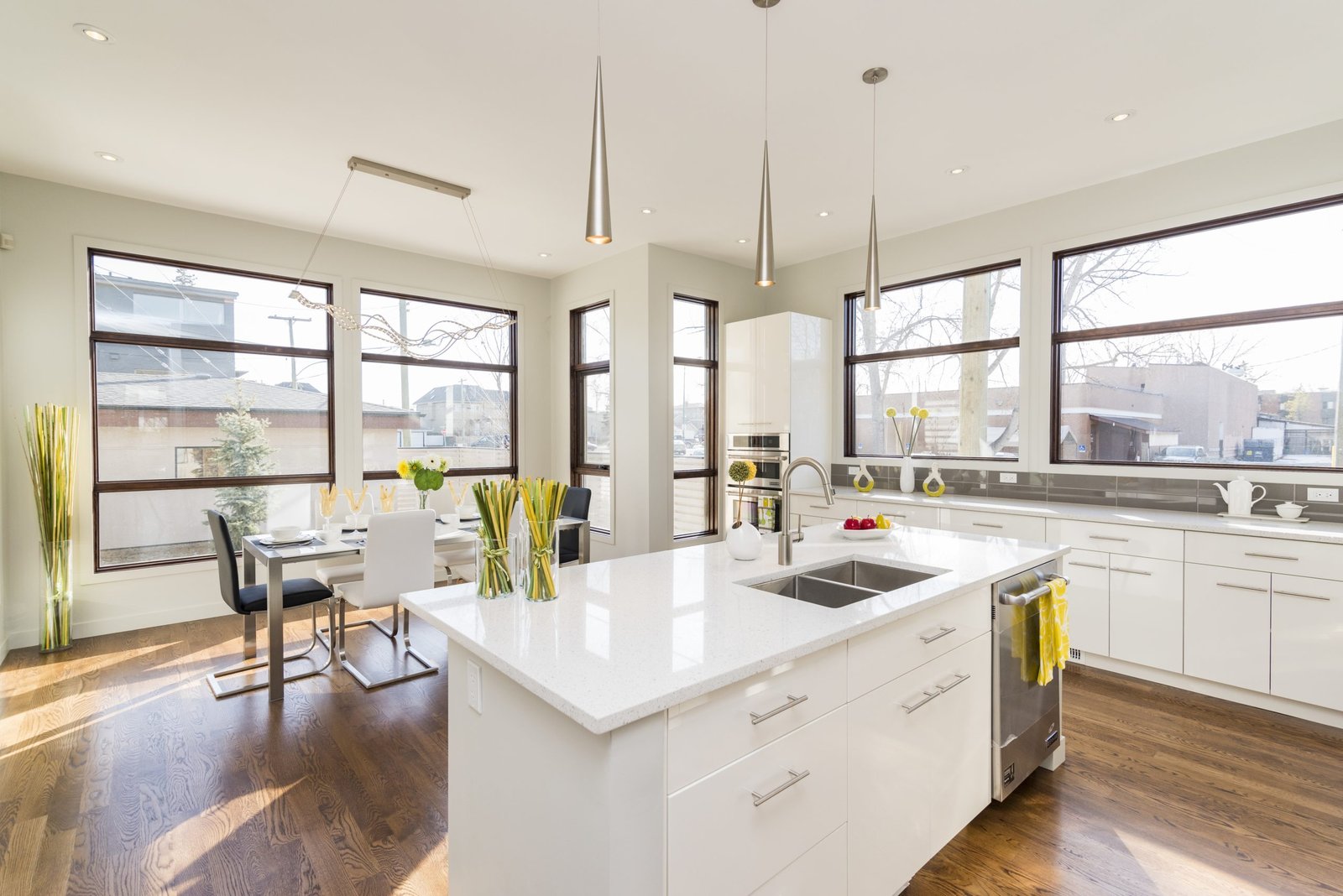
The ROI case is strongest when the remodel brings the kitchen in line with neighborhood comps. Over-improving beyond the neighborhood's price ceiling recovers less. For a full breakdown of what the numbers look like at resale, see our post on how much value a kitchen remodel adds at resale.
 Kitchen - T&J
Getting an Accurate Quote for Your Wisconsin Kitchen Remodel
Every number in this guide is a range for a reason: subfloor condition, electrical panel age, and existing plumbing configuration can't be assessed from photos or square footage. The only quote that's actually accurate is one that comes after a contractor walks your kitchen.
T&J offers a free in-home consultation, no cost, no obligation, no sales call. Use the kitchen remodeling cost estimate calculator to build a rough baseline before we meet, then we'll validate it against what your kitchen actually needs. For homeowners in the Brookfield area, learn more about our specific work in kitchen remodeling in Brookfield.
Ready to get a real number? Call (262) 352-9525 to schedule a free 30-minute kitchen walkthrough, we'll validate your scope and budget against your actual home, with no hand-off to a junior estimator. Credited contractor in Wisconsin. Family-owned. Owners on every project.
Frequently asked questions
What is the average cost of a kitchen remodel in Wisconsin in 2026?
In Wisconsin, a minor kitchen refresh runs $15,000-$30,000; a mid-range remodel with new cabinets, countertops, and appliances typically lands between $35,000 and $75,000; and a major or luxury remodel with layout changes and custom finishes runs $80,000-$150,000+. These are all-in numbers covering materials, labor, permits, and project management, not materials-only estimates. The single biggest cost variable is whether you change the kitchen layout, because moving plumbing and electrical adds thousands before any finish work begins. Keeping the layout intact is the fastest way to stay in the mid-range tier.
Why is one contractor's quote $20,000 lower than another's?
A $20,000 gap between quotes almost always means the scopes are different, not that one contractor is more efficient. Common omissions in low bids include permit fees, demo and haul-away, subfloor repair allowances, project management, and appliance installation. When you get three quotes, ask each contractor to confirm in writing that their price includes permits, haul-away, and a defined change-order process. If one bid uses "allowances" for materials you haven't selected yet, those placeholders will be replaced by real numbers, often higher, once you make selections. A complete quote is more expensive on paper and cheaper in reality; the low bid catches up through change orders once your kitchen is already torn apart and you have no leverage.
Do I need a permit for a kitchen remodel in Wisconsin?
In most cases, yes, especially if the project involves any electrical work, plumbing changes, or structural modifications. Wisconsin's Uniform Dwelling Code (UDC) requires permits for work that affects health, safety, and structural integrity. Local municipalities in Waukesha County, Brookfield, Hartland, Waukesha, Pewaukee, issue and inspect these permits. Skipping permits creates real problems: it can void your homeowner's insurance coverage for that work, trigger issues during a future home sale when a buyer's inspector pulls the permit history, and expose you to liability if something fails. A reputable, credentialed Wisconsin contractor pulls permits as a standard part of the job, not as an add-on. If a contractor suggests skipping permits on a project involving electrical or plumbing, that's a red flag, not a favor.
How long does a kitchen remodel take in Wisconsin?
A minor kitchen refresh, countertops, hardware, paint, can be done in 1-2 weeks. A mid-range remodel with new cabinets, countertops, flooring, and appliances typically runs 4-8 weeks from demo to punch list. A major remodel involving layout changes, structural work, or custom cabinetry can take 8-14 weeks. Add 4-8 weeks of lead time before the project even starts, reputable contractors in the Milwaukee/Waukesha market book out, especially in spring and summer. The most common cause of timeline overruns is coordination gaps between trades; a project with a single on-site owner who is physically running the build tends to stay tighter than one managed remotely.
What is the most expensive part of a kitchen remodel?
Cabinets consistently represent the largest single line item, typically 30-40% of the total budget. In a $60,000 mid-range remodel, that's $18,000-$24,000 in cabinets alone. The second-largest variable is labor, particularly if the project involves layout changes: moving a sink requires relocating drain lines, supply lines, and potentially the vent stack, which can add $2,000-$6,000 in plumbing costs alone. Appliances are the third major variable, the gap between a mid-grade appliance package and a professional-grade package can easily be $10,000-$20,000. If you need to control budget, cabinets are where the most meaningful trade-off lives: choosing semi-custom over custom can save $8,000-$15,000 on a mid-range project.
Should I move my sink during a kitchen remodel?
Only if the current location is truly dysfunctional. Moving a sink costs $2,000-$6,000 in plumbing alone, and that's before demo reveals anything unexpected in the wall cavity. In a 2026 remodel of a 1958 Waukesha ranch, we found knob-and-tube wiring running through the same wall as the new drain line, adding $3,200 in electrical remediation before the plumber could start. Moving the sink rarely delivers ROI unless you're also reconfiguring the entire layout for a specific functional reason, like converting a galley kitchen to an open plan. If the sink works where it is, leave it.
Can I save money by supplying my own appliances or materials?
Sometimes, but clarify this upfront with your contractor. Some contractors charge a higher installation fee for owner-supplied appliances because they can't warranty the equipment. Others are happy to install what you source. The real savings opportunity is in appliances (buying during sales events) and fixtures. Where owner-supplied materials tend to backfire: cabinets (delivery damage, missing pieces, and wrong sizing are common with big-box orders) and countertops (templating and fabrication need to be coordinated precisely with cabinet installation). Ask your contractor specifically: "What is your policy on owner-supplied materials, and does it affect my warranty?" Get the answer in writing before you order anything.
How do I know if a Wisconsin kitchen remodel contractor is legitimate?
In Wisconsin, contractors doing work that requires permits must be registered or certified with the state, ask for their credential and verify it through the Wisconsin DSPS credential lookup. Beyond that, look for: general liability insurance (ask for a certificate naming you as additionally insured), workers' compensation coverage for their crew, a written contract with a defined scope and change-order policy, and references from recent Wisconsin projects you can actually call. Red flags include: quotes delivered without a site visit, pressure to skip permits, no written contract, and payment structures that front-load cash before work begins. A contractor who pulls permits, carries insurance, and puts everything in writing is protecting you as much as themselves.