T And J All In Remodeling | Home Remodeling Waukesha & SE Wisconsin

Is $100,000 Enough to Renovate a Home? 2026 Budget Guide

Is $100,000 Enough to Renovate a Home? 2026 Budget Guide

35+ yrs combined|Father & son, on-site|WI Dwelling Contractor|Free in-home consultation

For a structurally sound 1,500-2,000 sq ft home in Waukesha County, $100,000 in 2026 is a serious renovation budget, enough to cover a mid-range kitchen remodel (~$40K-$50K), two bathrooms (~$15K-$20K each), and flooring plus paint (~$10K-$15K), assuming no major structural surprises. The moment foundation work or a full roof replacement enters the picture, that same $100K may only stretch to one or two of those rooms. The framework is simple: (1) Is the house structurally sound? (2) Which rooms deliver the most ROI? (3) Can you phase what doesn't fit?. Or call John at (262) 352-9525.

$40K-$50K
Project range
6-10 weeks
Timeline
$15,000-$75,000
Cost range
70% ROI
ROI

Calculate your kitchen and bathroom budget with our free cost estimator before you commit to scope.

The Short Answer: It Depends on Scope, Here's the Framework

Think of $100K as a budget with two modes. In cosmetic mode, kitchen, baths, flooring, paint, minor electrical and plumbing, it covers a meaningful whole-home refresh for a mid-size Wisconsin ranch or colonial with no structural surprises . In structural mode, foundation corrections, full roof replacement, joist reinforcement, it gets consumed fast, leaving little room for the livability upgrades most homeowners actually want .

Before you finalize any scope, get a structural inspection. This single step, typically a few hundred dollars, is the most important money you’ll spend before signing a remodeling contract. Hidden structural costs are the most common reason $100K budgets fall short.

Pro tip

Schedule your structural inspection before your contractor walkthrough, not after. If the inspector finds foundation or framing issues, you can adjust your scope conversation from the start, rather than discovering surprises during demo when change orders are most painful.

What $100,000 Actually Covers Room by Room

Kitchen

Kitchen remodels return approximately 96% at resale, the highest ROI of any single project . For a 1,500-2,000 sq ft home, a mid-range kitchen remodel (new cabinetry, quartz countertops, appliances, lighting, and tile backsplash without moving walls) can consume $40K-$50K of a $100K budget. A high-end gut renovation with custom cabinetry and premium appliances can exceed $100K by itself.

Scope discipline matters here more than anywhere else. A well-executed mid-range kitchen delivers nearly full ROI without blowing the budget on finishes that don’t come back at resale.

Watch out

Cabinet hardware is one of the fastest ways to overspend. At $300 per pull, a 30-cabinet kitchen adds $9,000 in hardware alone, money that rarely returns at resale in a mid-range Waukesha County neighborhood.

Bathrooms

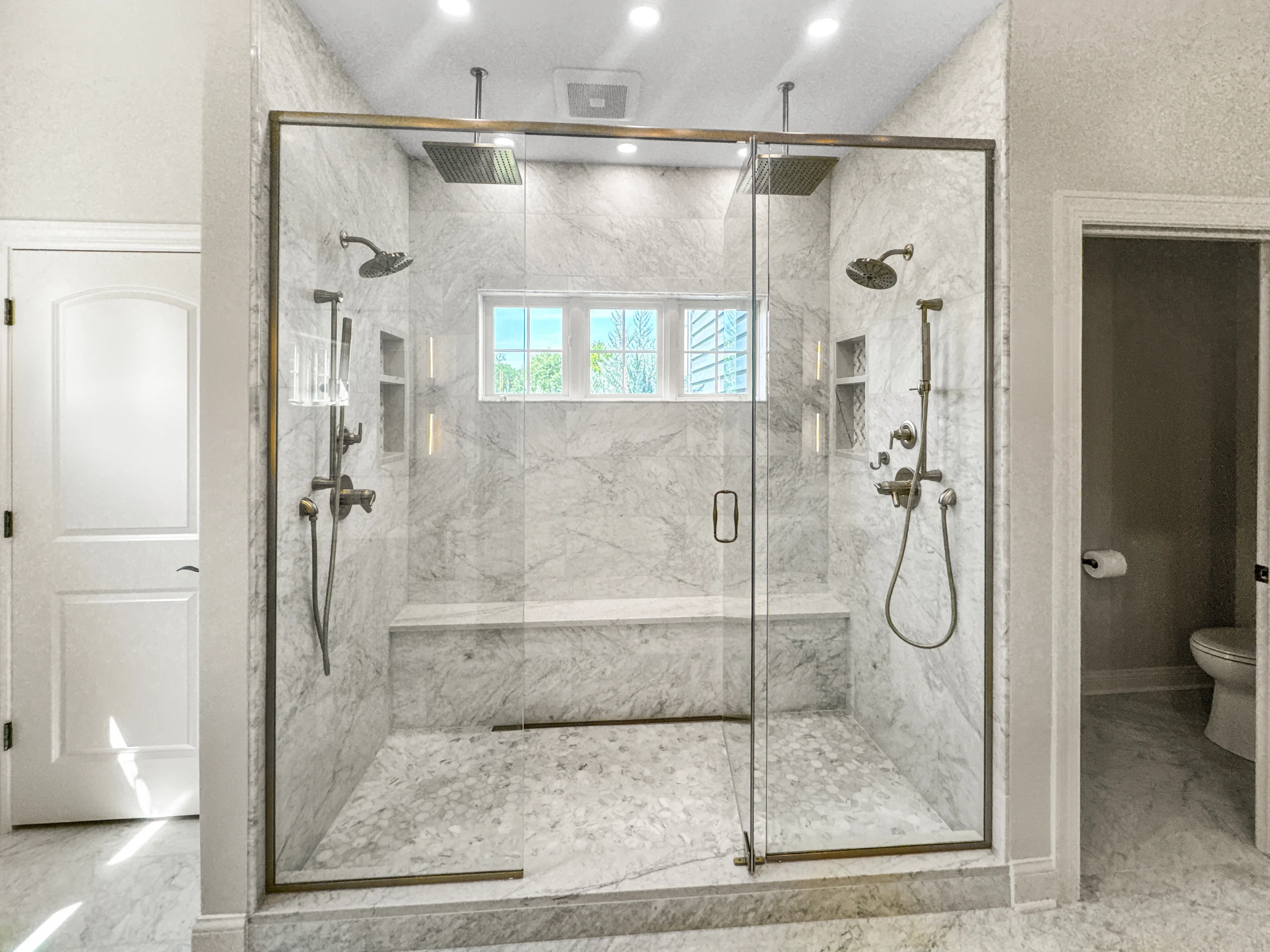
A single bathroom remodel returns around 70% ROI . A $100K budget can realistically cover a kitchen plus two bathrooms for a 1,500-2,000 sq ft home, but only if the structure is sound and finishes are mid-range . For a Brookfield colonial with a primary bath and a hall bath, plan the primary at $18K-$22K (walk-in tile shower, new vanity, updated plumbing fixtures) and the secondary at $12K-$15K. That leaves meaningful budget for flooring, paint, and electrical.

For a deeper look at what a bathroom renovation involves, see what a Waukesha County bathroom remodel actually costs.

Basement Finishing

Finishing a basement runs $15,000-$75,000 depending on scope . A basic egress-compliant finish with drywall, LVP flooring, and recessed lighting sits at the low end. A full build-out with a wet bar, bedroom suite, and full bathroom approaches the top. ROI runs around 70% , and the daily-use benefit is significant if you’re staying in the home long-term.

Code note

Wisconsin Residential Code § SPS 321.05 requires egress windows in any basement sleeping room, an egress window well installation adds cost but is non-negotiable for a legal bedroom. Confirm specific requirements with the City of Brookfield or your local Waukesha County municipality before finalizing basement scope.

Roof Replacement

New architectural shingles, the standard for Wisconsin’s freeze-thaw climate, run $12,000-$25,000 with an expected lifespan of around 30 years . Higher-quality materials like slate or metal run $60,000 or more . ROI lands at 48-57%, the lowest on this list, but a roof is a defensive spend. A failing roof flagged on a buyer’s inspection will reduce offers by more than the replacement cost.

Foundation and Structural Work

Foundation crack sealing, joist reinforcement, and wall corrections run $5,000-$20,000 depending on severity . Extensive foundation replacement on an older home can reach $100,000 on its own, consuming the entire budget before a single cosmetic upgrade happens.

This is the single biggest budget-killer in Wisconsin renovation projects. Always get a structural inspection before finalizing scope. The Wisconsin DSPS contractor certification database is a good starting point for verifying any structural contractor you bring in.

Flooring, Paint, Electrical, and Plumbing

These are the "glue" projects, individually modest, collectively transformative. Bundled into a whole-home refresh on a structurally sound 1,500-2,000 sq ft home, new LVP flooring, fresh paint, updated outlets, and replacing galvanized supply lines with PEX can fit within $100K alongside a kitchen and two bathrooms . They’re also the upgrades that make a home feel new without the sticker shock of structural work.

When a homeowner asks 'why does the quote vary so much,' the honest answer is scope. The cheapest bid is almost always the one that left the most off the sheet.

John, T&J co-founder · 14 yrs PM in Waukesha County

Where $100K Falls Short, and What to Do About It

$100,000 does not cover full structural remediation plus a full kitchen plus two baths simultaneously. It does not cover luxury finishes throughout, $300 cabinet pulls and custom tile in every room are how cosmetic budgets spiral past $100K without adding equivalent value. And it does not cover additions or major square footage expansions.

The solution is scope triage: rank projects by ROI, defer cosmetic upgrades that don’t come back at resale, and phase what doesn’t fit in Year 1. A homeowner who tries to do everything at once with a $100K budget usually ends up with a half-finished project or a change-order crisis.

We walk every client through scope prioritization before signing anything, so the phasing conversation happens at the estimate stage, not mid-demo when it’s expensive.

Phasing Your Renovation: Start Smart, Finish Strong

Phasing is not a compromise, for most Waukesha County homeowners, it’s the smarter financial move. For a Brookfield or Pewaukee homeowner on a 1,500-2,000 sq ft home, Year 1 kitchen plus Year 2 bathrooms is the most common phasing strategy we see. Here’s a concrete example:

  • Year 1: Kitchen remodel, highest ROI, highest daily impact, sets the visual tone for the rest of the home
  • Year 2: Primary bathroom + secondary bath, builds on the kitchen’s momentum, addresses the next-highest ROI projects
  • Year 3: Basement finishing or exterior work (roof, siding), longer-horizon projects with strong utility benefit

Phasing works financially for three reasons. First, borrowing $30K-$40K per phase instead of $100K at once means lower monthly payments and less total interest. Second, you rebuild equity between phases, a high-ROI kitchen remodel can increase your home’s value before you borrow for Phase 2. Third, each phase informs the next: a kitchen remodel may reveal plumbing that needs updating before the adjacent bathroom is tackled.

Timeline context: a full $100K renovation covering multiple rooms runs 3-6 months . A single-room project runs closer to 6-10 weeks . Phasing converts a 3-6 month disruption into manageable 6-10 week sprints with natural pause points.

Starting with the kitchen is often the highest-ROI first phase, and the one that makes every other room feel more intentional.

Financing $100,000: Monthly Payment Thinking

The lump sum is the wrong way to think about renovation financing. Think in monthly payments, because that’s what actually fits (or doesn’t) into a household budget. Three paths cover most Waukesha County homeowners:

1. HELOC (Home Equity Line of Credit) A HELOC, a revolving credit line secured against your home equity, is the most flexible option for phased projects. You draw what you need, when you need it, and pay interest only on what you’ve drawn during the draw period. Rates are variable; your lender will quote based on your equity position and credit profile. For a phased renovation, this is often the lowest-cost structure because you’re not paying interest on $100K when you’re only spending $35K-$40K in Year 1. The Consumer Financial Protection Bureau’s HELOC guide explains draw periods and rate structures in plain language.

We routinely phase projects so homeowners can budget around them.Talk phasing

2. Home Equity Loan A fixed-rate, lump-sum loan with a predictable monthly payment. Better for homeowners who want payment certainty and are doing the full renovation in one phase. The rate is set at closing, so you’re protected from rate increases, but you’re paying interest on the full amount from day one.

3. Personal / Unsecured Renovation Loan Higher interest rate, no equity required, faster approval. Best for newer homeowners who haven’t built enough equity to borrow against. The monthly payment on a $100K unsecured loan will be meaningfully higher than a HELOC or home equity loan at the same term, but it’s a real option when equity isn’t available.

The number

Borrowing $35K-$40K per phase instead of $100K at once can cut your monthly payment roughly in half, and gives you time to rebuild equity before the next draw.

For a deeper look at renovation financing options, including how to compare loan structures before you commit, that guide covers the mechanics in full.

Ready to talk through what your specific home needs? Call us at (262) 352-9525 for a free scope consultation, no obligation, no sales pitch.

ROI Reality Check: Which Projects Pay You Back

ROI in renovation means: for every dollar you spend, how many cents come back in added resale value? It is not a profit, it’s a partial recoup. The rest is the value of living in a better home while you’re there.

Project ROI Plain-English Translation
Kitchen remodel 96% A $40K kitchen adds ~$38,400 in resale value
Bathroom remodel 70% A $20K bath adds ~$14,000 in resale value
Basement finishing 70% A $40K basement adds ~$28,000 in resale value
Roof replacement 48-57% A $20K roof adds ~$9,600-$11,400 in resale value

If you plan to sell within 5 years, prioritize kitchen and bath, the ROI is strongest and buyers notice them immediately. If you’re staying 10+ years, basement finishing and structural work make more sense because you get the daily-use benefit for a decade before resale enters the picture.

The worst use of $100K for resale: over-investing in finishes that push your home above the neighborhood’s price ceiling. $300 cabinet pulls in a $250K neighborhood don’t come back at closing.

Budget Discipline: The 10-15% Contingency Rule

Industry standard is holding 10-15% of total project cost in reserve . On a $100K renovation, plan your active scope around $85,000-$90,000 and keep $10,000-$15,000 untouched until the project is complete.

Why? Older Wisconsin homes, especially the 1950s, 1970s ranch and colonial stock common in Brookfield, Pewaukee, and Menomonee Falls, frequently hide galvanized supply lines, knob-and-tube wiring, moisture damage behind bathroom tile, and inadequate insulation in exterior walls. None of these are visible until demo begins.

Want a real number for your kitchen, not a national average?See my number

A contractor who doesn’t raise the contingency conversation before you sign is a red flag. At T&J, John walks through what’s included, what could trigger a change order, and what the contingency should cover, before anyone picks up a demo hammer.

Working With a Contractor in Waukesha County: What to Expect

Labor rates, permit costs, and material availability in the Milwaukee metro area affect how far $100K stretches compared to national averages. The good news: Waukesha County is not a coastal market. A $100K budget here is a serious renovation budget, enough to do meaningful, high-ROI work on a mid-size home if scope is disciplined .

Permit timelines vary by municipality. Brookfield, Pewaukee, and the City of Waukesha each run their own building departments and inspection schedules, factor 2-4 weeks for permit approval into your project timeline before demo starts. The Wisconsin DSPS contractor certification page lets you verify any contractor’s credentials before you sign.

Collecting 2-3 quotes? We’d like to be one of them.Add us in

For what a full-service remodel looks like in Waukesha County, including how we handle permits, trade sequencing, and scope management, that page walks through our process end to end.

T&J is a father-son remodeling company based in Brookfield. John handles every project’s communication directly, not delegated to a junior project manager. If you call or email, you’re talking to the person who knows your project. Our free in-home consultation costs nothing and commits you to nothing. You’ll leave with a clear picture of what your $100K can realistically cover, and what to phase for later.

Frequently asked questions

Is $100K enough for a full kitchen and two bathrooms?

Yes, for a structurally sound 1,500-2,000 sq ft home with mid-range finishes, $100K can cover a kitchen remodel, two bathrooms, flooring, and paint. The key word is "structurally sound." If foundation work, a roof replacement, or major electrical upgrades are also needed, that same budget may only stretch to one room. A pre-renovation inspection tells you which mode you're in before you commit to scope.

What's the most common reason $100K renovation budgets fail?

Hidden structural issues discovered during demo, galvanized plumbing, knob-and-tube wiring, moisture damage, or inadequate framing, are the most common budget-killers in older Wisconsin homes. These costs are non-negotiable and non-deferrable, which is why holding a 10-15% contingency reserve is standard practice. A contractor who doesn't discuss contingency before you sign is a red flag, not a bargain.

Should I phase my renovation or do it all at once?

Phasing is usually the smarter financial move. Borrowing $35K-$40K per phase instead of $100K at once lowers your monthly payment, reduces total interest, and gives you time to rebuild equity between phases. It also lets each phase inform the next, a kitchen remodel may reveal plumbing issues that affect the adjacent bathroom scope. A typical structure: Year 1 kitchen, Year 2 bathrooms, Year 3 basement or exterior.

Why does foundation work consume so much of a renovation budget?

Foundation and structural repairs are labor-intensive, require licensed structural contractors, and can't be deferred or done in phases the way cosmetic work can. Crack sealing and joist reinforcement run $5,000-$20,000; full foundation replacement on an older home can reach $100,000. Unlike a kitchen remodel, structural work doesn't add visible value, it protects the value already there. That's why a structural inspection before finalizing scope is the single most important pre-renovation step.

How long does a $100,000 home renovation take?

A full $100K renovation covering multiple rooms typically runs 3-6 months depending on scope, permit timelines, and material lead times. Single-room projects, a kitchen or a bathroom, run closer to 6-10 weeks. In Wisconsin, winter scheduling can affect exterior work and material delivery, so start timing matters. The timeline is driven by trade sequencing: demo, rough plumbing and electrical, inspection, drywall, finish work, these run sequentially, not simultaneously.

How much contingency should I budget on top of $100,000?

Plan your active scope around $85,000-$90,000 and hold $10,000-$15,000 in reserve. Older Wisconsin homes, especially 1950s, 1970s ranches and colonials in Brookfield, Pewaukee, and Menomonee Falls, frequently hide surprises behind walls. The contingency buffer is what keeps a change order from becoming a financial crisis. That conversation should happen at the estimate stage, not mid-demo.
Get a real number for YOUR project

Cost ranges only get you so far. Tell us the room, scope, and zip — we’ll send back an honest estimate within one business day.

Estimates: open this week. New project starts are typically 4-6 weeks out, so the earlier we walk your space, the more flexibility you have on a start date.

35+ yrs combinedFather & son, on-siteWI Dwelling ContractorFree in-home consultation

Share the Post :

Facebook
Twitter
LinkedIn
Pinterest

More Posts

Send Us A Message