The Short Answer: Yes, Here's How Much to Expect
Finishing a basement converts unfinished square footage into conditioned living space. Wisconsin assessors treat that conversion as an increase in your property's assessed value, which flows directly into your annual tax bill.
Regional contractor pricing data shows that a $30,000 basement finish on a $350,000 home could add roughly $15,000 to $25,000 to assessed value. To put that in concrete terms: Waukesha County municipalities carry combined mill rates that vary by municipality and school district. The Wisconsin Department of Revenue's 2026 Statement of Assessment data shows combined mill rates across Waukesha County municipalities generally ranging from approximately $16 to $22 per $1,000 of assessed value, depending on the specific city or village and its overlying school district. Applied to a $20,000 assessed-value increase at a $20 mill rate, the annual tax increase works out to roughly $400 per year. That is an estimate, not a guarantee. Your actual number depends on your assessor's final valuation and your municipality's levy decision.
The Wisconsin Department of Revenue's Guide for Property Owners explains the full assessment process and your rights as a property owner.
A $30,000 basement finish on a mid-range Waukesha County home could add $15,000-$25,000 to assessed value.
How Wisconsin Assessors Value a Finished Basement
Consider a typical 1960s Brookfield ranch with a full, unfinished basement. Right now that basement carries storage and utility value only. The assessor's records show concrete walls, a furnace, and a water heater. The moment you add drywall taping and mud, flooring, recessed lighting, and HVAC distribution, that space becomes conditioned living area, and the assessor reclassifies it accordingly.
The assessment pipeline works like this. Your assessor assigns value based on property characteristics recorded in the municipality's database. An unfinished basement contributes modestly to overall value. A finished basement with drywall, flooring, lighting, and HVAC registers as livable square footage added to the home's gross living area (the total conditioned space used to calculate market value). That reclassification is what drives the assessed-value increase.
 Basement - T&J
Want this priced for your basement?
John walks your space, measures it, and leaves a written itemized estimate. No cost, no obligation, no sales script.
Two additions push the number higher than a basic finish. First, adding a conforming bedroom requires a code-compliant egress window (an egress window is an opening sized and positioned so an occupant can escape in an emergency, meeting minimum width, height, and sill-height requirements under Wisconsin building code). The assessor recognizes that window as evidence of a true bedroom, which carries a higher value classification than generic finished space. Second, adding a full bathroom involves plumbing rough-in and permanent fixtures, which is one of the highest-value additions in any room of the house.
The City of Milton, WI assessor FAQ confirms that Wisconsin assessors value improvements based on actual construction quality and permanence (Frequently Asked Questions). Substantial, permanent improvements add assessed value. Cosmetic or removable items add far less. An in-ground pool, for example, adds value at about 35% of its actual installation cost, while an above-ground pool adds nothing to assessed value at all (Frequently Asked Questions). A site-built wood shed with a foundation adds value; a metal or PVC shed does not (Frequently Asked Questions). The same permanence principle applies to basement finishes.
Wis. Stat. 66.0602: What the Levy Limit Law Actually Means for You
Most search results on this topic are written for homeowners in other states. They miss the mechanism that actually governs your Wisconsin tax bill. Wis. Stat. 66.0602 caps how much a municipality or county can grow its total tax levy each year.
The cap is tied to the "valuation factor," which equals the percentage increase in equalized value (the Wisconsin Department of Revenue's estimate of full market value across all properties in a municipality) attributable to net new construction. The floor on that factor is zero, not any positive percentage. Municipalities cannot grow their levy simply because home values rose across the board. A prior version of the law had a 3% floor; that floor no longer exists.
What this means for your basement finish: your individual assessed value goes up, but the total levy pot does not automatically expand. If the total levy stays flat, your neighbors effectively pay a slightly smaller share and you pay a slightly larger one, because your property now represents a bigger slice of the total assessed value in the municipality. Your taxes go up. Your neighbor's edge down a hair. The pie does not get bigger; the slices shift.
This is the nuance that out-of-state articles miss entirely. Your tax increase comes from your larger share of a levy that is itself constrained by state law, not from an uncapped municipal revenue grab.
Wis. Stat. 66.0602 sets the levy-limit floor at zero. Municipalities cannot grow their total levy simply because home values rose. Growth is tied only to net new construction equalized value. School district levies operate under separate per-pupil revenue limits and are not covered by this statute.
For the authoritative text, the Wisconsin Legislature's online statutes publish Wis. Stat. 66.0602 in full.
Does Pulling a Permit Automatically Trigger a Reassessment?
This is the question most DIY-curious homeowners are really asking: if I pull a permit, do my taxes go up the next day?
No. Pulling a permit notifies the assessor, who will update your property record, but most Wisconsin municipalities run annual assessment cycles. The Wisconsin Department of Revenue's property assessment guidelines require assessors to reflect improvements as of January 1 of the assessment year. A basement finished in October will typically appear in the following January's assessment, with the tax impact showing up in the bill issued later that year.
The more important point: skipping the permit does not protect you. Assessors conduct periodic drive-by and aerial inspections, and they cross-reference permit records with visible property changes. When you sell, the buyer's inspector will flag unpermitted finished space, and the lender may not appraise it as livable square footage. In some cases, the municipality can require you to open walls to verify code compliance before issuing a retroactive permit. The short-term tax savings from skipping a permit rarely outweigh the long-term risk.
For the broader permit consequences in Wisconsin, the Wisconsin basement bedroom egress requirements article covers what happens when unpermitted bedroom space is discovered at sale.
Unpermitted finished basement space discovered at sale can trigger back-assessment, lender appraisal complications, and a requirement to open walls for inspection. The short-term tax savings are not worth the long-term exposure.
What Adds the Most Assessed Value in a Basement Finish
Not all basement work is valued equally. Here is how the major scope items rank by assessed-value impact, from highest to lowest.
Full bathroom addition. Plumbing rough-in, fixtures, tile, and a finished surround represent one of the highest-value additions in any room of the house. The assessor sees permanent plumbing infrastructure, not cosmetic work. For a detailed look at what that scope costs, see the basement bathroom addition cost in Wisconsin guide.
 Basement - T&J
Conforming bedroom with egress window. A basement bedroom requires a code-compliant egress window plus proper ceiling height to count as a bedroom for assessment purposes. Without the egress window, the assessor classifies the space as a den or bonus room, which carries a lower value classification.
Full living space finish. Drywall, flooring, HVAC distribution, and recessed lighting convert raw square footage into conditioned living area. This is the baseline finish that moves the needle on assessed value.
Partial finish. One finished room with no bath and no bedroom adds the least assessed value. It still adds something, but the assessor's multiplier is lower.
The permanence principle runs through all of these. Permanent, structural, and substantial improvements are what assessors recognize (Frequently Asked Questions).
Call your local assessor's office before you finalize your basement design. Give them the scope (finish only, finish plus bath, finish plus bedroom) and ask for a rough assessed-value estimate. Most Wisconsin assessors will give you a ballpark over the phone. That call takes ten minutes and sharpens your ROI math before you spend a dollar.
The Real Math: Estimating Your Tax Increase Before You Start
You do not need to wait for the assessor's letter to get a ballpark. Here is the three-step calculation framework.
Step 1: Estimate the assessed value increase. Regional contractor pricing data suggests a $30,000 basement finish on a mid-range Waukesha County home could add $15,000 to $25,000 to assessed value. Add a bathroom and the number moves toward the top of that range or beyond it. A basic finish with no plumbing sits closer to the bottom.
Step 2: Find your municipality's mill rate. Waukesha County municipalities publish their mill rates annually. The Waukesha County Treasurer's office lists current rates by municipality. Your most recent tax bill also shows the combined mill rate, which includes municipal, county, school district, and other levies.
Step 3: Run the formula. Assessed value increase multiplied by mill rate, divided by 1,000, equals your estimated annual tax increase.
Example: a $20,000 assessed-value increase at a combined mill rate of $20 per $1,000 produces an estimated $400 annual tax increase. At $18 per $1,000, the same increase produces $360 per year. At $22 per $1,000, it produces $440. The formula is the same; the inputs differ by municipality and scope.
Remember: this is an estimate. The actual impact depends on the assessor's final valuation and the municipality's levy decision under Wis. Stat. 66.0602.
Is the Tax Increase Worth It? ROI on a Finished Basement in Wisconsin
The tax increase is a cost of ownership, not a penalty. You pay more because your home is worth more.
Basement renovation ROI data from comparable regional markets shows a 70 to 80 percent return on investment. Wisconsin market conditions differ, so treat that as a directional benchmark rather than a guarantee. The core logic holds: a finished basement typically adds more to resale value than it costs in annual taxes over a reasonable holding period.
For most Waukesha County homeowners, especially those adding a bedroom or bathroom, the math favors finishing. But the answer depends on finish quality, the specific additions you make, and local market demand for finished basement space.
For the full cost picture before you model your ROI, see the basement finishing cost in Waukesha County guide.
Wisconsin does not have an equivalent to the Illinois Home Improvement Exemption, which shields up to $75,000 of assessed value increase for four years. In Wisconsin, improvements are assessed at their added value without any temporary exemption period. If your research is surfacing Illinois results, that information does not apply to your Wisconsin property.
What to Do Before You Start Your Basement Finish in Waukesha County
Here is a practical checklist before you break ground.
Call your local assessor's office.
Ask how finished basement space is valued in your municipality. They will tell you. This is a free call that grounds your ROI math in local reality.
Pull the permit.
It ensures the work meets code and gives you legal, insurable living space.
Understand egress requirements before you design a bedroom.
A basement bedroom without a conforming egress window is not a bedroom in the assessor's classification or the buyer's inspector's eyes.
Get a realistic cost estimate so you can model the ROI.
Know what the finish actually costs before you calculate whether the tax increase is worth it.
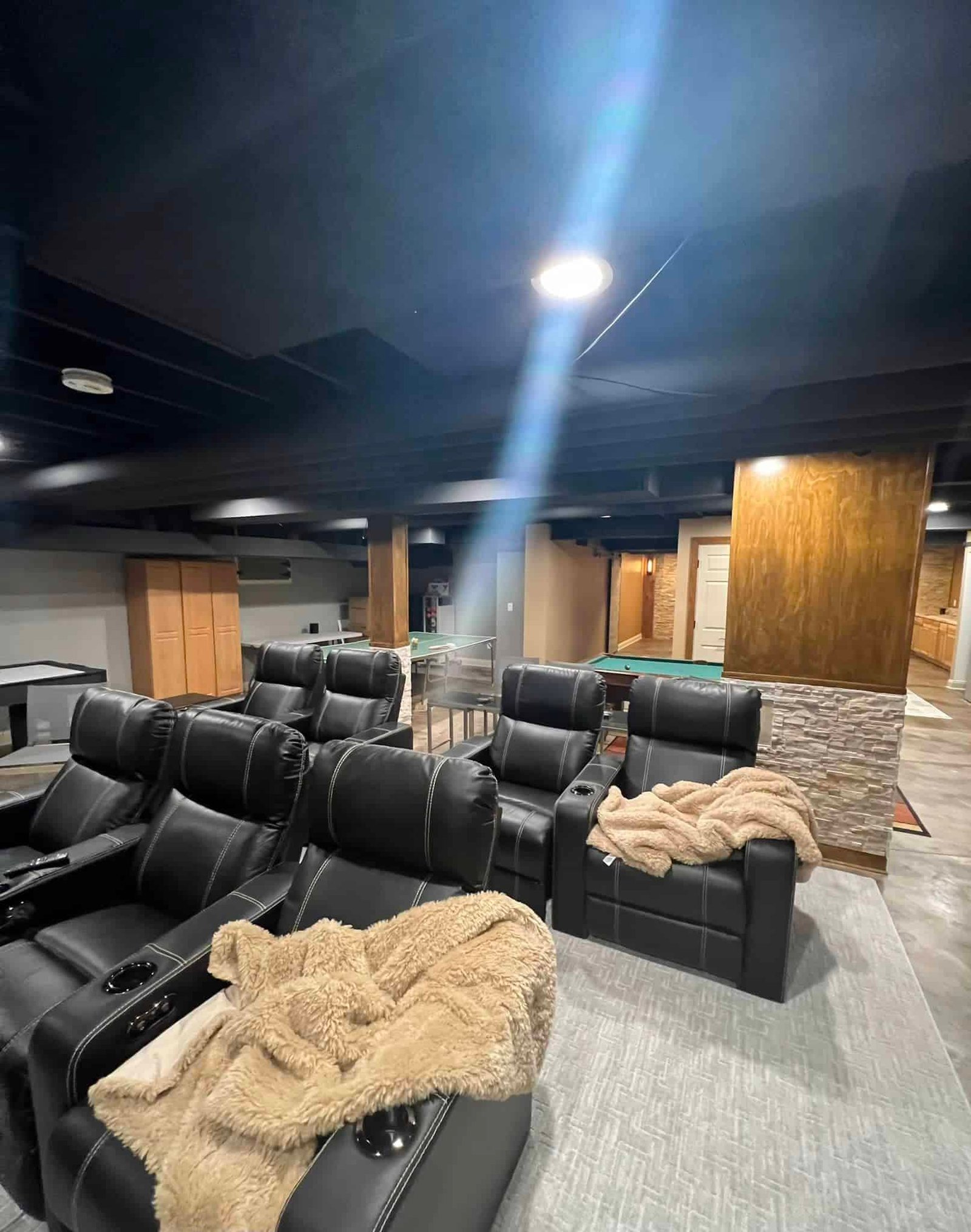 Basement - T&J
T&J's basement remodeling in Waukesha County service covers permit-pulling through final trim. John handles every project communication directly, so you always know where your project stands.
When you're ready to get a number you can plan around, book a free Waukesha County consultation with T&J. No obligation, no sales pressure. Just a straight conversation about what your basement finish should cost and what it will add to your home.
Frequently asked questions
How much will my property taxes go up if I finish my basement in Wisconsin?
There is no flat answer, because two variables drive the result: how much assessed value the finish adds and your municipality's mill rate. Regional contractor pricing data suggests a $30,000 basement finish on a mid-range home could add $15,000 to $25,000 to assessed value. Multiply that increase by your local mill rate (divided by 1,000) to estimate the annual impact. Your local assessor's office will give you a ballpark estimate before you start, and that call is free.
Does a finished basement always increase my property taxes in Wisconsin?
In practice, yes, if the finish is permanent and substantial. Wisconsin assessors classify finished basement space with drywall, flooring, HVAC, and lighting as conditioned living area, which raises your home's assessed value. The only scenario where taxes might not increase is if your municipality's total levy decreases at the same time your assessed value rises, which is uncommon. The more realistic outcome is a modest annual increase tied to your larger share of the levy.
Does pulling a basement permit automatically raise my property taxes?
Pulling a permit notifies the assessor, who will update your property record, but it does not mean your taxes go up the day the permit is issued. Most Wisconsin municipalities update assessments annually, with changes reflected as of January 1. The tax impact typically appears in the bill for the year following the completed improvement. Skipping the permit does not protect you. Assessors conduct periodic inspections, and unpermitted finished space discovered at sale can trigger back-assessment, penalties, and lender complications.
What does Wis. Stat. 66.0602 mean for my property tax bill after a remodel?
Wis. Stat. 66.0602 caps how much a municipality or county can grow its total tax levy. The cap is tied to the percentage increase in equalized value from net new construction, and the floor is zero. The total levy pot does not automatically balloon just because your basement is worth more. However, your individual share of that levy increases relative to neighbors who did not improve their homes, even if the total levy stays flat. School district levies operate under separate per-pupil revenue limits and are not covered by this statute.
Does adding a bedroom or bathroom raise taxes more than a basic finish?
Yes, significantly. A basic finish adds conditioned square footage, which raises assessed value modestly. Adding a conforming bedroom requires a code-compliant egress window, which the assessor recognizes as a true bedroom, a higher-value classification than generic finished space. Adding a full bathroom involves plumbing rough-in and permanent fixtures, which is one of the highest-value additions in any room of the house. The more your basement resembles above-grade living space, the more the assessor will value it like above-grade living space.
Can I appeal my assessed value after a basement finish?
Yes. Wisconsin homeowners have the right to appeal their assessed value through the local Board of Review, which meets annually. If you believe the assessor overvalued your finished basement, you can present evidence, such as comparable sales of similar homes in your municipality, to support a lower valuation. Appeals must typically be filed within a specific window after the assessment notice is mailed, so check your municipality's deadline. Winning an appeal does not eliminate the tax increase; it reduces the assessed-value basis from which the increase is calculated.
What if I sell my home within two years of finishing the basement?
Finished basement space adds to your home's appraised value at sale, which typically supports a higher sale price. The tax increase you paid in the interim is a cost of ownership, similar to higher insurance on a more valuable home. The risk runs the other way: if the finish was unpermitted, the buyer's inspector will flag it, and the lender may not appraise it as livable square footage. That can reduce the appraised value, complicate financing, or require you to retroactively permit and potentially open walls. Permitted, code-compliant work protects both your tax basis and your sale price.
Is there a Wisconsin property tax exemption for home improvements like there is in Illinois?
No. Wisconsin does not have an equivalent to the Illinois Home Improvement Exemption, which shields up to $75,000 of assessed value increase for four years. In Wisconsin, improvements are assessed at their added value without a temporary exemption period. The levy-limit rules under Wis. Stat. 66.0602 provide some indirect constraint on how much municipalities can grow their total levy, but there is no homeowner-level exemption for remodeling work. If your research is surfacing Illinois results, that information does not apply to your Wisconsin property.