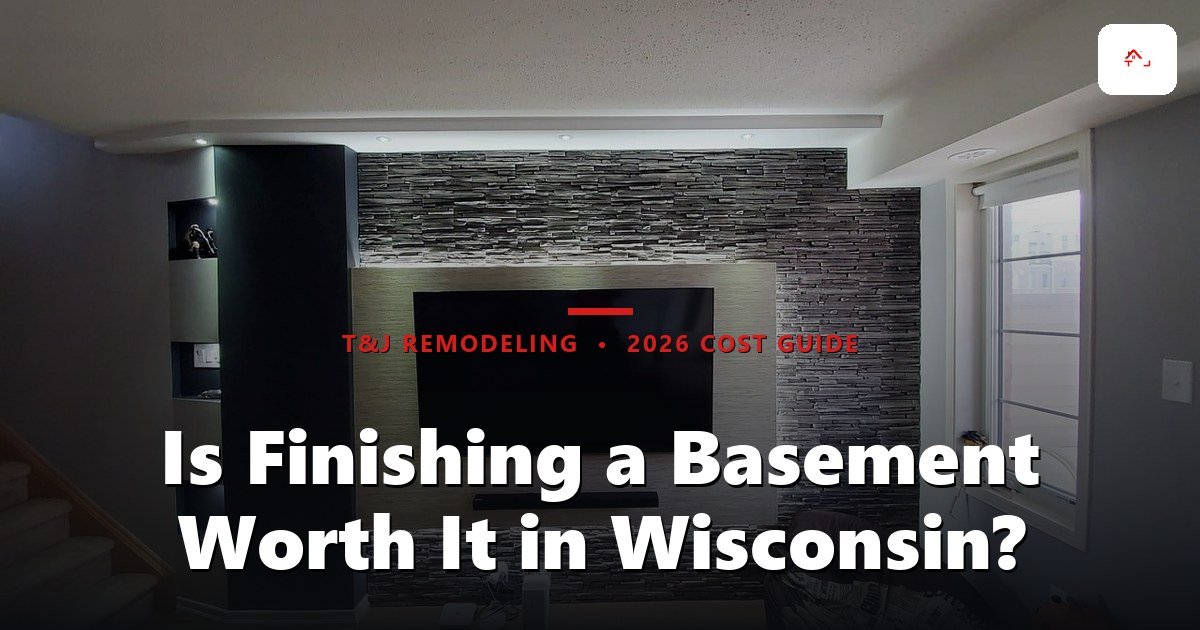
 Basement project - T&J
The Short Answer: 6 Things Wisconsin Requires
An appraiser or building inspector looks for all six of the following before classifying a basement as finished:
Finished walls
, drywall, taped and painted; not painted concrete block
Finished floors
, carpet, LVP, tile, or engineered hardwood; bare or painted concrete does not qualify
Finished ceiling
, drywalled or a drop-ceiling tile system; no exposed joists, beams, or pipes
Permanent HVAC
, a continuously powered heating and cooling system; space heaters and window AC units do not qualify
Electrical service
, code-compliant outlets, lighting, and GFCI protection near moisture sources
Permanent interior stairway
, the basement must be accessible from inside the home; ladder access does not count Every item is enforced at permit inspection and again at appraisal. These are not a contractor's opinion, they are the standard under Wisconsin's Uniform Dwelling Code (UDC SPS 321).
Ceiling Height: The Rule Most Homeowners Get Wrong
Wisconsin UDC SPS 321 sets a minimum of 7 feet of clear ceiling height for a habitable finished basement. The full range for finished basements runs 7 to 10 feet.
That 7-foot measurement is taken to the finished ceiling surface, not to the raw joists above. If you fur down and drywall the ceiling, you lose roughly 2 inches to framing and drywall. A basement with 7'2" to the joist may barely clear the minimum, with no room for error.
 Basement - T&J
Want this priced for your basement?
John walks your space, measures it, and leaves a written itemized estimate. No cost, no obligation, no sales script.
Beams, ducts, and pipes that drop below 7 feet create a code problem even if the surrounding ceiling clears it. You can sometimes box them in, but that changes your layout.
Before you buy a single sheet of drywall, measure your joist height at the lowest point, usually near a beam or duct run. If you're under 7'4" to the joist, talk to a contractor before you commit to a ceiling plan. Drywall that fails inspection after it's up is an expensive lesson.
This is one of the first things we check on a site visit, and it's one of the most common reasons a DIY plan gets redesigned before a board is cut.
Walls, Floors, and Ceilings: What 'Finished' Actually Means
Think of these three surfaces as a single pass/fail test. All three have to clear the bar.
Walls: Drywall is required, taped, mudded, and painted. Painted concrete block does not qualify. The wall finish must be a permanent, installed surface.
Floors: The floor must be completely covered with an installed floor covering, carpet, luxury vinyl plank (LVP), ceramic tile, or engineered hardwood all qualify. Painted concrete does not. Bare plywood subfloor does not.
Ceiling: Drywalled ceilings qualify. Drop-ceiling tile systems (a suspended grid with acoustic tiles) qualify in most Wisconsin jurisdictions. Exposed joists, pipes, or beams do not.
A basement where fewer than 50% of walls and ceilings have an installed finish is classified as partially finished, it does not count as finished square footage on an appraisal. This catches Wisconsin homeowners off guard constantly. A previous owner drywalls two walls, leaves two as painted block, lays carpet, and calls it done. The appraiser disagrees. The space gets logged as partially finished, and the listing price reflects it.
If you're going to finish the basement, finish it. A half-finished basement is the worst outcome for resale.
HVAC and Electrical: The Two Systems That Require Permits
These are the two systems where DIY ambition most often meets a permit inspector, and loses.
HVAC: A finished basement requires a permanently installed heating and cooling unit with a continuous power source, electricity, natural gas, permanently installed propane, or heating oil. Window AC units and portable space heaters do not qualify. In most Waukesha County homes, this means extending the existing forced-air system or installing a ductless mini-split (a wall-mounted unit connected to an outdoor compressor).
Electrical: Code-compliant outlets, lighting circuits, and GFCI protection near any moisture source are required. Both systems require a permit under UDC SPS 321.
Pulling your own electrical permit in Wisconsin is possible as a homeowner on your primary residence. But the work still has to pass inspection. A failed rough-in means rework before the drywall goes up, and rough-in mistakes in electrical and HVAC are the most common reason DIY basement projects stall or get red-tagged.
For more on how Wisconsin permit requirements work for interior remodeling projects, that breakdown covers what triggers a permit and what the inspection sequence looks like.
Both HVAC and electrical require permits under Wisconsin UDC SPS 321, skipping them is the most common reason finished basements get flagged at resale.
Egress Windows: Required the Moment You Add a Bedroom
An egress window, large enough and low enough for an occupant to escape in a fire, is required in any room used as a sleeping room. The key word is used. If you frame a room, hang a door, and put a bed in it, it is a sleeping room by code, regardless of what you call it on a floor plan.
Without an egress window, the room cannot legally be called a bedroom. It also needs a closet to count as a bedroom on an appraisal. Both requirements are enforced at permit inspection.
 Basement - T&J
Egress window installation involves cutting through a poured concrete or block foundation wall, waterproofing the opening, and installing a window well. It is not a beginner DIY task.
A poorly waterproofed egress opening can cause water intrusion that costs more to fix than the entire basement project. This is the call we get most often from homeowners who started DIY and got in over their heads.
Wisconsin UDC SPS 321 enforces egress requirements at the permit inspection stage. If you finish the walls before the egress window passes inspection, you may be required to open them back up.
Permits: What Triggers One and What Happens If You Skip It
Any work involving structural changes, electrical, plumbing, or HVAC in a basement finishing project requires a permit under Wisconsin UDC SPS 321.
Work that typically triggers a permit:
- Framing new partition walls
- Adding electrical circuits or a subpanel
- Extending or modifying HVAC, or installing a mini-split
- Any plumbing rough-in (bathroom, wet bar, floor drain)
- Cutting through the foundation for an egress window
Work that typically does NOT require a permit:
- Painting already-finished surfaces
- Replacing flooring on an already-permitted surface
- Installing drop-ceiling tiles in an already-permitted space
Always verify with your municipality, Waukesha, Brookfield, Pewaukee, and Menomonee Falls each run their own building departments under the state UDC framework, and local rules can vary.
The cost of skipping permits is real: unpermitted work gets flagged during a buyer's inspection, can force a retroactive permit (which may mean opening finished walls), and reduces appraised value. Rough out your project budget before pulling permits, the permit fees are not the expensive part. The rework is.
The Wisconsin DSPS publishes the full UDC SPS 321 code for reference.
Partially Finished vs. Fully Finished: What It Means for Your Home's Value
A properly finished basement that meets all code requirements returns 70-80% of the project cost to home value. That's a strong return compared to most remodeling projects, according to the Remodeling Magazine Cost vs. Value Report.
A partially finished basement, fewer than 50% of walls and ceilings finished, does not count as finished square footage and does not deliver that return. The appraiser uses the same checklist the inspector does.
In Waukesha County's housing market, a finished basement that's been inspected, permitted, and done to code is a real differentiator. A basement completed without permits is a liability that shows up in the buyer's inspection report, and in the negotiation that follows.
DIY vs. Hiring a Pro: Where Each Makes Sense
There are phases where a capable DIYer can do solid work and save real money. There are others where a mistake costs more than the pro would have charged.
What a capable DIYer can handle:
 Basement - T&J
- Painting finished drywall
- Installing flooring after the subfloor is done and inspected
- Trim work and finish carpentry
- Installing drop-ceiling tiles in an already-framed, inspected grid
Where pros earn their fee:
- Rough electrical, a failed inspection means paying for the work twice
- HVAC extension or mini-split, requires load calculations and licensed work in most Wisconsin municipalities
- Egress window cutting, structural and waterproofing risk; a bad install can cost more than the entire project to fix
- Plumbing rough-in, wrong slope on a drain means tearing up a concrete floor
Telli is on-site running the work on every T&J project, which is a different experience than a crew that shows up unsupervised and disappears. For a closer look at what a professionally finished basement project looks like start to finish, that page walks through the full scope.
Next Steps: Getting Your Basement Classified as Finished
The checklist is six items: drywall walls, installed floor covering, finished ceiling, permanent HVAC, electrical service, and interior stair access. Every item has to pass, at permit inspection and at appraisal.
Your next move: measure your ceiling height at the lowest point, check your existing HVAC reach, identify any rooms that will be used for sleeping (egress required), and pull the permit list from your municipality's building department.
If you want a second set of eyes before committing to a scope, T&J offers a free in-home consultation, no obligation, no sales pressure. Call (262) 352-9525.
Frequently asked questions
Does a finished basement count as square footage in Wisconsin?
Only if it meets all six finished basement criteria: drywall walls, installed floor covering, finished ceiling, permanent HVAC, electrical service, and interior stair access. Miss one item, say, painted concrete floors, and the space may be classified as partially finished and excluded from the square footage calculation. Wisconsin appraisers follow national standards, but local inspectors enforce UDC SPS 321 at the permit stage, so the two processes are directly linked.
What ceiling height is required for a finished basement in Wisconsin?
Wisconsin UDC SPS 321 requires a minimum of 7 feet of clear ceiling height for a habitable finished basement. That measurement is taken to the finished ceiling surface, not to the raw joists. If you plan to drywall the ceiling, you lose the thickness of the framing and drywall, so a joist height of 7'2" may leave you right at the legal minimum. Beams, ducts, and pipes that drop below 7 feet create a code problem even if the surrounding ceiling clears it.
Do I need a permit to finish my basement in Wisconsin?
Yes. Finishing a basement triggers at least one permit in virtually every Wisconsin municipality, usually several. Framing new walls, adding electrical circuits, extending HVAC, and any plumbing rough-in all require permits under Wisconsin UDC SPS 321. Skipping permits creates problems at resale: unpermitted work gets flagged in a buyer's inspection, may force a retroactive permit requiring open walls, and reduces appraised value. The permit process protects you, an inspector catching a wiring mistake before drywall goes up is far cheaper than finding it after.
Can a basement bedroom count as a bedroom without an egress window?
No. Any room used as a sleeping room must have an egress window, large enough and low enough for a person to escape in a fire. Without it, the room cannot legally be called a bedroom. It also needs a closet to count as a bedroom on an appraisal. Egress window installation requires cutting through a foundation wall, waterproofing the opening, and installing a window well, work that carries real structural and waterproofing risk if done incorrectly.
What's the difference between a partially finished and a fully finished basement?
The threshold is 50% of walls and ceilings finished. A basement where fewer than half the walls and ceilings have an installed finish is classified as partially finished, it does not count as finished square footage and does not deliver the same return on investment. A fully finished basement meets all six criteria: drywall walls, installed floor covering, finished ceiling, permanent HVAC, electrical service, and interior stair access.
Does a finished basement add value to a home in Wisconsin?
Yes, when it's done correctly and permitted. A properly finished basement returns 70-80% of the project cost to home value. Unpermitted work, partially finished spaces, and basements that miss one of the six criteria don't deliver that return. In Waukesha County's market, a finished basement that's been inspected and permitted is a genuine differentiator. One completed without permits is a liability that shows up in the buyer's inspection report.