 Kitchen project - T&J
T&J Remodeling is a father-son company based in Brookfield, and we've been finishing kitchens across Waukesha County for about ten years, with more than 35 combined years in the trade. The pricing below comes from published 2026 install data (Industry cost data, Homewyse, and industry cost reports), matched against what we actually charge on local jobs.
Anchor: Get a free backsplash estimate from a Wisconsin contractor
What Does a Kitchen Backsplash Cost in Wisconsin? (2026 Numbers)
Most Wisconsin kitchens fall in the $15-$28 per square foot range installed for ceramic or porcelain, which is the sweet spot for a typical 30-50 sqft project. In dollar terms, that puts a standard backsplash between $840 and $1,400 on average. Premium materials or busy patterns push it higher, and a full-wall marble or slab design can reach $4,500.
Here's the by-size breakdown using current install data:
| Backsplash area | Average installed | Typical range |
|---|---|---|
| 30 sqft | $840 | $450-$1,200 |
| 40 sqft | $1,120 | $600-$1,600 |
| 50 sqft | $1,400 | $750-$2,000 |
Those figures include labor. You'll see a national average of $700-$1,000 cited online, but that assumes a small, simple job. A standard Brookfield or Waukesha kitchen with a full run behind the range and along both counters usually runs higher, because Wisconsin labor rates and a complete scope (demo, prep, cleanup) add up.
Backsplash Cost by Material: Ceramic, Glass, Stone & More
Material is the biggest single line item on your quote. Installed prices in 2026 run from about $10 per square foot for simple tin or brick-look tile up to $150 per square foot for marble. Here's the full material picture, with per-square-foot pricing that includes labor:
| Material | Installed cost/sqft | Quick read |
|---|---|---|
| Tin | $10-$30 | Cheapest, best for straight simple layouts |
| Brick | $10-$40 | Rustic look, wide range by finish |
| Ceramic | $12-$32 | The affordable workhorse |
| Porcelain | $14-$28 | Denser than ceramic, moisture-friendly |
| Beadboard | $18-$26 | Cottage look, not true tile |
| Travertine | $16-$25 | Natural stone, needs sealing |
| Slate | $18-$42 | Textured, hides grout lines well |
| Glass | $18-$42 | Reflective, skill-heavy install |
| Granite | $20-$46 | Durable, often paired with slab counters |
| Natural stone | $20-$68 | Broad category, varies by species |
| Stainless steel | $25-$75 | Commercial look, tricky cuts |
| Marble | $30-$150 | Widest range in the category |
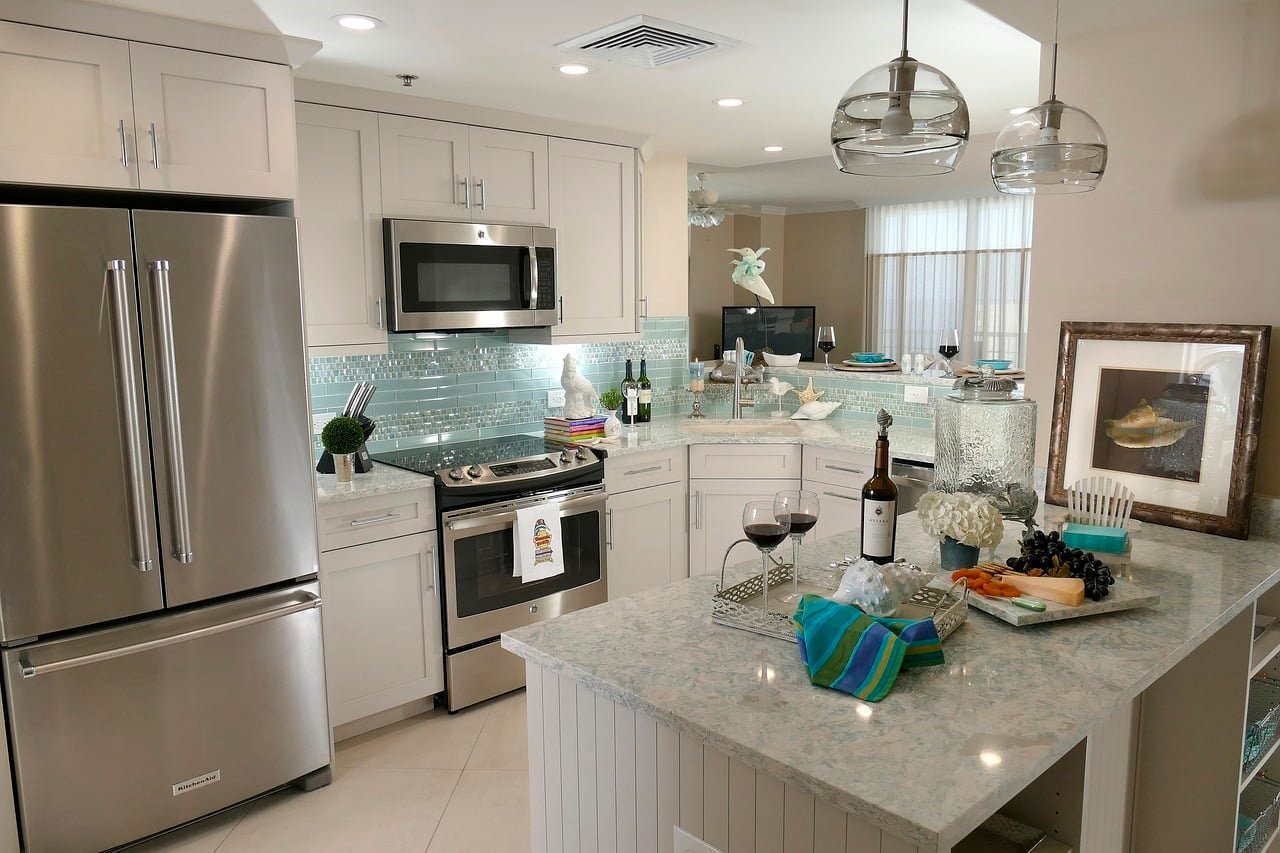 Kitchen - T&J
All figures above are Industry cost data 2026 installed ranges. A note on vocabulary: field tile is the main tile that covers the bulk of the wall, as opposed to trim, edge, or accent pieces. When a contractor quotes "field tile," that's the primary material, and trim gets priced separately.
Want this priced for your kitchen?
John walks your space, measures it, and leaves a written itemized estimate. No cost, no obligation, no sales script.
A low bid on glass tile is a red flag. Glass is unforgiving of voids in the adhesive because they telegraph through the tile face, so it demands a skilled installer who back-butters each piece and uses a white polymer-modified thinset. If a glass quote comes in well under ceramic pricing, someone's cutting a corner you'll see later.
Ceramic and porcelain are where most Waukesha County kitchens land, and for good reason. Ceramic at $12-$32 is the budget-friendly choice, while porcelain at $14-$28 is denser and handles moisture a touch better. Stone reads as premium but adds cost on two fronts: the material itself and the sealing and careful handling it requires.
Marble's $30-$150 range isn't a typo. The spread comes from two choices: slab versus tile, and polished versus honed finish. A honed marble tile backsplash sits near the low end. A book-matched polished slab behind the range sits near the top, and that's the design that pushes a project toward the $4,500 ceiling.
Anchor: Calculate your exact backsplash cost based on material and size
Labor Cost Breakdown: What You're Actually Paying For
Base installation labor runs $5-$20 per square foot depending on material and pattern. On an hourly basis, expect $40-$60 per hour for simple straight-stack layouts, up to $100 per hour for a herringbone pattern (tiles set at a 45-degree zigzag like a fabric weave) or diagonal work, and roughly $500 per day for custom mosaic. The reason quotes diverge here is time. A 30 sqft straight-stack ceramic job might take an experienced installer 4-6 hours, while that same 30 sqft in herringbone glass can eat 10-14 hours of tile work alone.
That time difference is the honest answer to "why does labor cost more on this one?" More cuts, more layout, more back-buttering.
Three line items that low bids love to leave off:
- Removal / demo of the existing backsplash: $3-$6 per square foot. A quote with no demo line on a kitchen that already has tile is an incomplete scope, period.
- Outlet cutouts and corner trim. Every outlet is a careful cut, and corners need edge treatment.
- Grout and sealing. Skipping sealer on stone or glass shortens the life of the job.
When you compare bids, separate the material from the labor. If one contractor buries everything in a single all-in number and another breaks it out, you can't compare them until both are itemized. If the backsplash is one piece of a bigger project, our kitchen remodel cost guide shows how the tile line fits the full budget.
Why Quotes Vary: What a Complete Scope Looks Like
If you've got three bids and one is hundreds cheaper, the gap almost always comes from scope, not greed. A complete backsplash scope has seven parts:
Demo/removal
of the existing backsplash ($3-$6/sqft) 2. Substrate inspection and repair (the wall behind the tile has to be sound and flat)
Field tile material plus waste factor
(plan for 10-15% overage on cuts and breakage)
Trim and edge tile
for exposed edges and corners
Grout and sealer
Outlet box extensions
if the tile adds depth over existing outlets
Cleanup and haul-off
of demo debris
A low bid usually drops items 1, 2, 6, and 7. Add those back and the gap between a $900 quote and a $1,400 quote often shrinks to almost nothing.
Here's a real example of why the missed items matter. A Brookfield kitchen we quoted had a cracked plaster wall hiding behind the existing tile. The low bid ignored it, but our scope included roughly $300 in substrate repair that prevented mold and eventual tile failure down the road. Older Milwaukee and Wauwatosa homes are especially prone to this, since plaster-and-lath walls behind decades-old tile often need patching before new tile goes up.
Ask every contractor these three questions:
- "Does your quote include demo of the existing backsplash?"
- "What happens if the substrate needs repair?"
- "Is tile waste and overage included in the material line?"
The contractor who can answer those on the spot has thought the job through. The one who gets vague is the one to watch.
When a general contractor supervises a tile sub, expect 13%-22% added to the total for overhead and markup. That's not padding. It covers scheduling, project management, and warranty accountability, which is exactly what disappears when you hire the cheapest handyman. At T&J Remodeling, John, our co-founder and project manager, runs each project A-Z as a single point of contact, so a surprise like that Brookfield plaster wall gets handled instead of ignored.
Pattern & Layout: How Design Choices Move the Price
Pattern is the hidden reason two quotes for the same tile don't match. Here's how layouts stack up on labor, from cheapest to priciest:
- Straight stack (subway tile set horizontally): lowest labor, fewest cuts.
- Vertical stack: slightly more cuts than horizontal.
- Offset / brick pattern: moderate, the classic look.
- Herringbone or diagonal: a 20-40% labor premium from all the angled cuts.
- Custom mosaic or medallion: priced at the $500/day rate.
 Kitchen - T&J
A concrete example. Take a 40 sqft glass tile backsplash. In a straight stack it might run $720-$1,680. The same tile in herringbone can run $900-$2,350, and nearly all of that difference is labor. That's why a $400-$600 spread between two "identical tile" quotes is often just the pattern.
A recent Waukesha kitchen with a marble herringbone backsplash ran about $2,100 because the substrate needed repair and the angled cuts doubled the tile hours, a detail a low bid would have missed. If you're still choosing a look, planning the finish alongside our kitchen remodeling in Waukesha County helps the backsplash tie into cabinets and counters instead of fighting them.
Wisconsin Market Context: What Moves Costs in Waukesha County
Material pricing is largely national because tile ships from the same distributors nationwide. Labor is local, and skilled tile work in Waukesha County and the Milwaukee suburbs tends to run at or slightly above national averages, driven by steady demand for kitchen remodels through the Brookfield, Elm Grove, and Delafield corridor. If you're budgeting the labor half of your project, plan for the upper end of the $5-$20 per square foot band.
Wall condition is the biggest local wildcard. Newer Delafield and Pewaukee builds usually have clean drywall that tiles straight over. Older Milwaukee and Wauwatosa kitchens often have plaster-and-lath walls that need substrate repair first, which can add $200-$400 to the scope before a single tile goes up.
Permits are usually a non-issue. Replacing a decorative tile backsplash is a cosmetic improvement that typically doesn't require a building permit in Wisconsin. The exception is electrical: if the job moves or adds an outlet (common when a full-wall backsplash covers an existing outlet location), that electrical work does require a permit under Wisconsin's Uniform Dwelling Code administered by the Department of Safety and Professional Services. Waukesha County townships vary slightly, so confirm locally. For the bigger picture, see our guide on what Wisconsin homeowners can do without a permit.