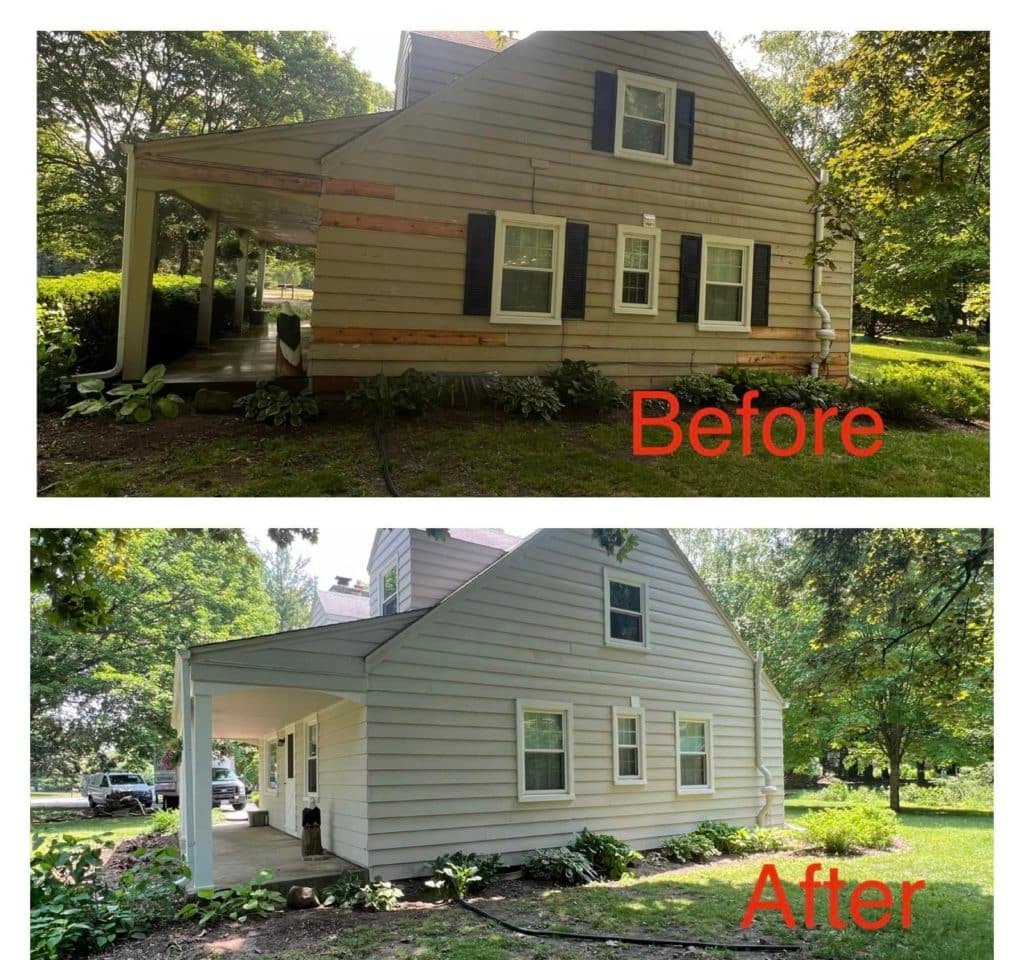
 Siding project - T&J
This guide covers what drives those numbers up or down, how Wisconsin's climate stresses each material differently, and what a complete siding scope looks like, so you can evaluate three bids side by side without getting surprised mid-project. The siding replacement services T&J handles across Waukesha County gives you a baseline for what a complete scope looks like before you sign anything.
What Each Material Costs Installed in Waukesha County (2026)
Fiber cement installed: $10-$18/sq ft. Vinyl installed: $5-$10/sq ft. On a 1,500 sq ft siding surface, the gap between the two materials runs roughly $7,500-$12,000 at midrange. That gap is real, and it's explainable line by line.
What pushes fiber cement toward $18:
- Shingle or staggered-panel profiles, more cuts, more labor per square
- Complex rooflines with multiple gable returns
- Full tear-off plus rotted sheathing replacement
- High window and door count, every opening needs trim wrapping and flashing
What pushes vinyl toward $10:
- Premium thick-wall panels (0.046" and above, more on this below)
- Full house wrap replacement on a larger home
- Two-story homes requiring scaffolding
- High window and door count driving trim labor
Wisconsin labor rates run above national averages. Seasonal demand compression, crews booked hard from April through October, shows up in every honest quote. A bid that lands well below these ranges almost always means something is missing from the scope.
To build a realistic budget before the first contractor walks your property, use the home remodeling cost calculator as a starting point for your full exterior project.
Before comparing three quotes side by side, confirm each one specifies the same panel profile, the same house wrap treatment, and whether tear-off and disposal are included. A $4,000 gap between bids often disappears when you line up the actual scope line by line.
How Wisconsin's Climate Actually Stresses Siding
Waukesha County averages 90-110 freeze-thaw cycles per year, defined as any period where temperature crosses the 32°F threshold in both directions, causing absorbed moisture to expand as ice and contract as liquid repeatedly. That cycle count is higher than most of the Midwest and higher than anything a generic national siding comparison accounts for.
Add an annual temperature delta of roughly 115°F, from January lows below zero to July highs above 90°F. That range drives thermal expansion (the dimensional change a material undergoes as temperature rises and falls). Vinyl moves approximately 0.4 inches per 10-foot panel across that range. Fiber cement moves approximately 0.003 inches per 10-foot panel. That's not a rounding difference, it's the difference between a material that must float freely in its fasteners and one that can be installed with conventional rigidity.
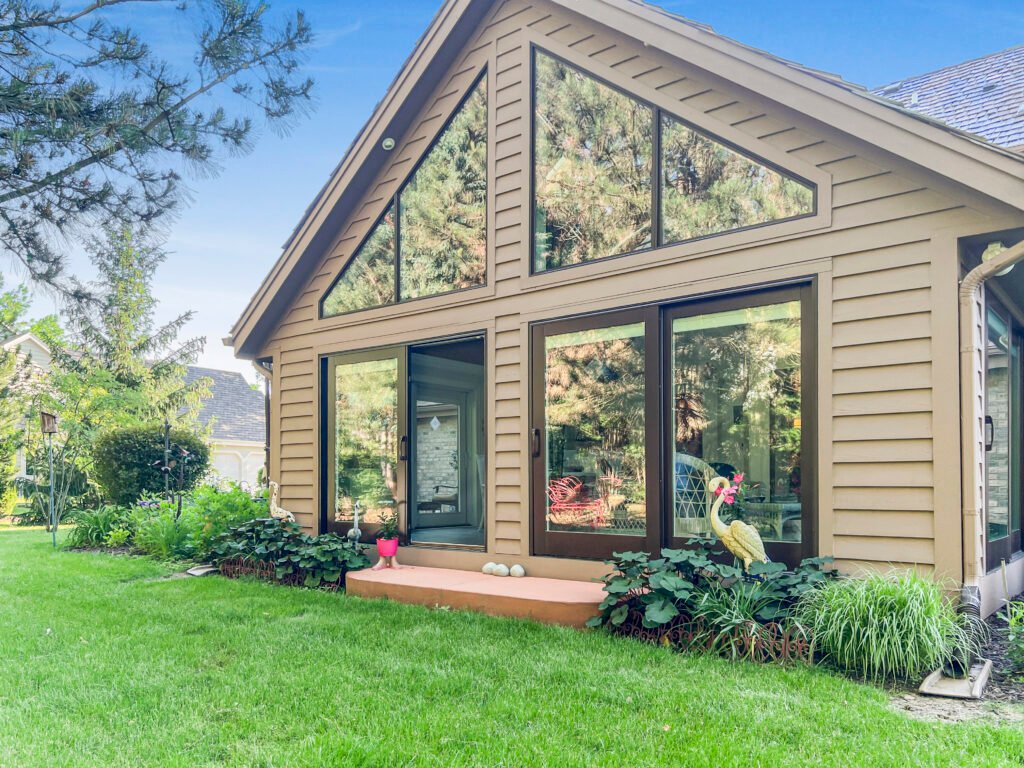 Siding - T&J
Want this priced for your siding?
John walks your space, measures it, and leaves a written itemized estimate. No cost, no obligation, no sales script.
Wisconsin also averages around 34 inches of annual precipitation, with spring humidity spikes that push moisture into any gap that freeze-thaw cycling has opened. Homes in New Berlin, Wauwatosa, and Elm Grove face the same freeze-thaw stress as Brookfield and Pewaukee, the entire county sits in the same climate band.
Bottom line: installation quality determines performance more than material choice in this climate. The sections below cover the specific failure modes for each material, because knowing them is how you evaluate a contractor's scope, not just their price.
90-110 freeze-thaw cycles per year in Waukesha County, roughly 3× the stress load most national siding warranties are written around.
Fiber Cement in a Wisconsin Winter: Where It Wins and Where It Doesn't
Where It Wins
Thermal movement is nearly zero. At approximately 0.003 inches per 10-foot panel, fiber cement joints stay tight through every freeze-thaw cycle Waukesha County delivers. Caulk lines at trim intersections hold longer, and the gaps that let water migrate behind other materials simply don't open up the same way.
Impact resistance is genuine. Fiber cement is a dense, cement-based composite. Hail, wind-driven debris, and the occasional errant ladder don't fracture it the way they fracture vinyl at low temperatures. For homes in Brookfield, Pewaukee, or Hartland, where western Waukesha County storm tracks bring more severe hail events, this is a material consideration, not a marketing claim. Some homeowner's insurance carriers offer premium discounts for impact-resistant siding; check with your agent before deciding the fiber cement cost premium isn't worth it.
Fire resistance matters in attached-garage situations. A large share of Waukesha County subdivisions built from the 1970s through the 1990s have attached two-car garages. Fiber cement's non-combustibility is a real benefit in those configurations that vinyl cannot match.
Where It Doesn't
Weight drives labor cost, not contractor margin. Fiber cement weighs roughly 2.5× what vinyl does per square foot. More crew hours, more scaffolding time on two-story homes, more precise handling to avoid chipping panel edges. When a fiber cement quote is higher than a vinyl quote, this is the primary reason.
The #1 Wisconsin-specific failure mode: moisture at cut ends. Fiber cement panels are sold factory-primed, meaning the manufacturer applies a primer coat to the face and back before shipping, but every field cut exposes raw board core. If those cut ends aren't field-primed (brush-coated with exterior primer on-site before the panel goes up), the core absorbs moisture, which freezes, and the panel delaminates from the inside out. James Hardie's 30-year warranty explicitly requires factory-primed product and proper field-priming of every cut end. A scope that doesn't mention field-priming will void the warranty.
Paint maintenance is a real ongoing cost. Fiber cement needs repainting every 8-12 years. For a typical Waukesha County exterior, budget $2,000-$5,000 per repaint cycle depending on home size and paint system. Plan for it, it's not a surprise if you do.
If a fiber cement quote doesn't specifically mention field-priming cut ends, ask about it directly before you sign. Skipping this step is the single most common installation shortcut on fiber cement jobs, and the damage won't show up until year 3 or 4, long after the crew is gone.
Vinyl Siding in a Wisconsin Winter: Where It Wins and Where It Doesn't
Where It Wins
Lower upfront cost with zero paint maintenance. Vinyl's installed cost range of $5-$10/sq ft and its permanent color-through construction mean you'll never pay for an exterior repaint. For a homeowner preparing to sell within 5-7 years, or managing a rental property where low maintenance beats longevity, that math is straightforward.
Panel replacement is easy and inexpensive. Individual vinyl panels can be unlocked and swapped without disturbing surrounding panels. A single damaged section typically runs $150-$400, a repair scale fiber cement can't match.
Thick-wall vinyl performs meaningfully better in cold. Modern panels at 0.046 inches and above are substantially more impact-resistant at low temperatures than builder-grade material at 0.040 inches and below. This distinction matters when reading quotes: a bid that doesn't specify panel thickness is almost certainly quoting the thinner product.
Where It Doesn't
Brittle fracture below 20°F is a real failure mode. Below approximately 20°F, vinyl loses meaningful impact resistance. A ladder leaned against the house in January, a piece of wind-driven ice, or a hailstone can crack a panel that would have flexed in summer. Thicker panels reduce this risk, they don't eliminate it.
Thermal movement requires loose-nail installation, each panel is fastened through a slotted nailing hem with the nail driven to leave approximately 1/32" of clearance, allowing the panel to float as it expands and contracts. If a previous installer nailed tight, the panel has nowhere to go in summer heat and buckles outward. In Wisconsin's temperature range, buckling and cracking on tight-nailed vinyl are predictable outcomes.
The J-channel problem is the most common water infiltration source. J-channel, the trim piece that receives the cut edge of a vinyl panel at windows, doors, and rooflines, is where most vinyl water failures originate. When J-channel is improperly lapped, not back-flashed, or left uncaulked, water runs directly behind the panel. This is almost always a flashing and J-channel failure, not a vinyl material failure, but the homeowner pays for the water damage either way.
'Lifetime warranty' on vinyl is typically tied to the original owner. Transferability varies by manufacturer and is often prorated after year 10. Read the warranty document before you treat it as a selling point.
What a Complete Siding Scope Looks Like, and How to Spot a Low-Ball Quote
A complete re-siding scope on a typical Waukesha County home includes every one of the following. If a quote is missing any of them, the number is artificially low, and the missing work will either get added mid-project as a change order or left undone.
A complete scope must include:
 Siding - T&J
- Tear-off of existing siding and disposal
- Sheathing inspection after tear-off, with a contingency allowance for rotted board replacement ($500-$1,500 is reasonable on most mid-size homes)
- New weather-resistive barrier (WRB/house wrap), the water-management membrane installed over sheathing before siding goes on. Wisconsin's Uniform Dwelling Code (SPS 321) requires a WRB on new siding installations
- All window and door trim wrapping
- Proper flashing at all penetrations: hose bibs, electrical boxes, dryer vents, roofline intersections
- Caulking at all trim-to-siding transitions
- For fiber cement: field-priming of every cut end before the panel goes up
Low-ball quotes commonly omit:
- House wrap replacement ('we'll reuse the existing'), this omission alone can represent $800-$1,500 in materials and labor
- Trim board replacement (quoting paint-over instead of new material)
- Flashing at penetrations, each skipped penetration is a future water infiltration point worth $800-$2,500 to fix later
Three questions to ask every bidder before you sign:
'Does your quote include replacing the house wrap?'
A yes/no answer tells you immediately whether you're comparing apples to apples.
'What panel thickness are you quoting for vinyl?'
Anything below 0.046" on a Wisconsin home is a compromise you should make consciously, not by default.
'Who pulls the permit, you or me?'
A licensed contractor pulls their own permits. Verify Wisconsin contractor licensing through the DSPS credential lookup.
Wisconsin SPS 321 requires a weather-resistive barrier on new siding installations. A permit inspection verifies WRB and flashing before panels go on, which is exactly where water infiltration problems originate. Permit costs in Waukesha County municipalities typically run $150-$400.
Lifespan, Maintenance, and the Real 20-Year Cost
| Fiber Cement | Vinyl | |
|---|---|---|
| Installed cost (1,500 sq ft surface) | $15,000-$27,000 | $7,500-$15,000 |
| Paint maintenance | $2,000-$5,000 every 8-12 years | $0 |
| Repair cost per incident | Higher, heavier material, more labor | $150-$400 per panel |
| Expected lifespan | 30-50 years | 20-40 years (thickness-dependent) |
| Thermal movement per 10 ft | ~0.003 inches | ~0.4 inches |
| Hail/impact resistance | High | Moderate; drops sharply below 20°F |
| Fire resistance | Non-combustible | Combustible |
| Warranty | 30 years (installation-compliance required) | Typically lifetime, original owner, often prorated after yr 10 |
| Best fit | Stay 15+ years; hail-prone area; higher-value home | Budget-primary; selling within 5-7 years; rental property |
On a home you plan to own for 15+ years, fiber cement's longer lifespan and lower surprise-repair frequency narrow the lifetime cost gap significantly, especially when a vinyl job may need a second replacement cycle before fiber cement needs its first repaint. Fiber cement also tends to appraise higher on luxury-tier homes in Waukesha County's market, while vinyl delivers strong resale value on mid-range homes.
If you're comparing bids and one contractor is quoting fiber cement at the low end of the range, ask whether they're including scaffolding and a full crew. Fiber cement installed by an understaffed crew takes longer, increases the chance of chipped panels, and often means cut ends get skipped on field-priming.
Which Material Is Right for Your Home?
Choose fiber cement if:
- You're staying 15+ years
- Your home is in a hail-prone area (western Waukesha County, Brookfield, Pewaukee, Hartland)
- You want a painted-look finish with color flexibility
- The home is higher-value and you want appraisal support on a future sale
- You have an attached garage and want the fire-resistance benefit
Choose vinyl if:
- Budget is the primary constraint
- You're prepping to sell within 5-7 years
- The home is a rental where low maintenance and easy panel replacement beat longevity
- The existing sheathing and WRB are in good condition, reducing the scope gap between materials
One honest line that applies to both: a correctly installed job with either material will outlast a cheap job with either material. The installation, flashing, WRB, fastening pattern, cut-end treatment, determines performance more than the product spec sheet.
Telli's background in high-end residential work means he's installed both materials in demanding conditions. John handles every quote personally, walking the full scope before any numbers are signed, so scope gaps don't become change orders mid-project. See siding work in Brookfield and exterior siding projects in Elm Grove for examples of completed work near you.
Getting an Accurate Quote for Siding in Waukesha County
Before a contractor walks your property, have these ready: rough square footage of siding surface, count of windows and doors, whether you know if the house wrap needs replacement, and any known areas of rot or water staining. That information lets a contractor give you a real number on the first visit instead of a placeholder that balloons after tear-off.
T&J offers a free in-home consultation, no obligation, no sales pressure. We walk the scope with you, identify what's actually behind the siding where it matters, and give you a transparent estimate before anything is signed. For a broader look at what we do across the county, see our home remodeling work in Waukesha County.
 Siding - T&J
Call (262) 352-9525, we'll walk your home and confirm which material fits your climate, your timeline, and your budget.
Frequently asked questions
Does fiber cement siding crack in Wisconsin winters?
Fiber cement itself doesn't crack from cold, its thermal movement is so low (approximately 0.003 inches per foot) that freeze-thaw cycles don't stress the panels the way they stress vinyl. The failure mode in Wisconsin is moisture, not temperature. If cut ends aren't field-primed before installation, the board core absorbs water, which then freezes and causes delamination from the inside out. James Hardie's 30-year warranty requires factory-primed product and proper field-priming of every cut end precisely because this failure mode is predictable and preventable. A correctly installed fiber cement job should show no cracking after 20+ Wisconsin winters.
Why does vinyl siding buckle or crack on Wisconsin homes?
Two separate problems, both installation-related. Buckling happens in summer: vinyl expands roughly 0.4 inches per 10-foot panel in heat, and if the installer nailed it tight instead of loose, leaving the panel to float in the nailing slot, it has nowhere to go and bows outward. Cracking happens in winter: below about 20°F vinyl becomes brittle, and any impact can fracture a panel that would have flexed in July. Thicker vinyl at 0.046" and above is meaningfully more impact-resistant at low temperatures than builder-grade 0.040" material. If a quote doesn't specify panel thickness, ask before you sign.
How much more does fiber cement cost than vinyl in Wisconsin?
In Waukesha County in 2026, expect to pay roughly $10-$18 per square foot installed for fiber cement versus $5-$10 for vinyl. On a home with 1,500 square feet of siding surface, that's a gap of roughly $7,500-$12,000. The gap exists because fiber cement is heavier (more labor hours, scaffolding), requires paint, and demands more precise installation to meet warranty requirements. Over a 20-year horizon, factor in fiber cement's repainting cost ($2,000-$5,000 every 8-12 years) against vinyl's near-zero maintenance, the lifetime cost difference narrows considerably if you stay in the home long-term.
Do I need a permit to replace siding in Waukesha County?
Yes, for most full re-siding projects, and it matters on three levels. First, Wisconsin's Uniform Dwelling Code (SPS 321) requires a weather-resistive barrier on new siding installations, and a permit inspection verifies the WRB and flashing before panels go on. Second, if water infiltration damage shows up later and you didn't pull a permit, your homeowner's insurance claim is at risk, unpermitted work is a standard exclusion. Third, at resale, an unpermitted re-side can flag on a home inspection and become a negotiating point against you. Permit costs in Waukesha County municipalities typically run $150-$400. Any contractor who tells you a permit isn't needed for a full re-side is either wrong or trying to avoid inspection.
Which siding holds up better to hail in Wisconsin?
Fiber cement wins clearly on hail resistance. It's a dense, cement-based product that absorbs impact without fracturing, most fiber cement products carry impact-resistance ratings that vinyl cannot match. Vinyl, especially thinner panels and at temperatures below 20°F, can crack or dent from hail that fiber cement shrugs off. Western Waukesha County sees more severe storm activity than the metro core, so this is a real consideration if your home is in Brookfield, Pewaukee, or Hartland. Check your homeowner's insurance: some carriers offer a premium discount for impact-resistant siding, which can offset part of the fiber cement cost premium over time.
Can I paint vinyl siding instead of replacing it?
Yes, but with real caveats. Vinyl can be painted with a 100% acrylic exterior paint formulated specifically for vinyl, standard latex will peel within a season. The color must be equal to or lighter than the original: darker colors absorb more heat, increase thermal expansion beyond what the panels were designed for, and can cause warping. Painting is a reasonable short-term fix if the panels are structurally sound and you're 3-5 years from a full replacement. It is not a substitute for replacing panels that are brittle, cracked, or have water infiltration behind them.
How long does a siding replacement take on a typical Waukesha County home?
A full re-side on a 2,000-2,500 sq ft two-story home typically runs 5-10 business days for a properly staffed crew. Vinyl installs faster than fiber cement, fiber cement's weight and the need to prime cut ends adds time. Variables that extend the timeline include rotted sheathing discovered after tear-off, complex rooflines, and permit inspection scheduling. Weather is the biggest wildcard in Wisconsin, plan for at least one weather delay day if you're scheduling in spring or fall. T&J books siding projects 4-8 weeks out depending on season; spring slots fill earliest.