 Deck project - T&J
Composite vs Wood Decking in Wisconsin Weather: The Short Answer
Composite decking handles Wisconsin's freeze-thaw cycle, moisture, and UV exposure better than wood. It also needs only a few hours of yearly upkeep instead of the 20-40 hours wood demands. Composite runs roughly $30-60 per square foot installed in the current Waukesha County market. Pressure-treated wood typically lands around $15-30 per square foot. Wood costs less on install day, but that maintenance gap adds up fast. Over 10-15 years, it closes a lot of the price difference you thought you were saving.
Neither choice is wrong. It depends on what you're optimizing for: lowest cost today, or lowest total cost and effort over the life of the deck. A homeowner planning to sell in five years thinks about this differently than one settling into a Brookfield or New Berlin ranch for the next twenty years. The rest of this guide breaks down where each material wins, what a complete deck quote should include, and the questions that separate a fair bid from one that's missing scope.
How Wisconsin's Freeze-Thaw Cycle Actually Damages a Deck
A freeze-thaw cycle happens when moisture soaks into a material, freezes and expands, then thaws and contracts, over and over through a Wisconsin winter. Wood grain absorbs water like a sponge. Every freeze cycle pushes that moisture outward. Over time it loosens fasteners, splits boards at the grain, and rots ground-contact points like deck posts and the ledger board, the horizontal board that bolts the deck to the house.
A typical deck in Waukesha, Pewaukee, or Delafield sees dozens of freeze-thaw cycles each winter, not just one hard freeze in January. Each cycle is small on its own. Repeated year after year, that's what turns a tight, solid deck into one with wobbly railings and a spongy ledger connection by year eight or nine. If a neighbor's deck in Wauwatosa needed a full rebuild after only a decade, this is usually why, not bad luck.
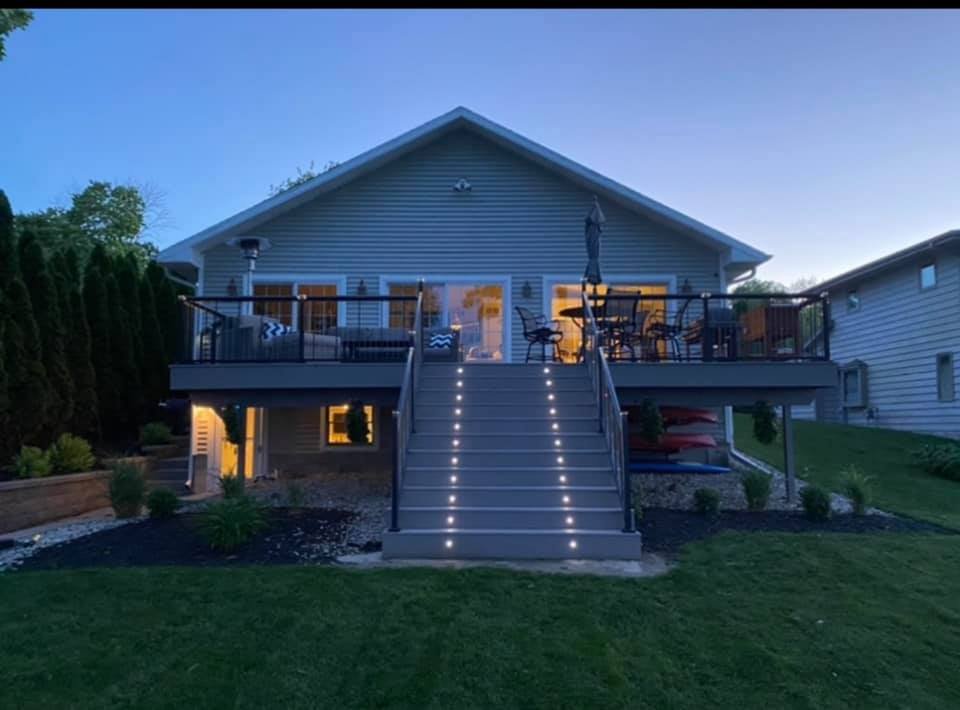
 Deck - T&J
Want this priced for your deck?
John walks your space, measures it, and leaves a written itemized estimate. No cost, no obligation, no sales script.
Composite decking barely absorbs moisture at all, so freeze-thaw has far less structural impact on it. It resists moisture, insects, rot, and UV fading far better than natural wood. Among wood species, cedar holds up better than most standard pressure-treated softwoods in this climate, which is why it shows up later in this guide as a middle option.
Southeastern Wisconsin's frost line runs to roughly 42 inches below grade, per the Wisconsin Uniform Dwelling Code footing standards enforced by local building departments [wisconsin.gov]. That's why attached decks require footings dug at least that deep. It's the same freeze-thaw physics damaging your deck boards, just applied to what's holding the whole structure up. Skip that depth and the post heaves a fraction of an inch every winter until the deck is visibly out of level.
If you're weighing whether some of the prep work is something you could tackle yourself, our breakdown of what Wisconsin homeowners can safely DIY without a contractor covers where that line usually falls.
Maintenance Time and Cost: What You're Actually Signing Up For
This is the comparison that changes most homeowners' minds. Wood decking needs staining or sealing every 2-3 years and a wash at least once a year. Composite needs only a few hours a year, total. Here's how the two stack up side by side, with cedar included as the middle-ground wood option:
| Pressure-Treated Wood | Cedar | Composite | |
|---|---|---|---|
| Staining/sealing | Every 2-3 years | Every 2-3 years, holds finish slightly longer | Not required |
| Washing | At least annually | At least annually | A few times a season, hose-only |
| Annual maintenance hours | 20-40 hours/year | 15-30 hours/year (estimate, less prone to warping) | A few hours/year |
| Pressure washing limit | Standard wood tolerances | Standard wood tolerances | Max 1500 PSI |
There's a detail most homeowners don't learn until after they've bought the deck: composite should never be pressure washed above 1500 PSI, or the cap layer can scar and strip. That sounds backwards since composite is marketed as tough, but the surface layer isn't as dense as solid wood. A wide fan tip at garden-hose-level pressure is all it needs.
If you're getting quotes from a few contractors and one never mentions a maintenance plan or a PSI warning for the material you're choosing, that's a scope gap, not a bargain. A contractor who's actually built decks in this climate tells you this upfront, because it decides whether you're happy with the deck in year three or fighting mildew stains and cracked boards.
Wood ages with a warm, natural look many homeowners like, but it grays and fades within a season or two without staining. Bare wood can also get slick with algae in shaded, moist spots. Composite holds its color far longer thanks to UV-resistant caps, and most modern boards are textured for slip resistance even wet, which matters on a deck near a pool or a shaded, north-facing yard.
A capped composite board (one with a protective plastic shell wrapped around a wood-fiber core) resists staining and moisture better than older uncapped composite, which can still absorb some water at the edges over time. If you're comparing composite brands, ask whether the boards are fully capped on all four sides. Some homeowners also look at PVC or vinyl decking, a 100% plastic board with no wood fiber at all. It costs more than composite and never needs staining, but it can flex more in extreme cold and typically looks less like natural wood grain.
Upfront Cost vs Lifetime Cost: Where's the Breakeven?
Composite costs more to install than wood, but the comparison shifts once you factor in years, not just square footage. On a typical 300-square-foot deck, that's roughly $4,500-9,000 for wood versus $9,000-18,000 for composite at current material and labor rates. Wood's lower material cost gets eaten by recurring stain, seal, and labor costs stacked over a decade or more. Composite's higher upfront number is mostly a one-time hit, with almost no recurring spend after that.
Run those maintenance hours out over ten years and the gap tightens considerably. Our cost calculator below can show that breakdown for your specific deck size.
High-quality composite decking, properly maintained, lasts 25-30 years in Wisconsin conditions. Wood's practical lifespan runs shorter in this climate whenever maintenance gets skipped or delayed, since that's exactly when freeze-thaw and rot get the upper hand at the ledger board and posts. We rebuilt a composite deck in New Berlin a few years back where the original ledger had rotted out around year six. The composite boards were fine; the original installer just never flashed the ledger properly against the siding. The boards outlasted the framing mistake underneath them.
Here's a rule of thumb. If you're planning to stay in the home under 5-7 years, wood's lower upfront cost is hard to argue against, since you likely won't live through the point where maintenance costs overtake the savings. If you're building for the long haul, 10+ years in the house, composite usually wins on total spend, because you're trading a bigger check now for two-and-a-half decades of skipping the staining weekend.
If you're also budgeting other exterior or interior work this year, it's worth looking at how a deck fits into budgeting for a whole house remodel in Wisconsin rather than pricing it in isolation.
What a Complete Deck-Building Quote Should Include (So You Can Spot a Low Bid)
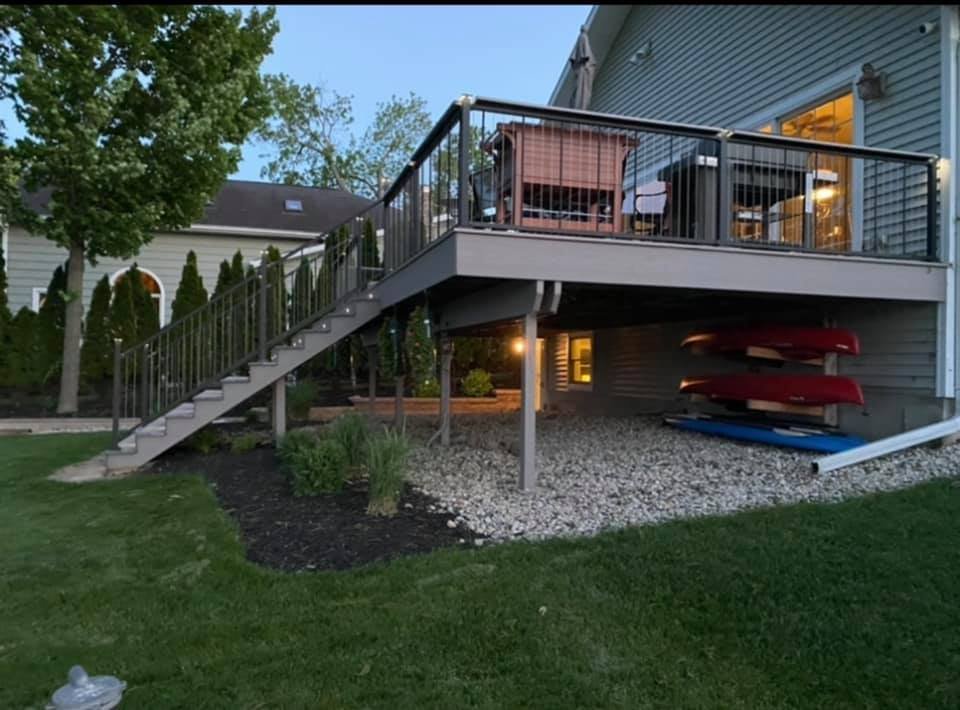
A complete deck quote covers the same core scope items no matter which decking material you pick: footings dug below the 42-inch frost depth, proper ledger board flashing where the deck meets the house, joist spacing matched to the board type, and a defined fastener system. Skip any of these and the deck can look fine on installation day and still fail within a few years.
Composite boards often need tighter joist spacing than wood to prevent sagging between supports, since the material flexes differently under load and temperature swings. Fastener systems matter too. Hidden clip systems keep the surface free of visible screw heads but cost more in labor. Exposed screws are cheaper and faster to install but show wear sooner.
 Deck - T&J
A suspiciously low bid often quietly skips footing depth or ledger flashing, because both are invisible once the deck is built. You won't see the problem until the deck heaves out of level or the ledger rots against the siding, usually 3-5 years in. That's exactly what happened on the New Berlin rebuild mentioned above. By then it's a repair job, not a maintenance task.
When comparing bids from contractors serving Waukesha, Pewaukee, or Delafield, ask each one these four questions directly:
- What's your footing depth, and does it meet the frost depth required for our area?
- How are you flashing the ledger board where it meets the house?
- What fastener system and joist spacing are you using for this specific board?
- What's covered under your workmanship warranty, separate from the manufacturer's material warranty?
A contractor who answers all four without hesitation has built decks that survived actual Wisconsin winters. For a deeper look at scope and pricing specific to this region, our page on deck construction in Waukesha County covers it in more detail. The North American Deck and Railing Association also publishes a homeowner checklist worth reviewing before you sign any contract [nadra.org].
If a bid comes in noticeably lower than the others and doesn't itemize footing depth or ledger flashing, assume those costs are missing, not included for free. They show up later as a change order or a repair bill.
Warranty, Licensing, and Insurance: The Other Half of "Fair Price"
Composite manufacturers typically back their boards with material warranties of 25 years or longer, but that only covers the product itself, not the labor that installed it. A homeowner needs both a manufacturer's material warranty and a contractor's workmanship warranty to actually be covered if something goes wrong, which is exactly the gap that caused the New Berlin ledger failure mentioned above.
A quote that looks cheaper on paper is often missing project management, permit pulling, and change-order discipline, the parts of a job that don't show up on the invoice line until they're missing mid-project. That's usually where the "why is your bid higher" gap comes from. It's not markup, it's scope.
We walk every homeowner through the full scope before anyone signs anything, so there are no surprise change orders halfway through the build. John, licensed as a credited contractor in the state of Wisconsin, has run project communication on every T&J deck build since joining full-time in 2014. He handles each project's communication directly rather than handing it off to a junior project manager, so you're never chasing someone new for an update on your deck.
Ask any contractor you're comparing who pulls the permit and who's your point of contact once the job starts. If the answer is vague, that's usually a sign the job gets passed around once it's underway.
Which Material Fits Your Situation
Choose wood if your budget is the primary constraint and you're genuinely comfortable committing a weekend every 2-3 years to stain and seal it, plus an annual wash. It's a fine choice for homeowners who like a hands-on relationship with their deck and don't mind the upkeep or the graying color between coats.
Choose composite if you'd rather spend a Saturday sitting on the deck instead of maintaining it, or if you're planning to stay in the home 10+ years and want the long-term cost to favor you. The 25-30 year lifespan and steadier color retention mean you're likely building this deck once.
Cedar sits in the middle: a natural wood look with better freeze-thaw resistance than standard pressure-treated softwoods, for buyers in Wauwatosa or Delafield who want wood grain but not quite the maintenance ceiling of a budget treated-lumber deck.
Whichever material you land on, build quality matters more than marketing. Telli started in construction at 13 in his father's business back in 1989, and that framing, flashing, and fastening discipline carries into every deck we build today, wood or composite, so it holds up through actual Wisconsin winters and not just the day it's finished.
Get a Clear Comparison for Your Deck Project
If you're gathering quotes right now, bring this article's scope checklist with you: frost-depth footings, ledger flashing, fastener system, joist spacing, and warranty coverage. Ask every contractor the same four questions and compare answers side by side, not just bottom-line numbers.
A free in-home consultation is a low-pressure way to get an apples-to-apples quote on your specific lot and layout, whether you're in Brookfield, Pewaukee, or anywhere else in Waukesha County. No cost, no obligation, just a transparent walkthrough of what your deck actually needs. Look through our full remodeling services in Waukesha County if you're weighing a deck alongside other projects, or book a free Waukesha County consultation directly. Learn more about T&J Remodeling and how we run our projects start to finish.
 Deck - T&J
For a firm number on your own project, free in-home estimate.
Frequently asked questions
Does composite decking crack in Wisconsin winters?
High-quality composite is engineered to resist the moisture absorption that causes wood to crack under freeze-thaw stress. Its wood-plastic composite structure doesn't soak up water the way solid wood grain does, so there's much less expansion and contraction during freeze cycles. Lower-quality or older composite boards can still get brittle in extreme cold, which is why board quality and manufacturer matter as much as the composite-versus-wood decision itself.
How long does a wood deck actually last in Wisconsin weather?
A well-maintained cedar or pressure-treated deck can last well over a decade, but the freeze-thaw cycle combined with UV exposure means skipped maintenance shortens that significantly. Staining every 2-3 years and washing annually is the baseline, not the ceiling. The deck usually doesn't fail all at once. It's the ledger board or ground-contact posts that rot first, because that's where moisture sits longest.
Is composite decking worth the extra cost in Wisconsin?
It depends on the breakeven. Composite runs roughly double wood's install cost per square foot, but it needs a fraction of the maintenance hours and lasts 25-30 years when maintained properly, versus wood's shorter practical lifespan under neglect. The total cost gap narrows the longer you own the house. Worth it comes down to how long you plan to stay and how much you value skipping the yearly upkeep.
Can I pressure wash a composite deck?
Yes, but stay under 1500 PSI, since composite's cap layer isn't as dense as solid wood and can scar or strip under higher pressure. Use a wide fan tip rather than a narrow, concentrated stream. It's gentler than most people assume decking needs, which is exactly why the PSI limit surprises so many first-time composite owners.
Do I need a permit for a new deck in Waukesha County?
Most raised decks attached to a home require a building permit through your municipal building inspector's office, tied to footing depth and structural attachment rules rather than the decking material itself. Permits typically require footings dug to roughly 42 inches, below the local frost line, to prevent the ground heaving that damages both decks and homes over repeated winters. Skipping this is one of the most common gaps in cheap bids. Read more on when a Wisconsin permit is required for exterior projects.
Why do some contractor quotes for the same deck vary so much?
Price gaps usually come from what's included, not just labor markup. Footing depth, ledger flashing, fastener systems, permit pulling, and warranty coverage all cost money, and they're often left off low bids entirely. Ask each contractor to itemize these specifics instead of comparing bottom-line numbers alone. The cheap bid tends to catch up once change orders or repairs surface later.