If Your Wisconsin Home Was Built Before 1978, Lead Paint Rules Apply to Your Remodel
Wisconsin is one of only 15 jurisdictions authorized by the EPA to run its own lead renovation program rather than deferring to federal enforcement (Lead Renovation, Repair and Painting Program). Wisconsin DHS, not the EPA, sets and enforces the rules here under Wis. Admin. Code ch. DHS 163, and Wisconsin's rules are stricter than the federal baseline in at least one important way.
The rule applies to contractors and paid workers performing renovation work in pre-1978 homes and child-occupied facilities (Lead-Safe Wisconsin: Wisconsin’s Lead-Safe Renovation Rule). It covers paint scraping, window removal, and general remodeling work (Lead-Safe Wisconsin: Wisconsin’s Lead-Safe Renovation Rule). If you're planning a kitchen update, bathroom gut, or any work that opens walls in an older home in Brookfield, Waukesha, or anywhere across the county, this rule is part of your project whether your contractor mentions it or not.
The rest of this guide covers: what specific work triggers the rule, how Wisconsin's lead standard differs from federal, what certification actually requires, your rights as a homeowner doing DIY work, and how to verify any contractor before you sign.
What Triggers the Rule: The 6 and 20 Square Foot Thresholds
The rule doesn't apply to every nail you drive in an old house. It applies when renovation work disturbs a specific amount of painted surface. For interior work, the trigger is 6 or more square feet of painted surface per room. For exterior work, it's 20 or more square feet. Those numbers are smaller than most homeowners picture.
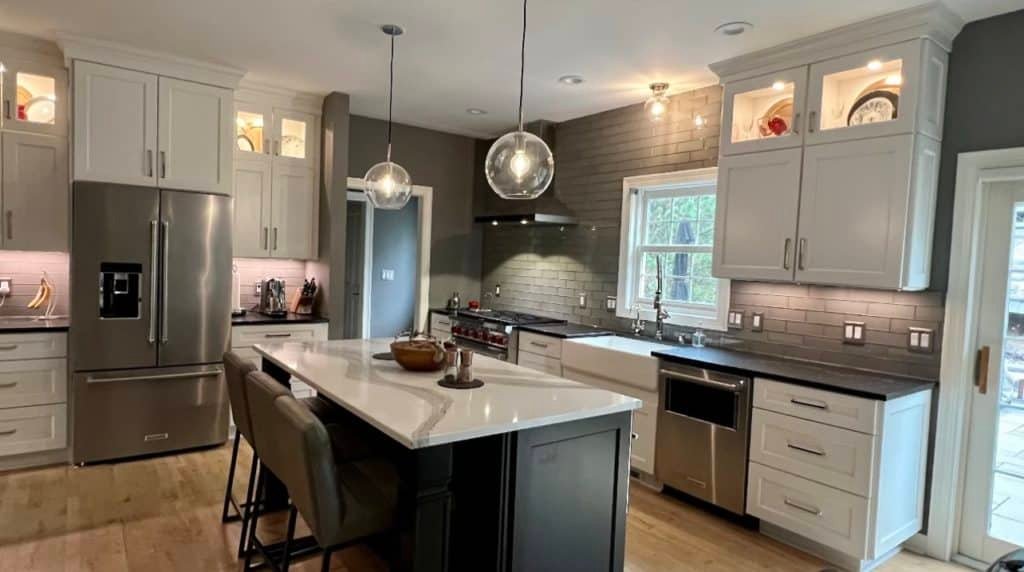
Six square feet is roughly the size of a standard interior door panel. A single window replacement almost always crosses that threshold once you account for surrounding trim, the sill, and any wall patching required. Scraping a wall before repainting, opening a wall cavity for plumbing rough-in, removing kitchen cabinet surrounds, pulling out a bathroom vanity that's been painted in place: all of these commonly exceed 6 square feet.
 Remodel - T&J
Want this priced for your remodel?
John walks your space, measures it, and leaves a written itemized estimate. No cost, no obligation, no sales script.
"Disturbance" (any activity that breaks, cuts, sands, scrapes, or otherwise disrupts a painted surface) is the operative word in DHS 163 (Lead-Safe Wisconsin: Wisconsin’s Lead-Safe Renovation Rule). You don't have to swing a sledgehammer to trigger the rule. Covered work types include paint scraping, window removal, and general remodeling (Lead-Safe Wisconsin: Wisconsin’s Lead-Safe Renovation Rule).
A single window replacement in a pre-1978 home almost always crosses the 6 sq ft interior threshold once trim and sill work are included. If a contractor says window swaps don't trigger lead rules, ask them to show you the math.
If you're planning any meaningful work on a pre-1978 home, assume the threshold is crossed and design your contractor search accordingly.
Wisconsin's Lead Standard Is Stricter Than Federal: Here's What That Means
Wisconsin defines lead-based paint at a lower concentration than the federal EPA does, and that difference has real consequences for how you interpret test results.
Under Wis. Admin. Code ch. DHS 163, paint is considered lead-based at 0.7 mg/cm2 or 0.06% lead by weight (600 ppm). That's the Wisconsin threshold, and it's the one that governs any remodel in Brookfield, Wauwatosa, or anywhere else in the state.
The federal EPA threshold is higher: 1.0 mg/cm2 or 0.5% by weight. Paint that tests negative under federal rules could still legally qualify as lead-based paint under Wisconsin law and trigger all associated renovation requirements. Wisconsin was authorized by the EPA in October 2026 to run its own program, and DHS set a lower threshold to provide greater protection, particularly for children under 6, who are the primary risk group the rule is designed to protect.
Wisconsin's lead-based paint threshold (0.7 mg/cm2) is 30% lower than the federal EPA threshold (1.0 mg/cm2), meaning more surfaces in Wisconsin homes legally qualify as lead-based paint.
If a contractor tells you a surface tested negative, ask which standard they tested against. A test conducted to federal EPA thresholds may not clear the surface under Wisconsin DHS 163. You can verify the current rule language directly at the Wisconsin DHS lead program page (Lead-Safe Wisconsin: Wisconsin’s Lead-Safe Renovation Rule).
What RRP Certification Actually Means (and Why It's Not the Same as a Handyman)
Wisconsin requires dual certification for any contractor performing lead renovation work in a pre-1978 home (Lead-Safe Wisconsin: Wisconsin’s Lead-Safe Renovation Rule). The renovation firm (the company) must hold a firm-level certification. The individual renovator doing the physical work must hold a separate individual certification. Having one without the other does not satisfy DHS 163 (Lead-Safe Wisconsin: Wisconsin’s Lead-Safe Renovation Rule).
The individual certification requires completing a 1-day Lead-Safe Renovator training course. That training covers containment setup, HEPA vacuuming, wet methods for dust suppression, and post-work cleaning verification. These are documented protocols a certified renovator is legally required to follow, not optional best practices.
An uncertified handyman working on a pre-1978 home and disturbing 6 or more square feet of paint is operating illegally under Wis. Admin. Code ch. DHS 163, regardless of how good their finish work looks. You can also read about what happens when remodeling work skips required permits and inspections to understand how regulatory shortcuts tend to compound.
When interviewing contractors for a pre-1978 home, ask them to describe their containment protocol without prompting. A certified renovator should walk you through plastic sheeting, HEPA vacuuming, wet wiping, and cleaning verification without hesitation. If they pause or generalize, ask for their DHS certification number.
What Happens If You Hire an Uncertified Contractor
Hiring an uncertified contractor for lead-disturbing work in a pre-1978 Wisconsin home creates two separate problems: a legal one and a practical one.
On the legal side, the contractor is violating Wis. Admin. Code ch. DHS 163. Wisconsin DHS can issue fines and enforcement actions against both the firm and the individual renovator. The homeowner is not fined, but the project can be stopped and the contractor removed from the job.
 Remodel - T&J
The practical problem is worse. Lead dust from an uncontained renovation is invisible. It doesn't stay in the room where work is happening. It spreads through HVAC returns, settles on soft furnishings, and contaminates surfaces throughout the home. A 2026 remediation case in Waukesha involving a 1962 ranch home illustrates the point: an uncertified crew removed painted cabinet surrounds and a window without containment, and lead dust spread through the HVAC return. Professional remediation ran over $8,000 and required the family to vacate for several days. That cost exceeded the original scope of the kitchen work.
For context on how permit and inspection shortcuts create similar compounding costs, see what happens when remodeling work skips required permits and inspections.
The Homeowner Exemption: What You Can (and Can't) DIY Legally
If you own and live in your home as your primary residence, Wisconsin's DHS 163 certification requirement does not apply to you personally (Lead Renovation, Repair and Painting Program). The rule was designed to protect occupants from hired contractors cutting corners, not to prevent homeowners from working on their own property (Lead Renovation, Repair and Painting Program).
That exemption disappears under three specific conditions (Lead Renovation, Repair and Painting Program):
You rent any part of the home to a tenant.
You operate a childcare center in the home.
You are buying, renovating, and selling homes for profit.
If any of those apply, the full DHS 163 certification requirements come back into play.
One more thing worth saying plainly: the exemption is legal, not medical. You're still disturbing lead dust that can affect your household. Children under 6 are the primary risk group the rule is designed to protect, and lead dust from renovation work is invisible. The exemption gives you the legal right to proceed without certification. It doesn't change the health math.
Pre-Renovation Disclosure: The Form Your Contractor Must Give You Before Work Starts
Before any lead-disturbing work begins in a pre-1978 home, a certified contractor is legally required to provide you with the EPA-approved lead hazard information pamphlet and obtain your signature acknowledging receipt. This is a legal requirement under the RRP rule, not a courtesy (Lead Renovation, Repair and Painting Program).
If a contractor shows up to start work without providing that disclosure, that's a red flag. It may mean they're not certified, or that they're not following the protocol their certification requires. Certified firms must also retain documentation of the disclosure and their lead-safe work practices for each job.
Just as Wisconsin bathroom plumbing permit requirements follow a similar paperwork trail, lead-safe renovation work generates its own documentation record that a legitimate contractor should be able to produce on request.
Under Wis. Admin. Code ch. DHS 163, certified renovation firms must provide the EPA lead hazard pamphlet and obtain homeowner acknowledgment before work begins. Failure to do so is a separate violation, independent of whether the actual work was performed correctly.
How to Verify a Contractor's Lead-Safe Certification in Wisconsin
Verifying a contractor's lead certification is straightforward if you know what to ask. Use this checklist before you sign any contract for work on a pre-1978 home.
Step 1: Ask for both certification numbers. The firm and the individual renovator each need separate Wisconsin DHS certifications (Lead-Safe Wisconsin: Wisconsin’s Lead-Safe Renovation Rule). Get both numbers in writing before any work begins.
 Remodel - T&J
Step 2: Check the Wisconsin DHS lead program database. Verify certifications directly at dhs.wisconsin.gov/lead (Lead-Safe Wisconsin: Wisconsin’s Lead-Safe Renovation Rule). Don't rely solely on what a contractor tells you.
Step 3: Ask about their containment and cleanup protocol. A certified renovator should describe, without prompting: plastic sheeting for containment, HEPA vacuuming, wet wiping of surfaces, and post-work cleaning verification.
Step 4: Ask if they provide post-work cleaning verification. This is the final step in a properly executed lead-safe renovation. Asking the question tells you whether they take the protocol seriously end-to-end.
At T&J All In Remodeling, John handles all project communications personally and will walk through both certification numbers and the full containment process before any commitment is made. For home remodeling services in Waukesha County, these questions apply to every contractor you evaluate.
What This Means for Your Waukesha County Remodel: A Practical Summary
Here's the short version for a pre-1978 home anywhere in Wisconsin, whether you're in Waukesha, Brookfield, or the broader Milwaukee metro.
If your remodel disturbs 6 or more square feet of interior painted surface per room, or 20 or more square feet of exterior paint, DHS 163 applies. Your contractor must hold both firm-level and individual-level Wisconsin DHS certification (Lead-Safe Wisconsin: Wisconsin’s Lead-Safe Renovation Rule). Wisconsin's lead threshold is stricter than federal, so a federal-standard test clearance is not enough. If you own and occupy the home, you can legally DIY without certification, but the health risk to your household is real, particularly if children under 6 are present.
Hiring a certified contractor isn't bureaucratic box-checking. An uncontained lead disturbance can spread invisible dust through your HVAC system and across every soft surface in the home. Remediation after the fact costs more than doing it right the first time.
Book a free Waukesha County consultation with T&J Remodeling to confirm your project scope and get straight answers on certification before any work begins.
Frequently asked questions
Does the Wisconsin lead paint rule apply to my home if it was built in 1977?
Yes. Wisconsin's DHS 163 rule applies to any home built before 1978, the year the federal government banned lead-based paint for residential use (Lead Renovation, Repair and Painting Program). A home built in 1977 or earlier is subject to the rule for any renovation disturbing 6 or more square feet of interior painted surface per room, or 20 or more square feet of exterior paint. The rule applies regardless of whether you've tested for lead. The 1978 cutoff is a bright-line rule, not a probability estimate. Lead paint was common in older homes, and the rule assumes it may be present until a certified test using the Wisconsin DHS standard proves otherwise.
Can I do my own lead paint renovation work in Wisconsin without being certified?
If you own and live in the home as your primary residence, Wisconsin's DHS 163 certification requirement does not apply to you personally (Lead Renovation, Repair and Painting Program). The exemption exists because the rule was designed to protect occupants from hired contractors cutting corners, not to prevent homeowners from working on their own property. However, the exemption disappears if you rent any part of the home, operate a childcare business there, or are renovating to resell for profit (Lead Renovation, Repair and Painting Program). The exemption is also legal, not medical. You're still disturbing lead dust that can affect your household, particularly children under 6, who are the primary risk group the rule is designed to protect.
What happens if a contractor does lead renovation work in my Wisconsin home without RRP certification?
An uncertified contractor performing renovation work that disturbs lead paint in a pre-1978 Wisconsin home is violating Wis. Admin. Code ch. DHS 163. Wisconsin DHS can issue fines and enforcement actions against the firm and the individual renovator. The more immediate risk is practical: improper lead disturbance spreads invisible dust throughout the home. It contaminates surfaces, HVAC systems, and soft furnishings across the entire house. Professional remediation after the fact can cost thousands and may require displacing your family during cleanup. The dust doesn't stay in the room where work happened. It travels through air returns and settles on every horizontal surface in the home.
How is Wisconsin's lead paint standard different from the federal EPA standard?
Wisconsin uses a stricter definition of lead-based paint than the federal EPA. Under Wisconsin DHS 163, paint is considered lead-based at 0.7 mg/cm2 or 0.06% lead by weight (600 ppm). The federal EPA threshold is higher: 1.0 mg/cm2 or 0.5% by weight. Paint that tests negative under federal rules could still qualify as lead-based paint under Wisconsin law. Wisconsin was authorized by the EPA in 2026 to run its own program, and DHS set a lower threshold to provide greater protection for young children.
Does a bathroom or kitchen remodel in a pre-1978 Wisconsin home trigger lead paint rules?
Almost certainly yes. Both bathroom and kitchen remodels typically involve removing or disturbing painted surfaces, including walls, window trim, cabinet surrounds, and door frames, well in excess of the 6 square foot interior threshold. Window replacement alone commonly crosses that line. Six square feet is roughly the size of a standard interior door panel, and most remodels disturb far more than that. If your home was built before 1978, assume the rule applies and confirm your contractor's DHS 163 firm and individual certifications before any work begins (Lead-Safe Wisconsin: Wisconsin’s Lead-Safe Renovation Rule).
Do both the contractor company and the individual worker need lead-safe certification in Wisconsin?
Yes. Wisconsin requires dual certification (Lead-Safe Wisconsin: Wisconsin’s Lead-Safe Renovation Rule). The renovation firm must hold a firm-level certification, and the individual renovator performing the work must hold a separate individual certification. Having one without the other does not satisfy DHS 163. The firm certification ensures the company has systems and accountability in place. The individual certification ensures the person holding the tool has completed the required 1-day Lead-Safe Renovator training and knows the containment, wet-method, and cleanup verification protocols. When vetting contractors, ask for both certification numbers and verify them through the Wisconsin DHS lead program database (Lead-Safe Wisconsin: Wisconsin’s Lead-Safe Renovation Rule).