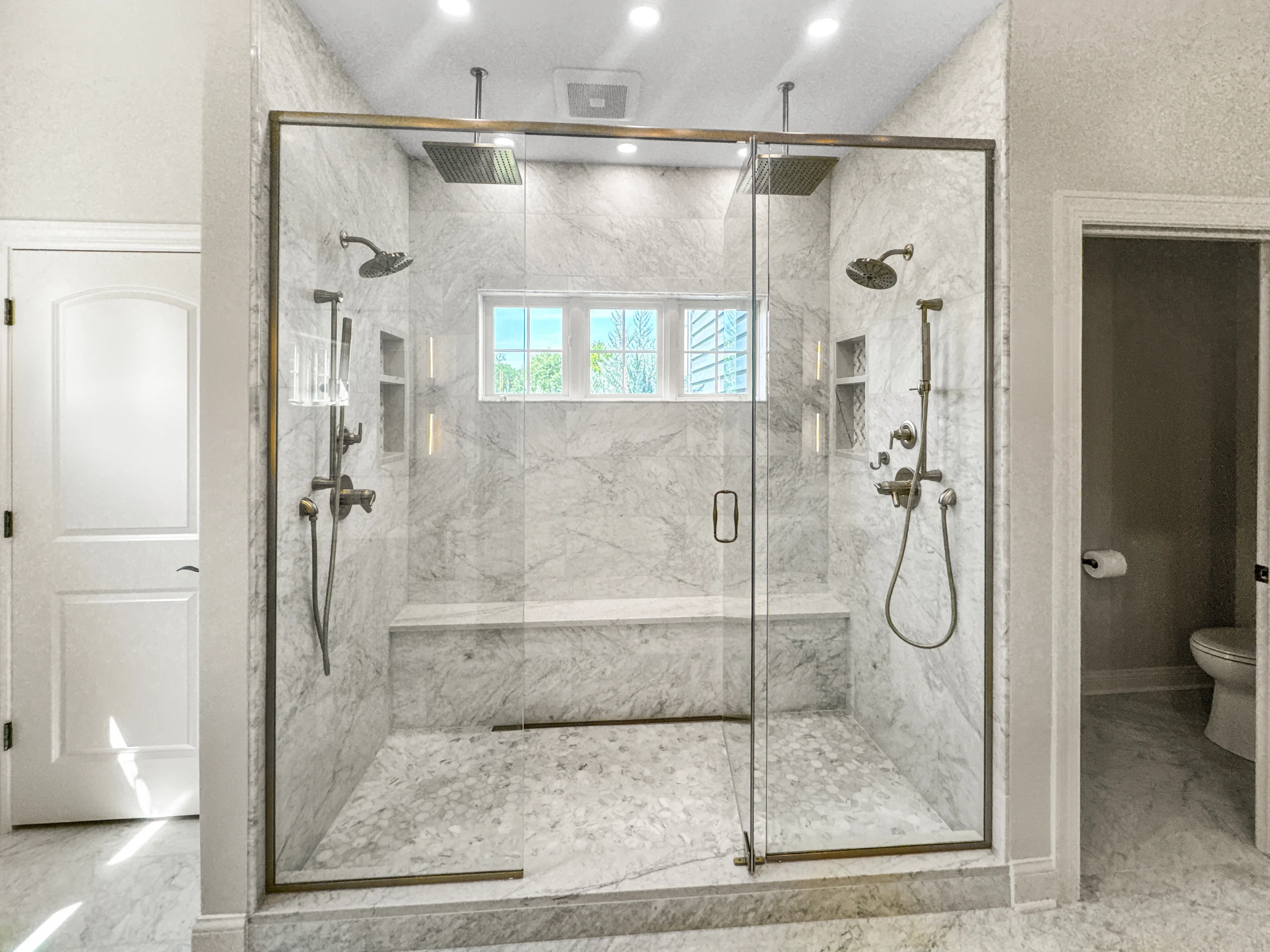
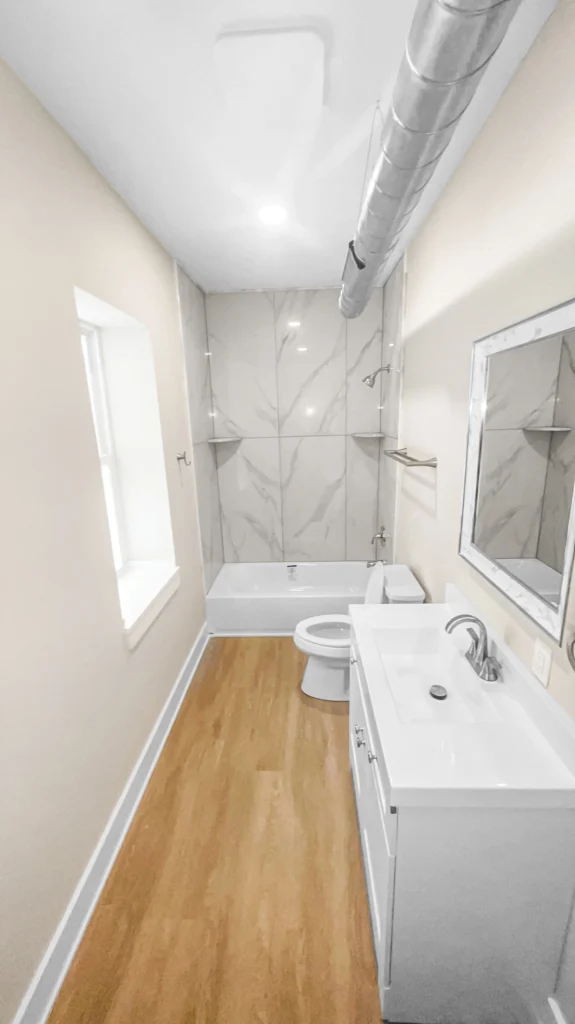
 Bathroom project - T&J
A quick word on the numbers below: the cost ranges in this article come from published remodeling cost data, Home Depot's bathroom cost guide, Synchrony's $10,000 renovation breakdown, and an independent budget-breakdown analysis, all listed with URLs in the Sources section at the bottom so you can verify them yourself. We've nudged a few figures toward 2026 reality where material costs have crept up, and cross-checked everything against what we actually see on Waukesha County jobs.
The $10,000 Budget Breakdown by Category
Here's how a complete $10,000 bathroom remodel typically divides up. Picture a 1960s Brookfield ranch with a 5x8 hall bath, original tile, a builder-grade vanity, and plumbing that's staying exactly where it is. These ranges come from published cost data, cross-checked against our own jobs:
| Category | Cost Range |
|---|---|
| Demolition & Prep | $500 -$1,000 |
| Plumbing & Fixtures | $2,000 -$3,000 |
| Flooring & Tile | $1,500 -$2,000 |
| Vanity & Toilet | $1,000 -$1,500 |
| Paint & Drywall | $500 -$800 |
| Labor | $2,000 -$3,000 |
Add those up and you land somewhere around $7,500-$11,300, which is exactly why scope discipline matters. There's no slack in this budget for surprises.
You can get a high-end look without high-end tile cost. A 12x24 porcelain laid in a herringbone pattern reads like a spa, but the tile material itself can come in under $800 for a small floor. The cost is in the careful layout, not the tile.
Labor: The Line That Tells the Truth
Labor typically runs 30-50% of a bathroom remodel budget, on a $10,000 project that's $3,000-$5,000. The table above shows $2,000-$3,000 because labor and materials trade against each other: spend mid-range on finishes and labor lands at the lower end; keep materials lean and labor eats a bigger share. That figure covers demolition, plumbing, tile setting, any electrical, and installation. When a quote shows unusually low labor, something got left off, usually a trade or the permit.
Plumbing & Fixtures: What You're Actually Paying For
"Fixtures" means the toilet, vanity, sink, and faucet, combined, that's roughly $2,000-$2,500 of the budget. The plumbing portion covers connecting all of it back to your existing supply and drain lines. As long as those lines don't move, this category stays predictable. The moment a drain relocates, this is where your budget springs a leak, figuratively and on the invoice.
What a Complete $10,000 Scope Looks Like (vs. What Gets Left Out)
This is the part that separates a fair quote from a low-ball. Two contractors can quote the same bathroom $3,000 apart, and the gap almost always lives in scope, not margin.
A complete $10,000 scope includes: pulling the permit, moisture-resistant cement board behind the tile (not standard drywall, which fails behind a wet wall), proper subfloor prep, fixture installation, haul-away of all demo debris, final cleanup, and a written warranty.
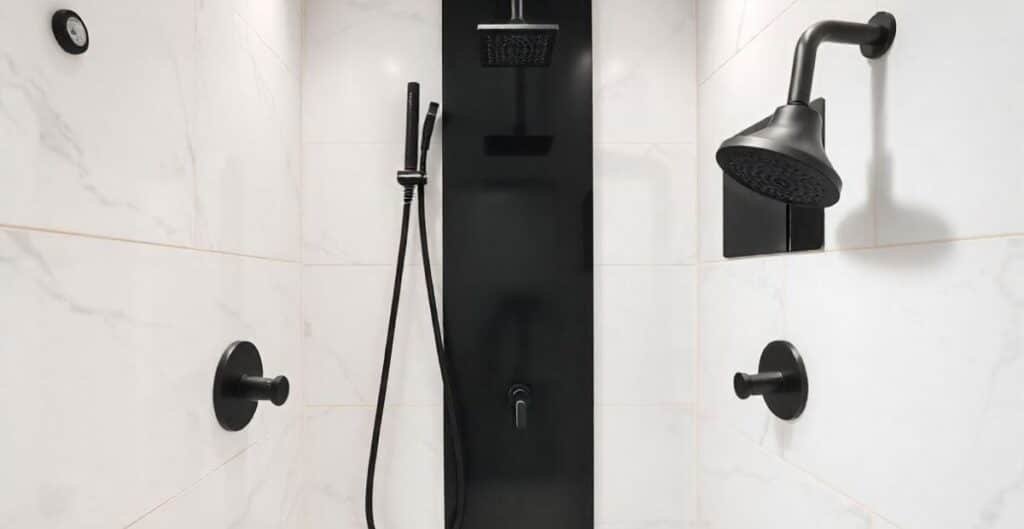 Bathroom - T&J
Want this priced for your bathroom?
John walks your space, measures it, and leaves a written itemized estimate. No cost, no obligation, no sales script.
A stripped low-bid scope quietly omits: the permit, the cement board (they use cheaper drywall and you find out when it rots), an allowance, the dollar amount budgeted for finishes you haven't picked yet, set artificially low, debris haul-away, and any drywall patching after the rough plumbing.
A $7,500 quote with a $300 tile allowance is not cheaper than a $10,000 quote with a $1,500 allowance. When you pick real tile, you pay the difference, except now it's a mid-project change order, where you have no leverage and the contractor has all of it.
That's why a complete scope costs more on paper and less in total. On every T&J project, John, our co-founder and project manager, a credited contractor in the State of Wisconsin, walks through the quote line by line before you sign, so there's no "we didn't account for that" three weeks in. A higher number that holds up under scrutiny beats a low number that balloons.
What a $10,000 Bathroom Remodel Looks Like in Waukesha County
Wisconsin labor markets generally run more favorable than coastal metros, which means $10,000 stretches further in Brookfield, New Berlin, or Wauwatosa than national averages suggest, your dollar buys more finish and more careful prep. We work across Waukesha County and the surrounding Greater Milwaukee communities, and even a budget bathroom gets the same substrate prep and tile-setting attention that Telli, our master carpenter co-founder, who cut his teeth on high-end residential work in Athens, brings to every job. That discipline is the difference between a floor that looks good on day one and one that still looks right in ten years. For local cost specifics and project examples, our bathroom remodeling serving Brookfield and Waukesha County page is the place to start, but the only way to get a real number is a free in-home consultation on your actual bathroom, not a national average.
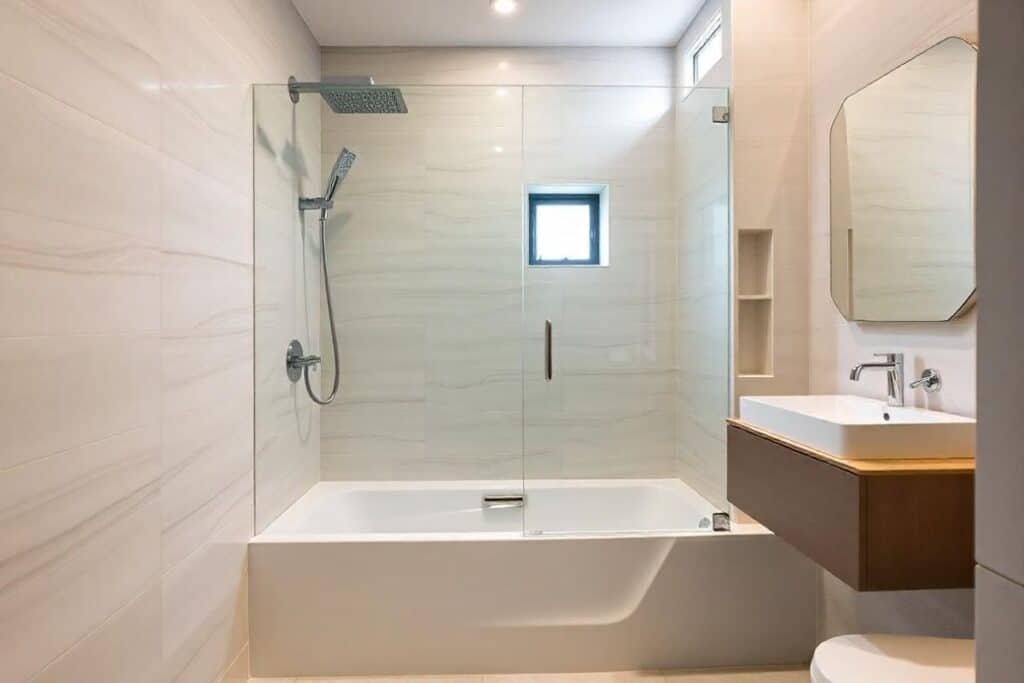 Bathroom - T&J
Frequently asked questions
Does your contractor's quote include pulling the permit?
If your remodel touches plumbing, electrical, or structure, the answer needs to be yes. In most Wisconsin municipalities a permit is required the moment you move supply lines, drains, or wiring, these are administered through your local building department under the Wisconsin Department of Safety and Professional Services and the state's Uniform Dwelling Code. Skipping the permit to shave cost isn't a discount, it's a transfer of risk to you. Unpermitted work can stall a future home sale (buyers' inspectors flag it), give your homeowner's insurer grounds to deny a water-damage claim, and leave you with zero recourse if the work fails. Any contractor who proposes going without is telling you how they handle accountability.
What substrate goes behind the tile, cement board or drywall?
A water-resistant backer board, cement board or an equivalent, belongs behind any wet wall, never standard drywall. Standard drywall behind a shower or tub surround absorbs moisture, fails from the inside out, and breeds mold you won't see until the tile starts cracking off. This is one of the most common corners cut on low-bid jobs because it's hidden the day the work finishes and only shows up a year or two later. Ask the question directly, and confirm the answer appears in your written scope.
What's the tile allowance, and what happens if I pick something above it?
An allowance is the dollar amount the contractor budgeted for finishes you haven't selected yet, and it's where low bids hide their real cost. A $300 tile allowance looks great on paper until you fall in love with a $900 tile and eat the $600 difference as a mid-project change order. Get the allowance amount in writing, ask how overages are handled, and compare allowances apples-to-apples between quotes. The bid with the honest allowance is almost always the cheaper one in the end.
Who is my single point of contact if something comes up mid-project?
You want one name, not a rotating cast. On a T&J job, John handles every communication on every project personally, it isn't handed off to a junior PM who wasn't in the room when the scope was set. This matters most when a hidden condition turns up mid-demo and a decision has to be made fast: a single accountable contact means you get a straight answer and a clear cost, not a game of telephone. Ask who picks up when you call, the answer tells you how the whole project will run.
What does the warranty cover, and for how long?
A written warranty is what separates a builder who stands behind the work from one who's gone the day the check clears. Ask exactly what's covered, labor, fixtures, tile work, and for how long, and get it in writing rather than as a verbal promise. Verbal warranties are worth what you'd expect when a grout line cracks eight months later. A contractor confident in their substrate prep and installation will put the warranty on paper without hesitation.
Can you fully remodel a bathroom for $10,000?
Yes, with the right scope. A $10,000 budget covers a complete cosmetic-to-mid-range remodel of a small bathroom (25-40 sq ft): new toilet, vanity, faucet, tile floor, paint, and updated fixtures, with labor included. The one hard constraint is keeping plumbing in its existing location. Move the drain or supply lines and rough plumbing relocation can consume $2,000-$4,000 of the budget before a single fixture is installed, turning it into a different project entirely.
How much of a $10,000 bathroom remodel budget goes to labor?
Labor typically runs 30-50% of a bathroom remodel budget, which on a $10,000 project means $3,000-$5,000. That covers demolition, plumbing, electrical if needed, tile setting, and installation. Labor climbs with complex tile patterns, multiple trades, or difficult access. A quote with unusually low labor is usually a signal that a trade, or the permit, got left off the scope.
How long does a $10,000 bathroom remodel take?
A well-scoped $10,000 bathroom remodel typically runs 1-2 weeks of active work, assuming no hidden conditions turn up during demo. Permit approval adds time before work begins, often 1-2 weeks in Waukesha County municipalities. Timelines slip on hidden moisture damage, back-ordered fixtures, or a contractor juggling too many jobs at once. Ask how many active projects they're running and who your day-to-day contact is, the answer tells you whether the timeline is real.