 Bathroom project - T&J
The Short Answer: Labor Is the Biggest Line Item, But It's Not the Whole Story
Labor runs 40-60% of a total bathroom remodel budget across all trades, according to industry cost data compiled by framelessshowerdoors.com from contractor surveys. On a $15,000 remodel, that's $6,000-$9,000 before you've purchased a single fixture. That number surprises most homeowners, and it's the right place to start.
But here's the more useful question for anyone comparing quotes right now: why do two bids for the same bathroom differ by $8,000? The answer almost never lives in one contractor's profit margin. It lives in what each quote includes, and what the cheaper one quietly left out.
This breakdown covers every major cost category with real numbers, explains why plumbing is the line item most likely to blow your budget, and gives you specific questions to ask every contractor before you sign anything. If you're planning a full bathroom remodel in Waukesha County, this is the framework you need before your next estimate call.
Full Cost Breakdown: Where Every Dollar Goes
Here's how a mid-range bathroom remodel budget actually breaks down. These ranges come from contractor cost surveys and industry pricing databases, not manufacturer list prices.
| Category | Typical Range | What Drives Cost Up |
|---|---|---|
| Plumbing labor | $1,000-$5,000 | Moving fixtures vs. keeping in place |
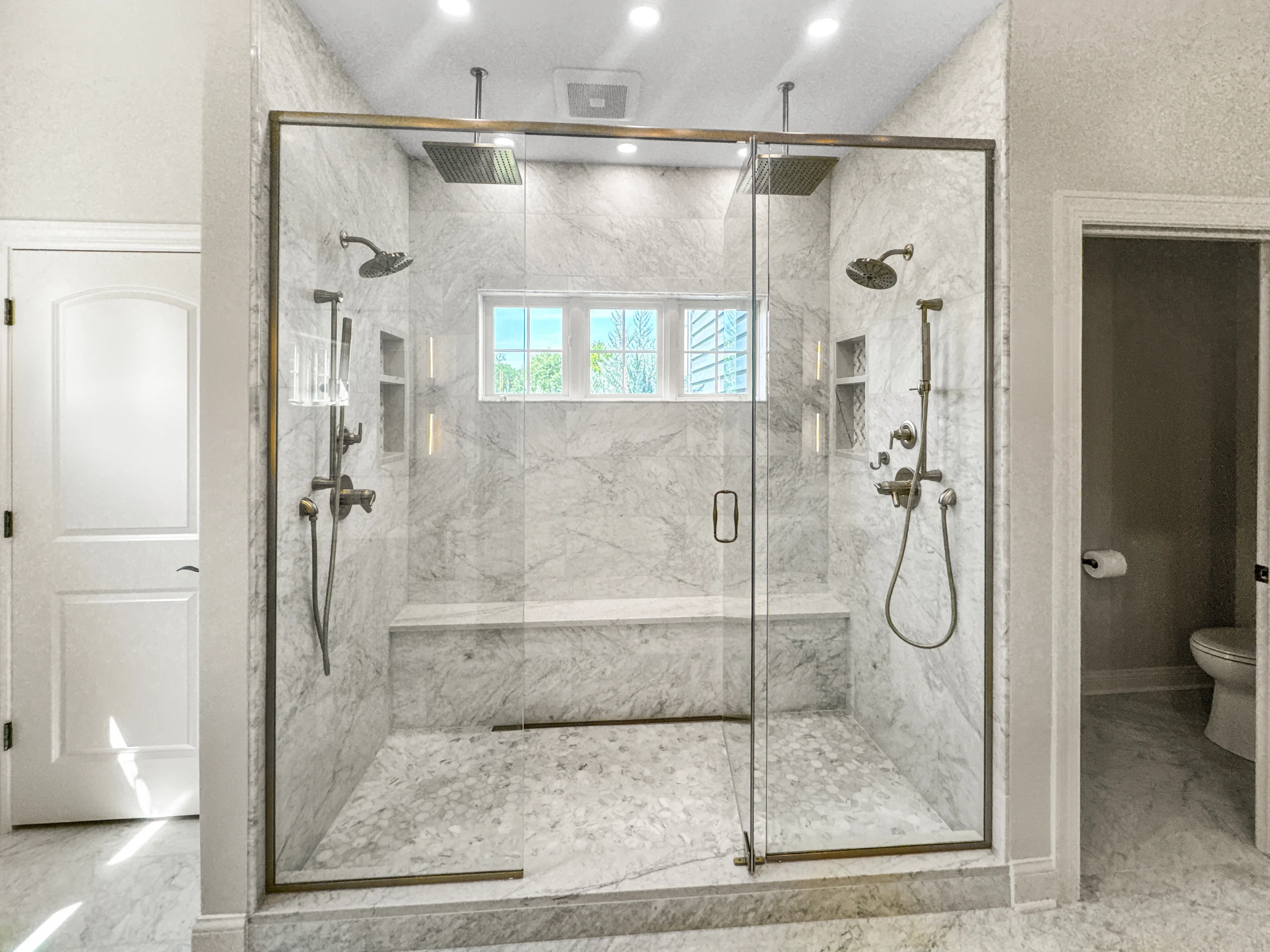
| Full tiled shower | $3,000-$8,000 | Size, tile grade, layout complexity |
| Tile installed (per sqft) | $15-$30/sqft | Waterproofing, backer board, labor |
| Custom vanity + countertop | $3,000-$10,000+ | Custom vs. stock, stone vs. laminate |
| Stone countertop alone | $500-$3,000 | Material and slab size |
| Frameless glass enclosure | 10-15% of budget | Glass thickness, hardware finish |
| Basic fixture set | $200-$500 | Brand, finish, single vs. dual control |
| Thermostatic shower system | $2,000-$5,000 (before install) | Rain head, body jets, handheld add-ons |
| Labor (all trades, total) | $1,250-$27,000 | Complexity, layout changes, discovery |
 Bathroom - T&J
Ranges sourced from contractor cost surveys by framelessshowerdoors.com and bathsrus.com; figures reflect 2026 Midwest market conditions.
Want this priced for your bathroom?
John walks your space, measures it, and leaves a written itemized estimate. No cost, no obligation, no sales script.
Plumbing: The Biggest Swing
Keeping fixtures in their current footprint keeps plumbing labor in the $1,000-$5,000 range. The moment you want to move a toilet, sink, or shower to a different wall, add $2,500-$3,500 per fixture on top of that, per cost data from Baths R Us's contractor pricing survey. That single decision can shift a $12,000 remodel to $18,000 before anything else changes.
Tile: Material Is the Smallest Part
Tile material starts at $5/sqft, but that's just the product sitting on a pallet. Installed tile, including cement backer board (a rigid substrate that prevents flex and moisture intrusion behind the wall surface), waterproofing membrane, thinset, grout, and labor, runs $15-$30/sqft. A fully tiled shower in a mid-range remodel typically lands at $3,000-$8,000; high-end tile design can reach around $7,000 depending on quantity and style. Tiling a bathroom properly takes two to three weeks, a quote promising it in three days is skipping steps.
Vanity and Countertop
A custom vanity with a quality countertop runs $3,000-$10,000+. Stone countertops alone add $500-$3,000. Custom-built cabinets cost two to three times more than stock RTA (ready-to-assemble) units, the price difference is real carpenter time, not markup.
Shower Enclosure and Fixtures
A frameless glass enclosure, the kind without a metal frame track at the base, runs 10-15% of a mid-range remodel budget. On a $15,000 project, that's $1,500-$2,250 just for the glass before installation labor. A basic showerhead, faucet, and valve set runs $200-$500. A thermostatic valve system, a pressure-and-temperature-balancing control unit that maintains your set water temperature regardless of pressure fluctuations elsewhere in the house, with rain head, handheld sprayer, and body jets runs $2,000-$5,000 before installation. That's a $1,500-$4,500 swing on one product.
Why Plumbing Is the Wildcard That Blows Budgets
Plumbing surprises more bathroom remodel budgets than any other category. Three reasons explain why, and understanding all three is what separates a homeowner who stays on budget from one who doesn't.
First, layout changes require re-routing supply and drain lines. Moving a toilet isn't just disconnecting it and reconnecting it three feet over. The drain line, which runs through the subfloor and ties into the main stack, has to follow. That means cutting into the floor, possibly the ceiling below, and re-sloping the drain to code. In a 1960s Brookfield ranch with a full basement, that work is accessible from below. In a slab-on-grade home in Waukesha or Pewaukee, it means cutting concrete, a meaningfully different scope and cost.
Second, older Wisconsin homes frequently have galvanized steel or cast-iron drain lines that are corroded from the inside. A wall that looks fine from the surface can hide supply lines that are heavily occluded or drain lines that are cracked. Once a wall opens, replacement isn't optional, it's code. That's not contractor padding; it's a condition that couldn't be diagnosed from a pre-demo walkthrough. The labor cost range of $1,250-$27,000 cited by Baths R Us's contractor survey reflects exactly how wide the swing can be when a project reveals major structural or plumbing issues underneath a surface that looked fine.
Third, Wisconsin requires all plumbing work to be performed by a licensed plumber through Wisconsin DSPS. That credential represents real training, bonding, and insurance. It shows up in the quote. A bid that prices plumbing at a fraction of the going rate is either using unlicensed labor or scoping less work than you think, both are problems that land on the homeowner.
The practical decision fork: if your layout stays the same, plumbing is a known, manageable cost. If you want to move the toilet, add a double vanity on a new wall, or relocate the shower, budget toward the upper end and build in a contingency.
If a contractor quotes plumbing relocation at a flat rate with no change-order language for what happens if they find cast-iron or slab work, that's a scope gap, not a deal. Ask specifically how discovery costs are handled before you sign.
What a Complete Scope Looks Like, and What Low Bids Leave Out
Overall bathroom renovation cost ranges from $4,000-$33,000, and a 7×7 bathroom remodel runs $6,000-$15,000, according to contractor pricing data compiled by Baths R Us. A quote significantly below that range for a full gut-and-replace isn't necessarily fraud, but it should prompt specific questions.
Here's what a complete scope includes that low bids frequently omit:
- Demo and haul-away, pulling tile, vanity, toilet, and tub, then disposing of it. This is a half-day of labor plus a dumpster fee, and it's often missing from the first number a contractor gives you.
- Cement backer board and waterproofing membrane behind all wet-area tile. Skipping this is the most common cause of moisture failure within three to five years.
- Permit fees, whether your project needs a permit depends on scope, but any work involving plumbing, electrical, or structural changes typically requires one in Waukesha County municipalities. Permit cost belongs in the quote.
- Subfloor inspection and repair, old tile hides a lot. Rotted subfloor under a 25-year-old tub surround is common in Wisconsin bathrooms and not visible until demo.
- Fixture supply lines and shutoffs, new valves and braided supply lines are code-required with new fixtures in most municipalities. They're inexpensive, but they disappear from low bids.
- Final inspection and punch list, the walkthrough that confirms everything is finished to spec.
Ask every contractor these four questions before comparing totals:
Does this quote include demo and haul-away?
Is cement backer board and waterproofing membrane included in the tile line item?
Who pulls the permit, and is that cost in this number?
What triggers a change order, and how are those priced?
Those four questions will surface scope gaps faster than any other approach. John walks through every line item with homeowners before a contract is signed, the goal is that nothing in the project comes as a financial surprise mid-demo.
Ask for the quote in writing with line items, not a single total. A contractor who can't break down their number by category either hasn't fully scoped the project or doesn't want you to compare apples to apples.
How Material Choices Move the Number, Without Changing the Layout
Two quotes for the identical floor plan can differ by $8,000-$10,000 based purely on material tier. The layout is the same. The scope is the same. The finishes aren't.
Concrete examples from contractor cost surveys:
 Bathroom - T&J
- Vanity: Stock RTA unit vs. custom-built cabinet, custom runs two to three times more. On a $2,000 stock vanity, that's $4,000-$6,000 for custom.
- Fixtures: Basic valve set at $200-$500 vs. a thermostatic shower system at $2,000-$5,000 before installation, a $1,500-$4,500 swing on one product.
- Tile: Standard ceramic at $5/sqft material vs. premium stone, the installed cost difference compounds fast across a full shower surround.
Telli's background in European luxury residential remodeling means he's installed $7,000 tile designs and $800 ceramic jobs. The craft standard doesn't change. The material cost does.
The practical tool for a comparison shopper: ask each contractor what brand and grade of fixtures and tile is included in their number. If one quote specifies a basic pressure-balance valve and another specifies a thermostatic Kohler or Hansgrohe system, you're not comparing the same project. Get the spec, then compare.
The Hidden Costs That Surprise Homeowners Mid-Project
There are two categories of unexpected cost, and they're not the same thing.
Discovery costs are legitimately unknowable until demo begins:
- Rotted subfloor under old tile, common in Wisconsin bathrooms where caulk has been failing for a decade
- Galvanized pipe replacement once walls open
- Mold remediation if moisture has been sitting behind tile
These aren't contractor padding. The labor cost range of $1,250-$27,000 from Baths R Us's contractor pricing data reflects exactly how wide the swing can be when a project reveals major structural or plumbing issues underneath a surface that looked fine.
Scope gaps are a different problem, costs that should have been in the original quote but weren't: permit fees, dumpster and haul-away, temporary fixture storage. Knowing the difference matters when you're mid-project and a contractor presents a change order. A legitimate discovery cost is reasonable to absorb. A scope gap is a conversation about who missed it in the original estimate.
Ask every contractor upfront: How do you handle discovery costs, fixed allowance, cost-plus, or change order? The answer tells you how they manage risk. Understanding the mistakes that cost homeowners the most mid-project before you start is one of the best ways to protect your budget.
In Wisconsin, plumbing and electrical work in bathrooms requires licensed trades and typically triggers a permit and inspection through your local municipality. The Wisconsin DSPS contractor licensing portal lets you verify any plumber's license before work begins, a two-minute check that protects you from unlicensed labor.