 Bathroom project - T&J
Why the Cheapest Bathroom Quote Is Rarely What It Looks Like
In 2024 we sat down with Sarah M. and her three quotes for a 50-square-foot hall bath in her 1960s Brookfield ranch: $9,000, $16,000, and $19,000. Her instinct was the same as everyone's, the $9,000 guy is the deal, the $19,000 guy is padding. He wasn't. The $9,000 bid had no waterproofing membrane, no permit line, and a tile allowance she'd have blown through on her first showroom trip. We won the job at $16,000, kept the scope intact, and finished on schedule, with no mid-project change orders, because the surprises were priced in from the start.
The spread comes from scope, not character. When the same project can be quoted across a six-figure range depending on inclusions, the price tag tells you almost nothing on its own. Here's the mechanic that matters: because labor is 40-65% of the total, a contractor who wants to win on price doesn't cut his profit, he cuts the labor hours he writes down. Those hours don't disappear. They reappear as change orders after demo, when you're already committed and have no leverage left.
The ranges in this guide come from published Wisconsin and national remodeling cost breakdowns plus our 15-plus years of Waukesha County project records, not stock numbers. If you're starting your research, our overview of bathroom remodeling in Brookfield and surrounding Waukesha County communities walks through what a full-scope project actually involves.
What a Complete Bathroom Remodel Quote Must Include
A legitimate quote reads like a parts list, not a single bottom-line number. Here's every line item that should appear, and where lowball bids tend to leave gaps.
Demolition & disposal. Demo labor runs $500-$1,500 and debris disposal $200-$500. Lowball bids often bundle these into nothing or assume you'll haul the old vanity yourself. Ask directly.
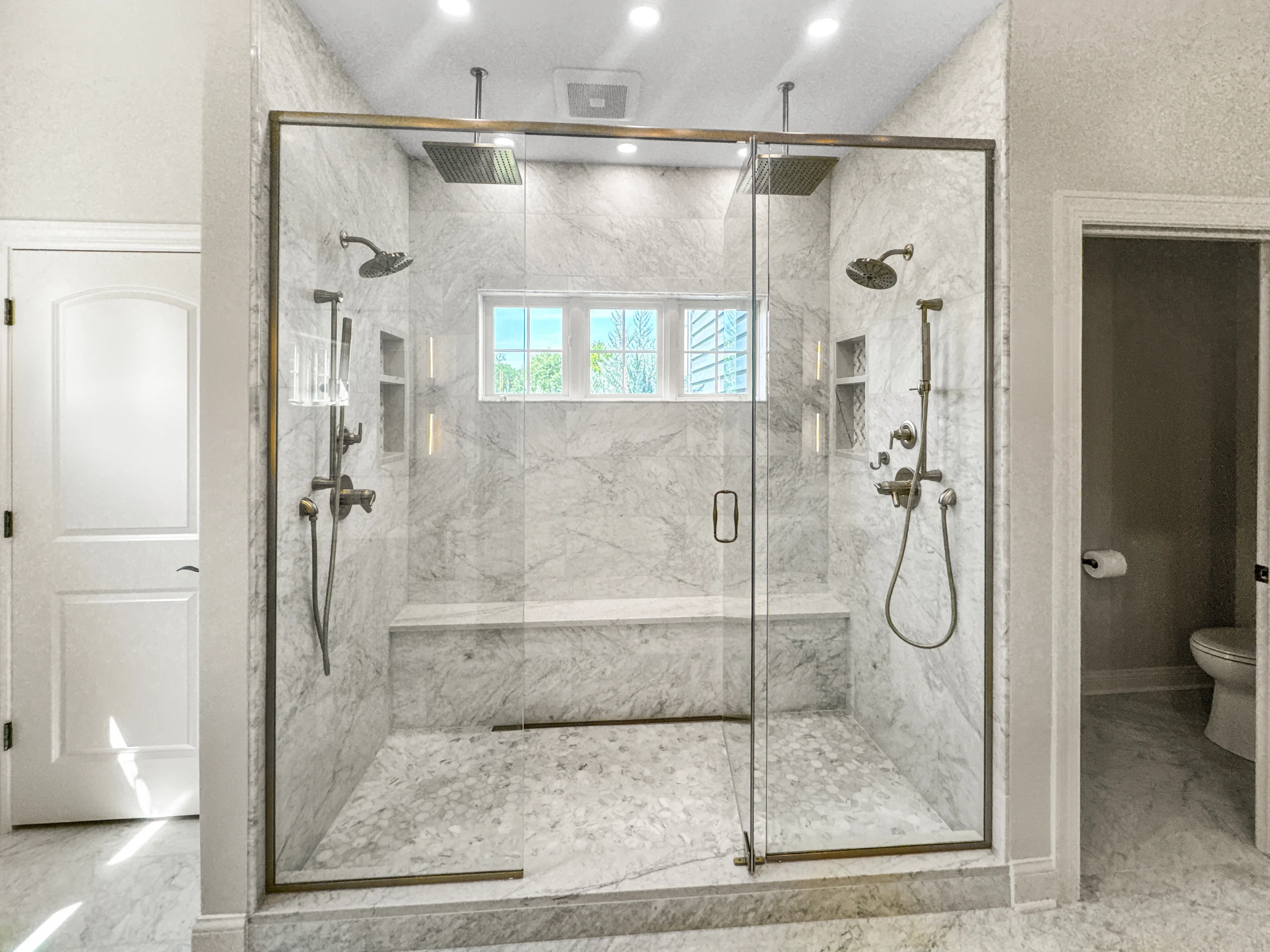
 Bathroom - T&J
Want this priced for your bathroom?
John walks your space, measures it, and leaves a written itemized estimate. No cost, no obligation, no sales script.
Plumbing. Plumbing labor is $1,000-$2,500 plus $300-$1,000 in materials. This is the biggest scope trap. A quote that only covers a fixture swap will explode if your project needs the drain line moved, rough-in work is a different animal than dropping a new toilet onto an existing flange.
Electrical. Electrical labor runs $500-$1,500 plus $200-$500 in materials, and a bathroom needs GFCI-protected outlets to pass inspection. Budget for an exhaust fan too, $100-$500 for the unit and $200-$500 to install it.
Permits. Per Kelley Construction's contractor cost breakdown, building permits run $100-$1,500 depending on your municipality and the scope of plumbing and electrical work. Wisconsin requires permits for plumbing and circuit changes. A quote with no permit line is a red flag, not a discount.
In Waukesha County, each municipality runs its own permit office, so fees vary, a full-bath remodel permit in a community like Brookfield commonly lands in the low hundreds, while jobs that move plumbing and add circuits climb toward the upper end of that $100-$1,500 range. Permitting traces back to the Wisconsin Department of Safety and Professional Services (DSPS) and its Uniform Dwelling Code. A credited contractor pulls the permit under their name, if a bid omits the line, the work is likely going in unpermitted. Here's what Wisconsin permit rules actually require for bathroom work.
Waterproofing & backer board. This is the most expensive thing a lowball quote omits, because you can't see it once the tile's up. Skip the membrane behind a shower and you get tile failure and mold inside two to three years. A complete quote names it as a line item.
Fixture allowances. An allowance is a placeholder dollar amount for a material you haven't picked yet, a "$200 toilet allowance" or "$500 tile allowance." A toilet runs $150-$500 and a sink $100-$500 on their own; if your quote allows $150 for a toilet and you fall for a $450 one, that $300 is a change order.
Project management. This is the invisible line. Pre-construction coordination alone, scheduling subs, booking inspections, sequencing the work, runs 30 to 40 hours of a professional's time before demo even starts. A complete quote bakes that in. A lowball bid pretends it's free, then drops the ball when the plumber and the tile guy show up the same morning.
The 3 Most Common Ways a Low Quote Hides Real Cost
These aren't vague warnings, they're the three specific mechanisms that turn a cheap bid into the expensive job.
1. Low allowances. A quote sets a tile allowance that covers builder-grade material, but the porcelain you actually want costs more installed. The gap arrives as a change order priced at the contractor's convenience, not the open-market rate you'd have negotiated upfront.
2. Buried scope exclusions. Read the fine print for phrases like "tile work by others," "final plumbing connections not included," or "assumes no subfloor repair needed." Each one is a future invoice dressed up as a clause. "By others" means you're hiring and paying a second trade the low bidder left out of his number.
3. No contingency line. A quote with zero contingency assumes a perfect demo. In Wisconsin homes built before 1990, that's fantasy, subfloor rot under a leaking shower pan, galvanized supply pipe that crumbles when touched, and electrical that doesn't meet current GFCI code are routine. Industry standard is a 10-20% contingency reserve.
When a homeowner asks us "why is your quote higher than the other guy's?", the honest answer is almost always that our number includes the work the low bid defers. The cheap quote isn't cheaper, it's incomplete. You pay the difference later, usually at a worse moment with less leverage.
Cost Benchmarks: What a Real Bathroom Remodel Costs in 2026
Use this grid to flag a quote that's implausibly low for your bathroom type. These are market benchmarks for comparison, not T&J prices, with Wisconsin labor and permit costs baked in.
| Bathroom type | Size | Total range | Typical scope |
|---|---|---|---|
| Half bath (powder room) | 20-30 sqft | $2,500-$10,000 | Basic refresh $2,500-$5,000; custom vanity & premium finishes $7,000-$10,000 |
| Full bath | 40-60 sqft | $6,000-$25,000 | Mid-range $10,000-$15,000 |
| Master bath | 75-150+ sqft | $10,000-$50,000 | Premium with heated floors, freestanding tub, custom tile $35,000+ |
On a per-square-foot basis: a basic refresh runs about $75/sqft, mid-range $100-$300/sqft, and high-end custom work $400+/sqft.
With 47% of homeowners planning a bathroom remodel in 2026, contractors are busy, and the lowest bid often belongs to whoever's least booked, not whoever's most thorough.
Use our bathroom remodel cost calculator to benchmark your quotes against market rates for your bathroom type and size before you sign anything. If a quote comes in significantly below the floor of these ranges, that's not a win, it's a question: which line items got left out to land that low?
Verify the License and Insurance Before You Compare Price
Before you line the quotes up, confirm each contractor is licensed and insured, because the cheapest bid sometimes comes from an operator who carries neither. In Wisconsin, residential remodelers register with the DSPS, and you can verify a credential through the state's license search tool. A bid from an unlicensed operator isn't a deal; it's a disqualifier.
Ask for proof of general liability insurance and worker's compensation, and ask whether the plumber and electrician are licensed too. Here's why it matters: if an uninsured worker is hurt in your bathroom, the liability can land on you as the homeowner. And unpermitted work can void your insurance and trigger problems at resale. A low number means nothing if it comes wrapped in that kind of exposure.
 Bathroom - T&J
6 Questions to Ask Every Contractor Before You Sign
Ask all six, of all three bidders.
"Is demolition and debris disposal included?"
If not, add $700-$2,000 back before you compare.
"Does this include pulling permits for plumbing and electrical?"
Wisconsin requires them. A contractor who skips permits to look cheap hands you the liability at resale.
"What are your fixture and tile allowances, and what happens if my selections cost more?"
This forces him to show his math instead of hiding behind a placeholder.
"Who does the plumbing and electrical, your people or subs, and are they licensed and insured?"
An uninsured sub who gets hurt becomes your problem.
"What's your process if demo reveals subfloor rot or outdated wiring?"
A pro has a written change-order process. A lowball contractor has a verbal "we'll figure it out."
"Who's my single point of contact start to finish?"
On our jobs, John handles every project's communication directly, not delegated to a junior PM or whichever sub is on-site that day.
What to Do When You're Comparing 3 Quotes Side by Side
Build a one-page comparison table. Take the most detailed quote and list every line item down the left side. Then go quote by quote and mark whether each one includes or excludes that item.
Say the low quote is $4,000 cheaper but excludes permits ($500), demo disposal ($700), and waterproofing ($400). Add those back at market rates and the real gap shrinks to roughly $2,400, before a single change order. Sometimes the low bid is genuinely legitimate: a smaller scope, lower overhead, or a different material tier. The point isn't to assume the high quote wins, it's to compare apples to apples.
Comparing incomplete quotes is one of the most expensive mistakes homeowners make before a remodel even starts. Normalize the scope first, then talk price.
How T&J Quotes Bathroom Remodels in Waukesha County
We quote the way we'd want to be quoted. It starts with a free in-home consultation, then a scope walkthrough before any paperwork, so you know what's in and what's out before you commit. The estimate comes back as a transparent, line-item document, not a single mystery number. Telli, our master carpenter, is on-site running the work, and John stays your single point of contact start to finish. As a credited contractor in the state of Wisconsin, we pull the permits, manage the inspections, and stand behind the work.
 Bathroom - T&J
Frequently asked questions
Why are two bathroom remodel quotes for the same project $10,000 apart?
The gap almost always comes down to scope, not greed or generosity. One quote may include permits, demo disposal, waterproofing membrane, and a realistic fixture allowance, the other may exclude all four. Why does that swing the total so hard? Labor accounts for 40-65% of a bathroom remodel's cost, so a quote that underestimates labor hours looks dramatically cheaper on paper while setting up change orders. The fix: ask each contractor to itemize what's in and out, then add the missing items back to the low quote before comparing totals.
Why do lowball quotes leave out waterproofing?
Because you can't see it once the tile is up, so it's the easiest line to cut without a homeowner noticing. The cost it saves them is small relative to the consequence: skip the membrane and backer board behind a shower and water wicks into the wall, causing tile failure and mold inside two to three years. The fix is simple, demand that waterproofing appears as its own line item in writing. If a contractor can't or won't show it, assume it's not in the price, and your future repair bill will dwarf whatever you saved.
What permits are required for a bathroom remodel in Wisconsin?
Wisconsin requires building permits for any work that moves or adds plumbing supply or drain lines, adds or modifies electrical circuits, or makes structural changes. Permit costs typically run $100-$1,500 depending on municipality and scope. Why does skipping them cost you later? Unpermitted work can trigger fines at resale, void your homeowner's insurance claims, and force a costly tear-out if an inspector discovers it. Each Waukesha County municipality runs its own permit office, and a licensed contractor pulls the permit under their name as part of the job. A bid with no permit line usually means the work is going in unpermitted.
What's a reasonable contingency percentage for a bathroom remodel?
Plan on 10-20% of the total project cost held in reserve for surprises found after demolition begins. Why is it nearly mandatory in our area? In Wisconsin homes built before 1990, common finds include subfloor rot from slow shower-pan leaks, galvanized supply pipes that need replacing, and electrical that doesn't meet current GFCI code. A lowball quote with no contingency line assumes a perfect demo, which is almost never reality. The fix: a professional builds the contingency conversation in upfront, so a surprise behind the wall is a planned-for expense, not a panicked mid-project invoice.
What's a realistic tile allowance for a mid-range bathroom?
The honest answer is that an allowance only means something when it matches the finishes you actually want, so check the math, not the label. A builder-grade allowance might cover the cheapest in-stock tile, but the porcelain or stone most homeowners pick costs more installed, and that gap returns as a change order. Why do lowball bids set allowances low? It drops the headline number without removing visible scope. The fix: bring a sample of the tile you actually like to each bidder and ask whether their allowance covers it installed, then watch which contractor adjusts honestly.
Should I always go with the middle quote when comparing bathroom bids?
No, "pick the middle" ignores scope differences. A middle quote that excludes waterproofing and permits can end up costing more than the highest quote once those items return as change orders priced after you're committed. The right approach is to normalize all three to the same scope: add missing line items to the cheaper bids at market rates, then compare. If the low quote excludes demo disposal ($700), permits ($500), and waterproofing ($400), the real gap shrinks by $1,600 before a single change order is written.
Can I ask a contractor to match a lower competitor's quote?
You can ask, but the honest answer is that a contractor can only match a lower number by removing something from his scope. A complete quote already has the permits, disposal, and waterproofing built in, cutting price means cutting one of those, which lands back on you as a change order later. Before you ask, use the line-item comparison to see what the lower quote actually excludes. If it's genuinely apples-to-apples with a legitimate reason for the lower price, a price conversation is reasonable. If it's missing core scope, you're really asking a complete-scope contractor to take on risk and hand it back to you.