What Wisconsin Commercial Renovation Actually Costs Per Square Foot in 2026
| Scope Tier | What's Included | 2026 Wisconsin Range |
|---|---|---|
| Light Refresh | Paint, LVP flooring, LED lighting, minor repairs | $40-$80/sq ft |
| Mid-Grade Tenant Improvement | New partition walls, updated restrooms, HVAC balancing, commercial flooring | $80-$150/sq ft |
| Full Gut Renovation | Structural changes, new MEP rough-in, ADA upgrades, full finishes | $150-$250+/sq ft |
These tiers align with industry benchmarks from Harris Constructors' commercial cost data and ACCG's renovation cost analysis. The Wisconsin premium over national averages comes from licensed trade labor rates, not inflated contractor margins.
Waukesha County projects track slightly above the state average. Milwaukee and Madison commercial markets run 5-10% higher due to urban labor demand, while Green Bay and Appleton projects typically land 10-15% below Waukesha County rates.
Industry data puts the average commercial renovation range at $50-$250/sq ft nationally, Wisconsin mid-market projects track near the top of that band due to current labor market conditions.
The tier you land in depends less on square footage and more on what you're touching. The moment you open walls, move plumbing, or trigger ADA compliance, you move up a tier. For landlords managing multiple units, our commercial remodeling services in Waukesha County page outlines how we scope repeat-client work.
Cost Breakdown by Space Type: Office, Retail, and Restaurant
The tier table is a starting point. Space type is the next filter, the same 3,000 sq ft costs very differently depending on what goes inside it.
Office Suite Renovation: $60-$130/sq ft
 Remodel - T&J
The low end is an open-plan refresh: LVP flooring, commercial paint, LED retrofit, drop ceiling tile swap. The high end adds private offices with full-height partition walls, a server room with dedicated circuits, and an ADA-compliant restroom. The jump from $60 to $130 is almost entirely driven by electrical and partition work, not finishes.
Want this priced for your remodel?
John walks your space, measures it, and leaves a written itemized estimate. No cost, no obligation, no sales script.
Retail Renovation: $70-$160/sq ft
Storefront buildouts add cost fast: display lighting circuits, POS rough-in, storefront glazing, and higher-durability flooring rated for heavy foot traffic. A second-generation retail space, where basic MEP is already in place, can save $20-$40/sq ft over a cold-dark shell. A Wauwatosa retail buildout we completed recently came in at $92/sq ft by reusing the existing MEP infrastructure entirely; new shell spaces in the same corridor were running $130-$145/sq ft.
Restaurant / Food Service: $150-$300/sq ft
This is the most expensive category, flag it clearly if you're evaluating a food-service tenant. A commercial Type I hood ventilation system alone runs $8,000-$25,000 regardless of square footage. Add a grease trap, make-up air unit, health department-required quarry tile, and three-compartment sink rough-in, and the mechanical costs alone can exceed the entire budget of an office refresh. Don't spec a restaurant buildout against office TI numbers.
Mixed-Use / Light Industrial: $45-$100/sq ft
Warehouse-to-office conversions and light industrial refreshes stay lower because the structural shell is already heavy-duty and finishes are utilitarian. Cost drivers here are HVAC zoning and bathroom additions.
Per Wisconsin SPS 101 and IBC Section 202, any renovation that changes occupancy classification or exceeds 50% of the building's assessed value triggers a full ADA compliance review. Waukesha County municipalities, including Brookfield, Pewaukee, and New Berlin, typically require 3-6 weeks for commercial plan review before a permit is issued. Budget that time into your vacancy window.
The Biggest Cost Drivers on a Wisconsin Commercial Job
Knowing the range is useful. Knowing what moves you from the bottom to the top of that range is where real budget control lives.
1. MEP (Mechanical, Electrical, Plumbing)
In John's experience managing commercial projects across Waukesha County, MEP surprises, a hidden plumbing stack in the wrong wall, an undersized electrical panel that can't support new circuits, have derailed more commercial budgets than any other single factor. Adding or relocating a bathroom adds $8,000-$18,000 to the project cost. A new electrical panel or service upgrade runs $4,000-$12,000.
These costs are largely fixed regardless of square footage, they're scope-driven, not area-driven. A 1,200 sq ft suite and a 4,000 sq ft suite pay roughly the same to relocate a plumbing stack.
2. Existing Conditions
A 1970s Brookfield office building we renovated revealed knob-and-tube wiring behind walls that didn't show on any drawing. Discovery added over $6,000 to the electrical scope and pushed the schedule by two weeks. That's not unusual, it's why we build contingency in before demo starts. If you encounter existing water or structural damage found during demo, that's a separate scope item with its own cost trajectory.
Budget a 10-20% contingency, a reserved line in your project budget for unforeseen conditions, on every commercial job. Investors who skip the contingency line are the ones calling their contractor angry in week four. Old buildings don't reveal themselves until demo day.
3. ADA Compliance Triggers
Per Wisconsin SPS 101 and IBC Section 202, if you change occupancy classification or your renovation exceeds 50% of the building's assessed value, full ADA upgrades may be required: ramp grades, restroom turning-radius clearances, 36-inch minimum door widths. This is the building department's call, not the contractor's, and it's non-negotiable.
4. Material Lead Times
Commercial HVAC equipment and electrical switchgear are still running 8-16 week lead times in Wisconsin in 2026. This affects your schedule more than your budget, but a delayed equipment delivery can push your tenant's move-in date by weeks, which costs you rent.
5. Labor Rates
Wisconsin general contractor markup on subcontractors runs 15-25%. Licensed electricians and plumbers in Waukesha County bill $85-$130/hr. That's not negotiable on permitted work, it's what licensed trades cost in this market.
3,000 Sq Ft Renovation: What Does a $200K Budget Actually Get You?
This is the question investors ask most. Here's the honest math.
$200,000 ÷ 3,000 sq ft = ~$67/sq ft, that's a light-to-mid refresh, not a full gut.
What $67/sq ft realistically buys in Wisconsin 2026:
| Line Item | Installed Cost | 3,000 Sq Ft Allocation |
|---|---|---|
| LVP flooring (commercial-rated) | $6-$9/sq ft | $18,000-$27,000 |
| Commercial paint (walls + ceiling) | $2-$4/sq ft | $6,000-$12,000 |
| LED lighting retrofit | $3-$6/sq ft | $9,000-$18,000 |
| Drop ceiling tile replacement | $4-$7/sq ft | $12,000-$21,000 |
| ADA restroom refresh (flat) | , | $12,000-$18,000 |
| Reception/lobby update (modest) | , | $15,000-$25,000 |
| Permit fees + 15% contingency | , | $20,000-$26,000 |
Rough total: $92,000-$147,000, leaving room for minor surprises at this scope, but not much.
What $67/sq ft does NOT cover:
- New HVAC system or full ductwork replacement
- Structural wall removal or new load-bearing work
- Full electrical service upgrade
- Restaurant-grade kitchen buildout
- Major plumbing reconfiguration
For a 3,000 sq ft office or retail space, the highest-ROI allocation of a $200K budget is: durable commercial flooring first, then LED lighting (fastest utility payback), then restroom ADA compliance. Save custom millwork and feature walls for a second phase once the space is leased and generating income.
Timeline: How Long Does a Commercial Renovation Take in Wisconsin?
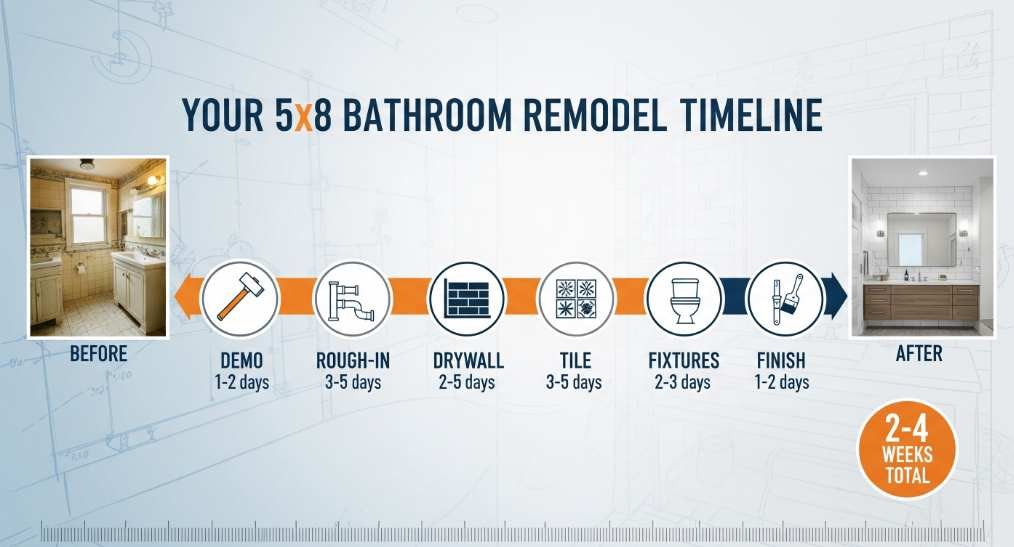
Every week a space sits vacant is lost rent. Here's the realistic phased timeline, including pre-construction time most investors forget to budget.
| Phase | Light Refresh (1,000-2,000 sq ft) | Mid-Grade TI (2,000-5,000 sq ft) | Full Gut (3,000-5,000 sq ft) |
|---|---|---|---|
| Pre-construction (design, permit, review) | 4-6 weeks | 6-8 weeks | 8-12 weeks |
| Construction | 2-4 weeks | 6-12 weeks | 12-20 weeks |
| Total from signed contract to keys | 6-10 weeks | 12-20 weeks | 20-32 weeks |
 Remodel - T&J
Waukesha County commercial permit review runs 3-5 weeks for straightforward projects. Complex projects with engineered structural drawings take longer, plan for it.
Starting construction without a permit is the #1 cause of stop-work orders in Wisconsin commercial renovation. A stop-work order doesn't just pause the job, it triggers a re-inspection sequence that can add 4-8 weeks to your timeline. That's a far worse outcome than the permit review you were trying to skip.
We handle permit pulling as part of every project scope, it's not an add-on. That's part of what the full scope of T&J's commercial renovation work covers from day one.
ROI Math: Does the Renovation Pay Off for Wisconsin Landlords?
Here's a straightforward payback example for a Waukesha County office landlord.
Scenario: 2,000 sq ft office suite currently renting at $12/sq ft/year gross. Mid-grade TI renovation: $100,000 spend ($50/sq ft). Post-renovation rent bumped to $15/sq ft/year.
- Annual rent uplift: $6,000/year
- Simple payback on rent alone: ~16-17 years
That number looks long until you factor in reduced vacancy (renovated spaces lease faster, cutting months of zero income between tenants), longer lease terms (updated spaces attract 3-5 year commitments instead of month-to-month), and avoided deferred maintenance costs over the next decade.
Commercial renovation costs may also be depreciable under Section 179 or bonus depreciation rules, talk to your CPA, not your contractor, on that one.
Not every renovation pencils out. A $250/sq ft restaurant buildout for a speculative tenant with no signed lease is high-risk capital. Use this as a decision framework, not a green light on every project.