 Bathroom project - T&J
What Bathroom Fan Installation Costs
| Scope | What is involved | 2026 cost |
|---|---|---|
| Replace existing fan, same location and duct | Swap unit, reuse wiring and duct | $450-$750 |
| Replace with upgraded fan and light combo | New unit, minor wiring, trim repair | $650-$1,200 |
| Add a fan where none exists | New circuit or tie-in, ducting, exterior vent | $900-$1,800 |
| Add a fan with a long or difficult duct run | Above plus attic or joist-bay routing | $1,400-$2,400 |
| Add humidity-sensing controls | Sensor switch, wiring | add $120-$300 |
Replacing an existing fan is the cheap version because the duct and the wiring already exist. Adding one means a new circuit or a tie-in, a duct route to the outside, and a penetration through roof or wall that has to be flashed properly.
These ranges reflect what we quote across Waukesha County and the Milwaukee metro.
The Detail That Matters Most
The duct must terminate outside the building. Not in the attic.
This is the single most common defect we find in Wisconsin bathrooms, and it is the one that causes real damage. A fan that discharges into the attic is pumping warm, moisture-laden air into an unheated space every time somebody showers. Through a Wisconsin winter that moisture condenses on the underside of the roof deck, soaks the insulation, and over a few seasons rots sheathing and grows mould across the attic floor.
 Bathroom - T&J
Want this priced for your bathroom?
John walks your space, measures it, and leaves a written itemized estimate. No cost, no obligation, no sales script.
It looks fine from the bathroom. The fan runs, the mirror clears, and nothing appears wrong until someone goes into the attic or a roofer notices dark staining on the sheathing.
If your house is more than twenty years old and nobody has checked, it is worth looking. The repair is far cheaper than the roof deck.
Sizing the Fan
Fans are rated in CFM, cubic feet per minute of air moved. The rule of thumb is one CFM per square foot of bathroom for rooms up to 100 square feet, with a sensible minimum of 50 CFM.
A 40 square foot powder room needs 50 CFM. A 90 square foot family bathroom needs 90 CFM. Larger bathrooms, and any bathroom with a separate enclosed shower or a jetted tub, need more, and the enclosed shower often deserves its own fan.
The second number to look at is sones, which measures noise. A cheap 4-sone fan is loud enough that people turn it off, which defeats the point entirely. A 0.3 to 1.5 sone fan is quiet enough to leave running, and that behaviour change is worth more than the specification difference suggests.
Wisconsin Code and Permits
Wisconsin requires every bathroom to have either an operable window or mechanical ventilation, under the state Uniform Dwelling Code as administered by your local building department. Many older Waukesha County bathrooms rely on a window that nobody opens in February, which technically complies and practically does nothing.
Replacing an existing fan in place is generally treated as fixture replacement and does not require a permit. Adding a fan where none exists usually does, because it involves new electrical work and a new exterior penetration. Adding a dedicated circuit is permitted electrical work.
Inspectors check that the duct terminates outside and that the exterior cap has a functioning damper. Both are things a rushed installation gets wrong.
What Drives the Price Up
Duct run length and route. A fan on an exterior wall with a short straight run is cheap. A fan in the middle of the house venting through a long attic run with elbows costs more and moves less air, which sometimes means sizing up.
Roof versus wall termination. Wall caps are simpler. Roof penetrations need proper flashing, and getting that wrong causes leaks.
 Bathroom - T&J
Insulated duct. In an unheated attic the duct should be insulated, otherwise moist air condenses inside the duct and drips back. This is frequently omitted and it matters here.
Electrical. Tying into an existing circuit is straightforward. A new dedicated circuit means a run to the panel and panel capacity to spare.
Ceiling access and repair. Working from an accessible attic is easy. Working blind from below means opening the ceiling and patching, priming and painting afterwards.
Fan and light combos. Units with lights, heaters or Bluetooth speakers cost more and may need additional circuit capacity, particularly heater models which draw heavily.
Is It Worth Upgrading a Working Fan?
If the existing fan runs and vents outside correctly, replacement is discretionary. Two reasons still justify it.
Noise. If yours is loud, people stop using it. A quiet unit gets left running and actually ventilates the room.
Humidity sensing. A sensor switch runs the fan until humidity drops rather than for a timer or until someone remembers. In a household where the last person out never turns it on, this solves the problem structurally rather than by nagging.
If you are already remodelling the bathroom, replace the fan while the ceiling is open. Doing it later means opening a new ceiling, and the marginal cost during a remodel is small. Our bathroom remodel budget guide covers where this sits in a full project.
How to Read a Quote
Where does the duct terminate? Should say "to exterior" explicitly, through wall or roof.
Is the duct insulated where it passes through unheated space?
What CFM, and how was it sized? The number should relate to your room, not be a default.
What sone rating? Noise decides whether the fan gets used.
Is the exterior cap included, with a damper?
Is electrical tie-in or a new circuit included?
Is ceiling patching, priming and painting included if access requires opening it?
Timeline
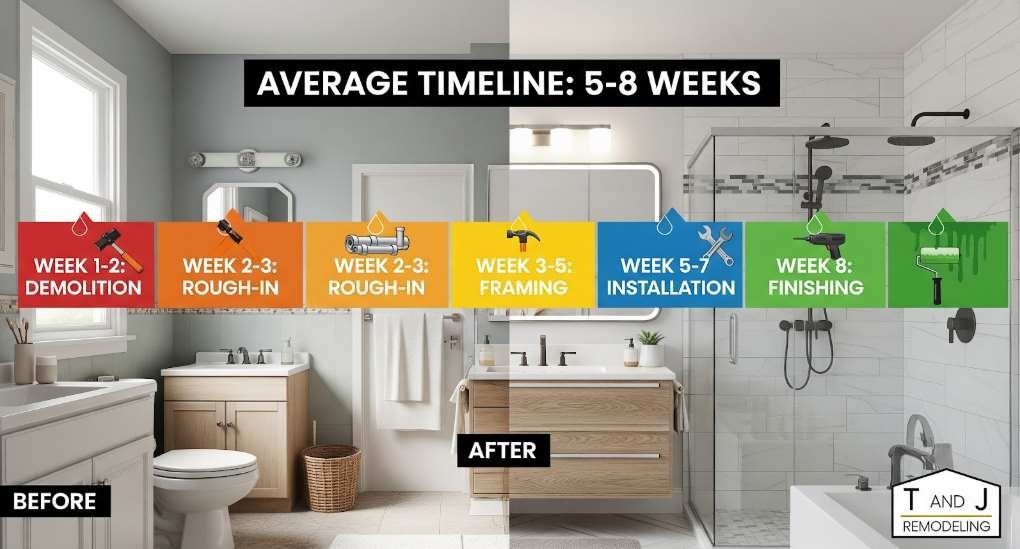
Replacing an existing fan in place is a half-day job. Adding a fan with a straightforward duct route is one day. A difficult route with ceiling opening and repair runs two to three days, mostly waiting on patching compound and paint.
 Bathroom - T&J
Get a Ventilation Quote in Waukesha County
The important question is not what a fan costs, it is where your existing one actually vents. That takes a look in the attic and about ten minutes.
John will check the termination, the duct condition and the sizing, and tell you plainly whether you need a replacement, a new installation, or simply a duct that finishes where it should. If there is moisture damage above the bathroom he will show you rather than describe it. We are a licensed and insured Wisconsin remodeling contractor serving Waukesha County and the Milwaukee metro since 2016.
Frequently asked questions
How much does it cost to install a bathroom exhaust fan in Wisconsin?
Between $450 and $750 to replace an existing fan reusing the duct and wiring, $650 to $1,200 for an upgraded fan and light combination, and $900 to $2,400 to add a fan where none exists. The fan unit itself is only $60 to $350; the rest is electrical work, ducting, the exterior penetration and any drywall repair. Difficult duct routes through attics push toward the top of the range.
Can a bathroom fan vent into the attic?
No, and this is the most damaging defect we find in Wisconsin bathrooms. A fan discharging into the attic pumps warm moist air into an unheated space with every shower, and through a Wisconsin winter that moisture condenses on the roof deck, soaks insulation and rots sheathing. It looks completely normal from inside the bathroom. If your home is over twenty years old and nobody has checked, it is worth a look in the attic.
What size bathroom fan do I need?
Roughly one CFM per square foot for bathrooms up to 100 square feet, with a minimum of 50 CFM. So a 40 square foot powder room needs 50 CFM and a 90 square foot family bathroom needs 90 CFM. Larger bathrooms, and any with an enclosed shower or jetted tub, need more, and an enclosed shower often deserves its own fan. Also check the sone rating: a loud fan gets switched off, which defeats the purpose.
Do I need a permit to install a bathroom fan in Wisconsin?
Replacing an existing fan in its current location is generally treated as fixture replacement and does not require one. Adding a fan where none exists usually does, since it involves new electrical work and a new exterior penetration, and adding a dedicated circuit is permitted electrical work. Inspectors check that the duct terminates outside and that the exterior cap has a working damper.
Is a humidity-sensing fan switch worth it?
For most households, yes, and it costs only $120 to $300 extra. A sensor runs the fan until humidity actually drops rather than for a fixed timer or until someone remembers to switch it on. In a house where the last person out of the shower never turns the fan on, it solves the problem structurally instead of relying on habit, and it stops the fan running pointlessly for an hour afterwards.
Should I replace my fan during a bathroom remodel?
Yes, if the ceiling is open anyway. The marginal cost during a remodel is small because access is already there, whereas doing it later means opening a finished ceiling and patching, priming and painting afterwards. It is also the moment to correct the duct if it currently terminates in the attic, and to size the fan properly for the room rather than inheriting whatever was fitted decades ago.