Kitchen project - T&J
Minor vs. Midrange vs. Major: Which Scope Wins for Investors?
The Cost vs. Value Report, Remodeling Magazine's yearly study comparing remodel cost to resale value by region, is the cleanest data we have, and for rentals it points one direction.
| Scope | Wisconsin ROI | What's in it |
|---|---|---|
| Minor | 70-80% (up to 113% recovery) | Cabinet paint/reface, hardware, countertop swap, LVP, lighting |
| Midrange | 60-70% | Full cabinet, countertop, appliance, and flooring replacement |
| Major / upscale | 55-65% | Custom cabinetry, structural changes, premium appliances |
Minor wins for rentals almost every time. A midrange full swap is worth it only when the unit rents under market and the bones are tired, new boxes, quartz, mid-grade stainless, LVP. Major remodels are where investors lose money: custom cabinets and a moved wall don't translate into higher rent.
The investor question is never "what looks nicest." It's "what does the comparable unit in this zip code rent for, and what's the cheapest scope that lets me match it?" Match the comps, don't beat them.
For the resale side of this math, our breakdown of how kitchen remodels affect home value at resale walks through the same diminishing-returns curve in more detail.
Ready to scope a unit? Call us at (262) 352-9525 for a free walkthrough and a flat-scope bid.
The Upgrades That Actually Move the Needle (and the Ones That Don't)
Here's the spec-level call for a rental, using standard kitchen budget allocations.
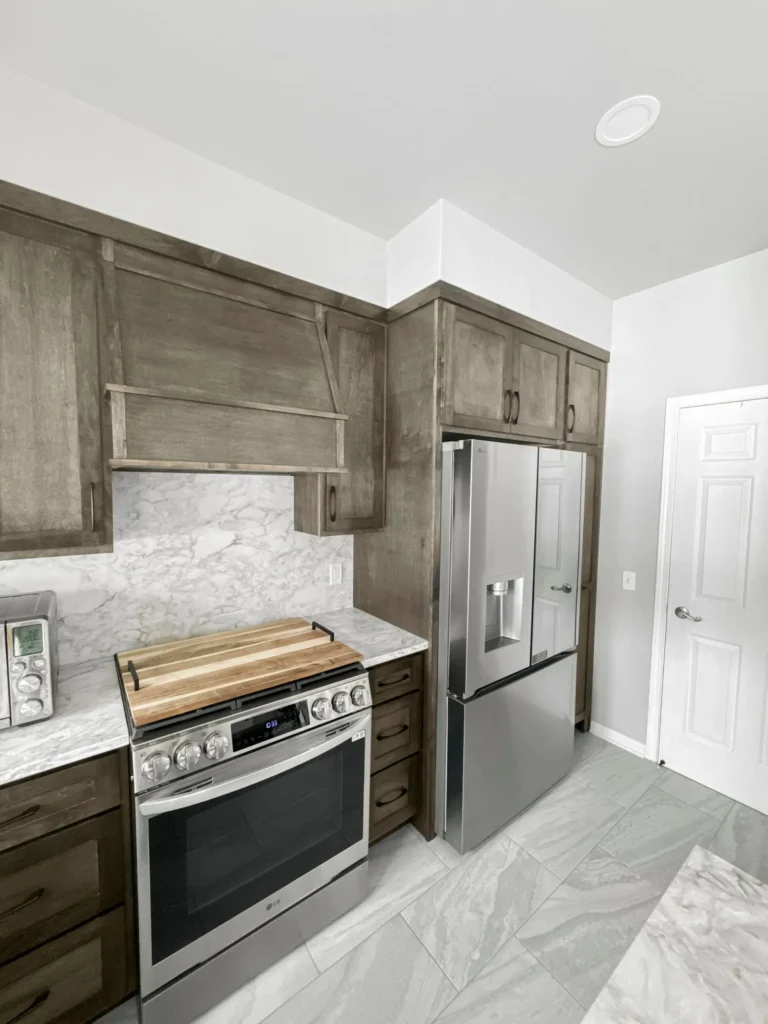
Cabinets (30-40% of budget): Stock or semi-custom is fine. Ready-to-assemble big-box boxes look clean, and tenants don't inspect dovetail joints. If your existing boxes are solid, reface them and replace the doors, that alone can cut your cabinet line in half. Custom cabinetry is pure cost with no rent premium.
 Kitchen - T&J
Want this priced for your kitchen?
John walks your space, measures it, and leaves a written itemized estimate. No cost, no obligation, no sales script.
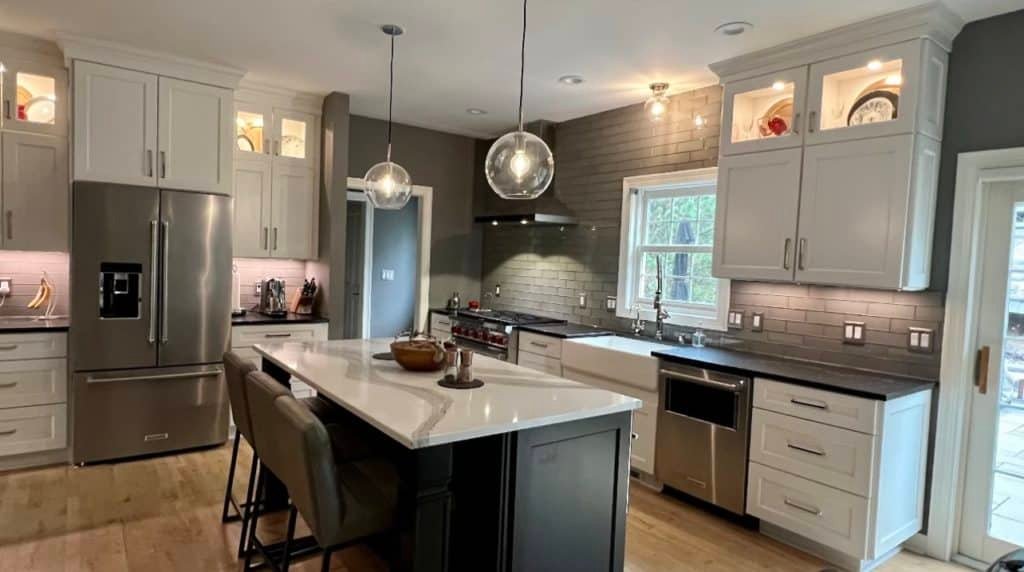
Countertops (10-20% of budget): Quartz remnants are the investor sweet spot, durable, premium-looking, mid-cost. You get the look of a slab kitchen without slab pricing. Skip full granite (cost) and laminate (it reads cheap and drags down perceived value).
Flooring (10-20% of budget): LVP, luxury vinyl plank, a rigid waterproof vinyl floor that snaps together over the subfloor, is the clear call. It shrugs off scratches and water, installs fast, and holds up through turnover far better than hardwood or tile grout lines.
Appliances (15-20% of budget): Mid-grade stainless as a matched set. Skip smart appliances and pro-grade ranges. No tenant pays an extra dime for a Wolf range.
Lighting (5-8% of budget): Updated fixtures and under-cabinet LEDs are some of the cheapest perceived-value dollars you'll spend, and they live in the minor-remodel bucket.
Structural layout changes, custom range hoods, wine fridges, and smart-home integration all add real cost with near-zero rental ROI. Every one of these is a line a low bidder will happily sell you and a tenant will never pay back.
Turn-Time Is Part of Your ROI Math
Turn-time, the days from demo to tenant-ready, belongs in your ROI math just as much as material cost, because every vacant day is lost rent. A minor refresh runs 1-2 weeks. A midrange full remodel runs 3-6 weeks. A major remodel runs 6-12+ weeks.
Do the math. At $1,500 a month in rent, you're losing about $50 a day. A six-week remodel costs roughly $2,100 in vacancy before you've spent a dollar on construction. That's why a contractor who gives a firm schedule and hits it is worth more than the cheapest bid.
A six-week vacancy on a $1,500-a-month unit burns roughly $2,100 in lost rent before construction even starts.
On our jobs, John, our co-founder and project manager, a credited Wisconsin contractor who has run rental kitchen and bath turns across the Milwaukee metro for years, handles the schedule directly. One contact, a real timeline, not a delegated guess. On a recent Wauwatosa duplex turn, we refaced the existing cabinet boxes, dropped in a quartz remnant counter and LVP, and had the unit tenant-ready in about four weeks, the landlord relisted at a higher rent without ever gutting the kitchen. When you've got a unit sitting empty, that speed is the ROI.
Wisconsin Market Context: What Buyers and Renters Actually Pay For
Wisconsin mid-market buyers and renters, across Waukesha County and the Milwaukee suburbs, want clean, functional, updated kitchens, not luxury finishes. That's why the ROI gap between minor and major remodels runs wider here than on the coasts: home prices are more moderate, so there's less room to absorb a six-figure kitchen. You cannot recover a $160,000 kitchen on a $300,000 home.
The working rule of thumb: keep total kitchen remodel cost under 10-15% of the property's current market value if you want positive ROI. Madison's midrange benchmark of $80,000-$160,000 tracks closely with what we see in Waukesha County, where local labor and materials land in the $325-$550 per square foot range for comparable midrange work. A Brookfield ranch and a Waukesha duplex still won't quote the same, size and condition drive it.
Rentals in Elm Grove, Wauwatosa, and New Berlin command stronger post-remodel rent than outlying submarkets, which is exactly why matching local comps, not exceeding them, is the discipline that protects your return. If you're scoping multiple units, working with the same kitchen remodeling contractors in Waukesha County across the portfolio gets you repeatable specs and repeatable pricing.
Budgeting Your Rental Kitchen Remodel: Cost Ranges and What to Expect
Here's a working budget framework. Madison's minor cosmetic update benchmark runs $35,000-$80,000, but that includes owner-occupant finishes. For a rental, a tighter scope, cabinet paint or reface, new hardware, countertop swap, LVP, updated lighting, is often achievable well below that range, depending on kitchen size and condition. A full midrange remodel runs $80,000-$160,000, or roughly $325-$550 per square foot, with Waukesha County tracking the Madison numbers closely.
Per the Wisconsin Uniform Dwelling Code (administered by the Department of Safety and Professional Services), a cosmetic refresh, paint, hardware, countertops, flooring, usually doesn't need a permit. New appliance circuits, relocated plumbing, or layout changes do. New small-appliance branch circuits also fall under National Electrical Code Article 210, which Wisconsin adopts, so any new wiring means inspection. Unpermitted work surfaces during a sale inspection or insurance claim, so a licensed contractor pulls them as part of scope.
 Kitchen - T&J
For protection against overruns between tenants, get a flat-scope bid, not time-and-materials. To the "can you give me a flat per-unit price?" question, yes, but only after a real walkthrough. We walk the scope before signing so there are no surprises mid-project. Use our free rental kitchen cost calculator to model your specific unit and scope before you call for bids.
How to Maximize ROI: A Practical Checklist for Landlords
- Match finish level to the local rental comps, don't over-improve
- Use LVP, not hardwood
- Quartz remnants over full slabs
- Stock cabinets, or reface the existing boxes if the bones are good
- Replace appliances as a matched set for visual cohesion
- Add under-cabinet lighting, cheap, high perceived value
- Get a fixed-price bid with a written schedule
- Factor vacancy days into your total project cost, not just construction